The primary friction in the United States government’s assessment of Unidentified Anomalous Phenomena (UAP) is not a lack of sensor data, but a failure of signal-to-noise processing across fragmented bureaucratic silos. While public discourse focuses on the existential or "other-worldly" implications of UAP reports, the strategic reality centers on a collection-analysis gap. The Department of Defense (DoD) and the Intelligence Community (IC) are currently attempting to retrofit cold-war era reporting structures to account for high-velocity, multi-domain sensor hits that defy immediate classification. This creates a systemic vulnerability where legitimate adversarial incursions—such as advanced drone platforms or electronic warfare testing—can be masked by the "noise" of atmospheric phenomena, sensor malfunctions, and consumer-grade hardware.
The Triad of Observational Constraints
The U.S. government’s ability to resolve a UAP event relies on three independent variables: sensor fidelity, environmental context, and the presence of human observational bias. When these variables do not align, the result is an "unresolved" case.
- Sensor Fidelity and Metadata Gaps: Most UAP reports originate from military training ranges equipped with sophisticated radar and infrared systems. However, these systems are calibrated to detect known threats with specific radar cross-sections (RCS) and thermal signatures. When a signature falls outside these parameters, the system may discard the data as clutter or "ghost" tracks. The lack of standardized metadata across different branches of the military means that a Navy infrared hit may not be correlates with Air Force radar data in real-time, leading to a loss of the temporal chain of custody for the object.
- Environmental Masking: High-altitude weather balloons, temperature inversions causing "mirage" effects on radar, and ionospheric disturbances account for a significant percentage of resolved cases. The government’s challenge is that the atmosphere is a chaotic medium. Without a persistent, global atmospheric model integrated into the tactical data link, sensor operators often interpret standard physical anomalies as physical craft.
- Human Interpretation Errors: Pilot testimony, while high-value for establishing a timeline, is subject to the physiological limits of the human eye and the vestibular system. At high speeds, the absence of a frame of reference in a clear blue sky can lead to "size-distance" illusions. A small object close to the cockpit can be perceived as a massive object moving at hypersonic speeds.
The Intelligence Cost Function
The resource allocation for UAP investigation is governed by a cost function where the "cost" is the risk of an unidentified threat versus the "budget" of analytical man-hours. The All-domain Anomaly Resolution Office (AARO) was established to minimize this cost by centralizing the ingest of data.
The analytical bottleneck persists because of the Data Ingestion Paradox: The more sensitive our sensors become, the more anomalies they detect. By increasing the sensitivity of AN/APG-79 AESA radars, the military inadvertently captured a wider spectrum of "clutter." This results in an exponential increase in the workload for analysts who must manually scrub this data to find high-interest signals.
This creates a blind spot. If an adversary uses a low-observable platform that mimics the flight characteristics of a common weather balloon or a "glitchy" radar return, the current analytical framework is likely to categorize it as an "unresolved anomaly" rather than a high-priority threat. The government is effectively being "DDoS'ed" by atmospheric and orbital debris.
Mechanisms of Misidentification
To understand the government's recent disclosures, one must deconstruct the specific categories into which most "UFO" files are eventually sorted.
- Airborne Clutter: This includes everything from Mylar balloons to commercial drones and "sky lanterns." These objects often lack propulsion and move with the prevailing winds, yet on infrared sensors, they can appear to possess unusual thermal signatures if they reflect sunlight or have internal batteries.
- Sensor Artifacts: Modern fighter jets use sensor fusion to combine radar, infrared, and electronic warfare data into a single display. If a software bug occurs in the fusion engine, a "phantom" target can appear to jump thousands of feet in a second. This is not a physical maneuver but a computational error.
- Adversarial Probes: This is the highest-risk category. State actors use UAP as a testing ground for probing U.S. response times and sensor capabilities. By deploying objects with unconventional shapes or flight paths, they force the U.S. to activate its most sensitive radars, which the adversary then monitors to "map" our electronic signatures.
The Structural Failure of Declassification
The tension between transparency and national security creates a distorted public narrative. When the government releases a video, it is often stripped of its most critical data—the telemetry, the location, and the specific sensor type—to protect "sources and methods."
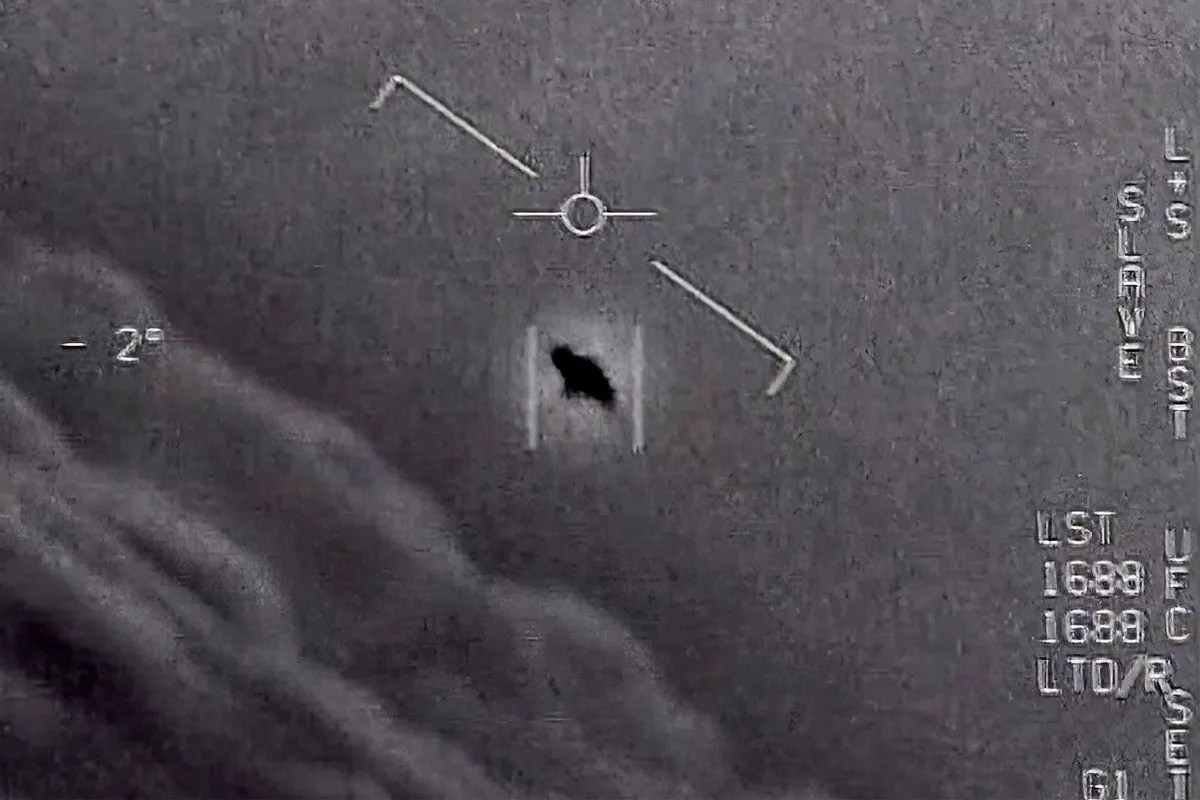
This redaction process leaves the public with a low-resolution image that is essentially a Rorschach test. The "GoFast" or "Gimbal" videos, for example, are often debated based on the visual pixels alone, which is a fundamentally flawed approach. The true "truth" of those encounters lies in the raw metadata: the exact wind speed at altitude, the angle of the sensor relative to the horizon, and the range-to-target calculations. Because this data remains classified, the government’s attempts at "transparency" often result in increased speculation rather than clarity.
The classification system itself acts as a barrier to scientific progress. Academic institutions cannot verify military claims without access to the raw data, and the military cannot share the raw data without compromising the technical specifications of their billion-dollar sensor arrays. This creates a permanent state of "explained but not proven" for the general public.
Tactical Realignment and the Shift to Multi-Domain Awareness
The shift from the term "UFO" to "UAP" (Unidentified Anomalous Phenomena) signals a transition in the government's analytical framework. It acknowledges that these objects are not limited to the air but can transition between space, the atmosphere, and the ocean.
To bridge the intelligence gap, the DoD is moving toward a Zero-Trust Data Architecture for UAP. This involves:
- Automated Triangulation: Deploying dedicated, unclassified sensor "nodes" in high-activity areas (like the Virginia Capes or the Socorro range) that can capture data without the baggage of military classification. This allows for immediate sharing with the scientific community.
- Machine Learning Filtering: Training AI models on the "signatures" of known clutter (balloons, birds, plastic bags) to automatically filter them out of the stream. This allows human analysts to focus exclusively on objects that demonstrate "transmedium" travel or non-ballistic trajectories.
- Cross-Agency Interoperability: Establishing a standardized reporting protocol that forces the FAA, NASA, and the DoD to use the same taxonomy. Currently, a pilot’s "UFO report" and a radar technician’s "anomalous track" might be filed in two different databases that never talk to each other.
The current state of UAP reporting indicates that while there is no confirmed evidence of extraterrestrial origin, there is overwhelming evidence of a systemic failure in airspace management. The government has identified a massive "dark data" problem where objects are flying in restricted airspace undetected or uncharacterized.
The strategic priority is now the hardening of the analytical pipeline. The government is moving away from the "investigation of mysteries" toward the "management of anomalies." This is a fundamental shift from a reactive posture (investigating a video months after it was filmed) to a proactive posture (identifying and intercepting an anomaly in real-time).
The final resolution of the UAP question will likely not come from a single "smoking gun" document, but from the gradual improvement of our global sensor grid. As we fill in the gaps of our atmospheric and orbital surveillance, the "anomalous" will either be identified as a known physical phenomenon or isolated as a distinct technological signature. Until then, the primary risk is not the phenomena themselves, but the analytical paralysis caused by the lack of a unified, data-driven framework for identification.
Deploying specialized, unclassified sensor hardware to military "hotspots" to bypass the redaction bottleneck is the only viable path to public and scientific resolution. Without unclassified raw data, the UAP cycle will remain a closed loop of bureaucratic obfuscation and public speculation, providing a perfect cloak for genuine adversarial technological surprises.