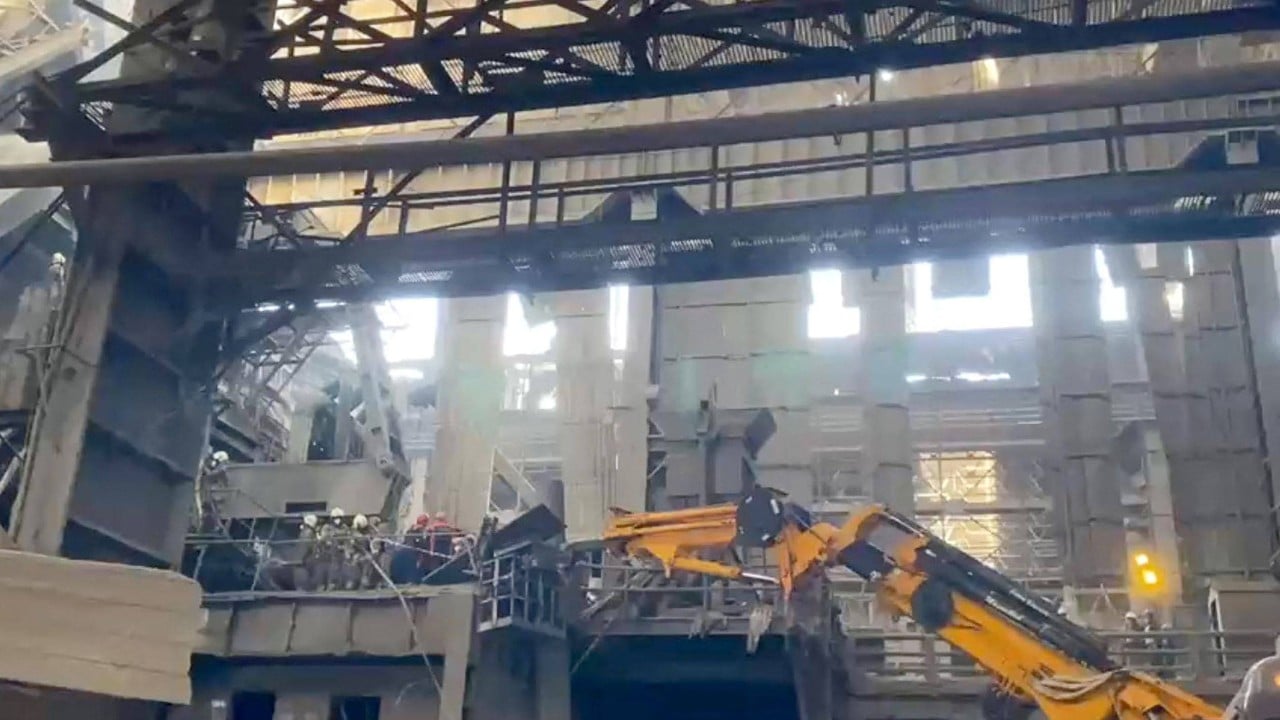
Silence.
That is the first thing you notice after the concussion wave passes, before the screaming starts, before the sirens even leave the station three miles down the highway, when the ringing in your ears swallows the world whole and leaves you staring at a ceiling that used to hold up fifty tons of corrugated iron and overhead cranes.
In the industrial heartlands of Turkey, steel does not sleep. It roars. It breathes out orange dust that settles into the creases of your knuckles and coats the inside of your nostrils with the metallic tang of iron ore and sulfur. When a headline flashes across a smartphone screen reading 10 dead, several injured in explosion at Turkey steel factory, the eye skims it in less than two seconds. A thumb flicks upward. The mind registers a tragedy, files it away under distant industrial news, and moves on to the weather forecast or a sports score.
Numbers have a way of anesthetizing us. Ten is a clean, round digit. "Several" is a comfortable abstraction.
But ten is not a statistic when you have stood beside a blast furnace at four in the morning, watching sweat evaporate off a man's forearm before it can even drip onto the concrete. Ten is ten sets of work boots sitting empty by the locker room door. It is ten half-drunk glasses of tulip-shaped black tea cooling on a breakroom table while the night shift changes over. It is a sudden, violent severing of ten entire universes.
The Anatomy of a Furnace Blast
To understand how a steel plant turns into a detonation chamber, you have to understand what happens when water meets liquid fire.
Imagine—as a purely hypothetical illustration of the physics at play—a cauldron of molten steel simmering at roughly 1,600 degrees Celsius. At that temperature, iron does not merely burn; it glows with a blinding, solar white light that turns shadows pitch-black and radiates heat hard enough to blister exposed skin from twenty feet away. Inside a modern electric arc furnace or a traditional blast furnace, every valve, cooling pipe, and pressure gauge exists to keep two mortal enemies separated: superheated metal and cold water.
When a cooling jacket cracks, or when trapped moisture hides inside a load of scrap metal dropped into the bath, physics stops negotiating. Water trapped beneath molten steel expands to roughly 1,600 times its volume in a fraction of a second. It does not boil. It detonates.
That is the mechanical reality behind the reports coming out of Turkey's industrial corridors. Whether the spark originates in a ruptured cooling line, a pressurized gas main, or a volatile scrap charge, the result on the factory floor is instantaneous. Steel beams twist like wet cardboard. Concrete walls blow outward. And the workers standing within the blast radius—men who spent years learning to read the subtle color shifts of slag and flame—have zero margin for error.
A Shift Like Any Other
Consider a composite portrait of the men who work these floors—not a specific named victim from the official casualty manifests, which authorities release slowly as families are notified, but a realistic composite drawn from thousands of Turkish metallurgists and foundry hands.
Let us call him Murat.
Murat wakes up before dawn in a working-class district bordering an organized industrial zone—places like İskenderun, Gebze, Ereğli, or İzmir, where the skyline is dominated by smokestacks and the rhythm of the town beats in eight-hour shift rotations. He pulls on heavy flame-retardant coveralls that never quite lose the smell of grease and scorched dust. Before leaving the apartment, he checks on his sleeping children, kisses his wife's forehead, and catches the company shuttle bus while the stars are still out.
On the factory floor, Murat is not a victim in waiting. He is a craftsman.
People who have never worked inside heavy industry often assume foundry work is mindless brute labor. They are wrong. Guiding raw scrap and pig iron into structural steel requires an intimate, almost intuitive reading of heat, chemistry, and timing. You learn to listen to the hum of the transformers. You recognize the specific shriek of a hydraulic leak before a sensor even triggers on the control room board. You trust the man standing ten feet to your left with your life, because in a room full of suspended ladles carrying liquid metal, vigilance is a shared currency.
When an explosion rips through a facility like Murat's, the betrayal feels personal. The very machinery you spent a decade mastering suddenly turns lethal. Survivors of industrial blasts frequently describe the aftermath not just in terms of physical trauma, but as a profound sensory disorientation. Dust hangs so thick in the air that flashlights cannot pierce six inches ahead. The heat lingers in the rubble. Men with ruptured eardrums stumble toward the faint gray light of blown-out bay doors, calling out names they cannot hear themselves speak.
The Invisible Economy Behind the Beam
Why do these tragedies keep recurring in heavy manufacturing hubs, and why should someone sitting thousands of miles away in an office chair care about an explosion at a Turkish steel mill?
Look around the room you are sitting in right now.
The structural skeleton of the building holding up your ceiling, the chassis of the car parked outside, the reinforcing bars buried inside the concrete bridges you drive across every morning, the hull of the container ship that carried your laptop across the ocean—all of it comes from furnaces just like the one that exploded. Turkey ranks consistently among the top ten steel producers in the world and stands as one of Europe's largest suppliers of rebar and structural steel. When global construction booms, Turkish furnaces run hot. When supply chains tighten, production quotas climb.
Here lies the uncomfortable truth that rarely makes it into breaking news dispatches: the global appetite for cheap, fast infrastructure is subsidized by physical risk on the factory floor.
Every nation that industrializes rapidly walks a razor's edge between output and oversight. Turkey's manufacturing sector has expanded at a breathtaking pace over the last three decades, transforming regional towns into export powerhouses. Yet rapid industrial scaling frequently outpaces safety culture. Maintenance windows get compressed because shutting down a blast furnace costs tens of thousands of dollars an hour. Subcontracted labor—workers brought in for specialized cleaning, welding, or transport tasks—often operates under different safety protocols than full-time plant veterans.
I remember walking through a heavy fabrication yard years ago, watching a crew rush to clear a jammed conveyor line while the overhead crane swung twenty-ton coils directly above their hard hats. Nobody was being malicious. The floor supervisor was staring at a shipping deadline; the workers wanted to finish their shift on time and get home. Everybody assumed the cables would hold, the sensors would catch an overload, and the odds would favor them one more day. Most days, the odds do. Until the single afternoon when metal fatigue, human exhaustion, and pressurized heat collide in the same second.
When the Sirens Stop
In the hours immediately following a major factory explosion, a familiar script unfolds.
Ambulances line the perimeter gates. Riot police or gendarmerie cordon off the access roads as frantic relatives gather behind the barricades, holding up phone screens with photos of husbands, brothers, and sons who haven't answered their texts. Local governors arrive to give somber statements to television cameras. Prosecutors open an investigation. Company executives issue condolences and pledge full cooperation.
Within forty-eight hours, the national news cycle moves on.
For the families inside those grieving neighborhoods, however, the explosion has only just begun. When a primary breadwinner dies in an industrial accident, the financial shockwave hits almost as hard as the grief. Compensation battles can drag through labor courts for years. Injured survivors—men dealing with third-degree thermal burns, crushed limbs, or permanent lung damage from toxic smoke inhalation—face months of skin grafts and physical therapy, often wondering if they will ever be able to hold a wrench or lift their own children again.
We also have to confront our own confusion when reading these reports. Early dispatches from industrial accidents are notoriously chaotic. Initial casualty counts fluctuate as rescue teams dig through collapsed roofing and twisted steel girders. Rumors swirl about whether the blast started in a boiler room, an oxygen tank storage area, or the main smelting hall. It is easy to throw up our hands, blame bad luck, and treat industrial fatalities as an unavoidable tax on modern civilization.
They are not unavoidable.
What Actually Stops a Blast
History proves that catastrophic industrial explosions are almost never pure "acts of God." When investigators finally sift through the melted wiring and bent steel months later, they rarely find a single mysterious cause. Instead, they find a chain of small, preventable compromises—a warning alarm muted because it triggered too often, a mandatory pressure test postponed until next quarter, a moisture check skipped on a batch of imported scrap metal because the trucks were backed up at the gate.
Look at how aviation transformed over the last half-century. Commercial flying used to be terrifyingly routine in its lethality. The industry did not become safe by telling pilots to "be more careful." It became safe by building ruthless, non-negotiable redundancies into every bolt and procedure, by empowering the lowest-ranking technician on the tarmac to halt a takeoff if a single gauge looked wrong, and by treating every near-miss as a forensic emergency rather than an inconvenience.
Heavy metallurgy requires that exact same cultural spine.
Real safety on a steel floor is expensive, slow, and deeply unglamorous. It looks like automated infrared scanners checking every single load of scrap for sealed containers or trapped water before a crane ever lifts it toward the furnace. It looks like mandatory cooling-down periods that cannot be overridden by a production manager chasing a monthly bonus. It looks like independent union inspectors walking the catwalks with the legal authority to padlock a leaking valve on the spot without fearing for their jobs.
Until that standard becomes universal—from the largest integrated mills down to the smallest regional foundries—the men working beside liquid iron will continue to carry an invisible wager every time they punch their timecards.
The Weight of a Steel Beam
Next time you walk past a construction site and see a flatbed truck loaded with freshly rolled rebar, pause for just a second and look at the dull gray metal.
It looks cold, inert, and indestructible. You cannot see the 1,600-degree fury that birthed it. You cannot hear the deafening roar of the electrodes or smell the acrid smoke clinging to the coveralls of the men who poured it. And unless a headline forces you to look, you will never know the names of the ten men in Turkey who walked into a factory to make that metal possible, and never walked back out through the gate.


