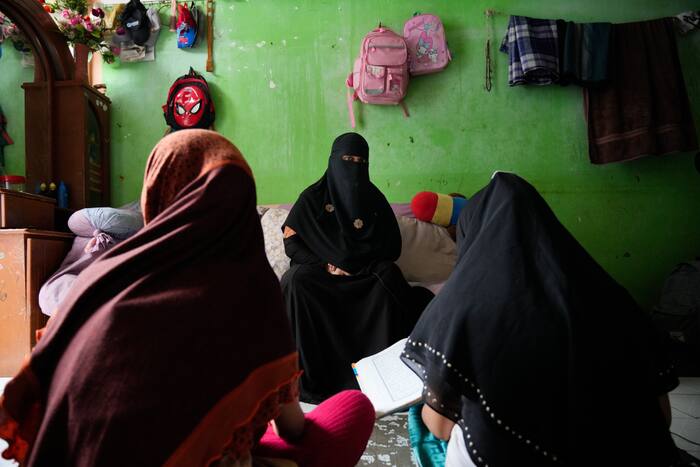
The call to prayer echoes through the humid twilight of Kuala Lumpur, spilling out from concrete minarets and washing over the tin roofs of Selayang. Inside a cramped, third-floor walk-up apartment with peeling lime-green paint, a man named Tariq—a composite character built from the lived testimonies of dozens of Rohingya refugees in the Klang Valley—rolls out a worn prayer mat.
He faces Mecca. He recites the same Arabic verses as his Malaysian neighbors downstairs. He shares their faith, their dietary laws, and the quiet rhythm of their holy days.
When Tariq steps outside his front door, however, that shared spiritual bond evaporates into thin air.
To the police cruiser idling at the corner of the wet market, Tariq is not a brother in faith. He is an "illegal." Despite carrying a laminated blue-and-white card issued by the United Nations High Commissioner for Refugees, Tariq has no legal right to exist on Malaysian soil. He cannot legally work a construction site, drive a delivery van, or open a bank account. His seven-year-old daughter cannot step foot inside a Malaysian public school. If he falls off a scaffolding tomorrow, the emergency room bill will cost more than he makes in six months of off-the-books labor.
For decades, a comforting myth persisted across Southeast Asia: that fleeing Buddhist-majority Myanmar for Muslim-majority Malaysia meant coming home to safety. The reality on the ground tells a far more complicated, bruising story.
The Architecture of Limbo
To understand why more than 132,400 registered Rohingya refugees—and tens of thousands more unregistered—live like ghosts in Malaysia, you have to look at a single missing signature.
Malaysia never signed the 1951 UN Refugee Convention or its 1967 Protocol.
In the eyes of Malaysian domestic law, there is no legal difference between a Rohingya mother who swam across a river in Rakhine State while her village burned behind her and an economic migrant who overstayed a tourist visa. Under the Immigration Act 1959/63, both are simply undocumented immigrants. Both are subject to arrest, indefinite detention, and deportation.
Think of Malaysia’s immigration framework like a house with a welcoming porch light, an unlocked front door, and no floorboards inside. For years, Malaysian leaders spoke passionately on the world stage about the plight of the Rohingya, condemning the atrocities in Myanmar and organizing humanitarian flotillas. Refugees heard those speeches across the Andaman Sea. They sold everything they owned to pay smugglers for passage on overcrowded wooden trawlers, believing that a Muslim nation would catch them when they fell.
Instead, they landed in a legal void.
"You trade the fear of being killed by soldiers for the fear of being caught by police," says a community organizer in Penang who has spent twelve years navigating this shadow existence. "In Myanmar, they told us we didn't belong because of our blood and our faith. Here, we share the faith, yet we are still told we do not belong."
The Daily Tax of Being Invisible
When a government refuses to recognize your legal existence, your survival depends entirely on informality. And informality is expensive.
Consider what happens when Tariq wakes up at 4:30 AM to haul crates of vegetables at the wholesale market. Because he lacks a work permit, his employer pays him roughly half of what a documented worker earns—and sometimes nothing at all when payday arrives, knowing Tariq cannot walk into a labor court to file a complaint.
On the walk home, Tariq keeps his eyes fixed on the pavement. When he sees the dark blue uniforms of a roadblock ahead, his stomach drops. A UNHCR card offers zero statutory immunity. Depending on the mood of the officers at the checkpoint, that card might buy him a wave-through, or it might trigger a demand for "coffee money"—extortion that routinely wipes out a week's wages.
If he refuses to pay, or simply encounters an officer determined to meet an arrest quota, the consequences are catastrophic.
Across Malaysia, thousands of refugees—including children—are locked inside Immigration Detention Centers. Human rights monitors and former detainees describe cells packed so tightly that men must sleep in alternating shifts because there is not enough floor space for everyone to lie down at once. Because UNHCR has been barred from accessing these detention centers since 2019, people disappear into the system for months or years without legal representation, trapped in a bureaucratic purgatory where they cannot be deported to a country that denies their citizenship, yet cannot be released into the country holding them.
The Lost Generation Behind Closed Doors
The sharpest edge of this policy doesn't cut the adults. It cuts the children.
Of the roughly 227,400 refugees and asylum-seekers registered in Malaysia, nearly a third are under the age of eighteen. By law, non-citizen children without proper documentation are barred from enrolling in Malaysia's national school system.
Imagine an eight-year-old boy pressing his face against the chain-link fence of a neighborhood schoolyard in Johor Bahru, watching children his own age in crisp white shirts and navy shorts kick a football during recess. He speaks fluent Malay. He knows the local slang. He has never seen Myanmar in his life. Yet the gate remains locked to him.
In response, the Rohingya community and local charities have built a parallel network of more than 120 makeshift learning centers. Tucked above shop lots and behind mosques, these classrooms run on shoestring budgets, donated textbooks, and volunteer teachers who often lack formal training themselves. There are no accredited exams. There are no high school diplomas. For most Rohingya teenagers, formal education hits a brick wall around age fourteen, right when economic desperation pushes boys onto construction sites and girls into early marriages.
You don't need an economics degree to see the tragedy unfolding here. Malaysia is actively cultivating an underclass of young adults who grew up on Malaysian soil, speak the Malaysian language, and possess zero legal pathways to contribute their talents to the Malaysian economy.
Why Solidarity Turned Sour
How did a nation celebrated for its hospitality grow so weary of its guests?
Honesty requires looking at the pressures felt by ordinary Malaysians, too. During the COVID-19 pandemic, economic anxiety collided with anti-refugee rhetoric online. Viral misinformation painted Rohingya communities as ungrateful, demanding citizenships and draining public resources—claims that collapsed under basic fact-checking, given that refugees receive no state welfare and pay full foreigner rates at public hospitals.
Yet perception hardens quickly when streets feel crowded and wages stagnate. Working-class Malaysians in neighborhoods like Selayang watched their local markets transform overnight as desperate refugees took over low-wage stalls and manual labor jobs. Without a government framework to regulate where refugees live, work, or integrate, friction became inevitable.
Compounding the tension is a stubborn geopolitical reality: Malaysia cannot solve the Myanmar crisis alone. Neighboring countries have largely closed their doors, leaving Malaysia to shoulder the heaviest urban refugee burden in Southeast Asia. Politicians across the ideological spectrum quickly realized that defending refugee rights wins zero votes at the ballot box, while promising tough immigration crackdowns plays well on the evening news.
The Economics of Dignity
Here is the irony that gets lost in all the political noise: keeping refugees illegal actually costs Malaysia more than recognizing them.
Right now, the Malaysian government spends hundreds of millions of ringgit every year running raids, maintaining overcrowded detention centers, and policing a shadow workforce. Meanwhile, major Malaysian industries—from palm oil plantations to construction and manufacturing—suffer from chronic labor shortages.
Independent economic analyses and UNHCR studies have repeatedly pointed out the obvious fix. If Malaysia issued temporary work permits to registered refugees, those workers would immediately step out of the black market. They would pay income taxes and registration fees. Employers would be legally required to provide safe working conditions, breaking the cycle of exploitation that depresses wages for local Malaysian workers, too. Children could enter accredited schools, transforming a potential social liability into an educated, productive workforce.
Pilot programs to grant limited work rights have been proposed, debated, and shelved multiple times over the past decade, stalled by bureaucratic inertia and political fear.
Twilight in Selayang
Back in that third-floor apartment in Kuala Lumpur, the evening prayer ends. Tariq folds his mat and sets it neatly beside a plastic crate holding his family's entire worldly possessions: a few changes of clothes, a battered rice cooker, and a clear plastic folder containing their UNHCR documents.
Outside, the night market comes alive with the sizzle of fried noodles and the chatter of families heading home from work. Tariq’s daughter sits by the window, tracing letters from a donated Malay storybook with her index finger in the dust on the sill. She whispers the words aloud, her accent indistinguishable from any child born in the hospital three miles down the road.
She has mastered the language of the only home she has ever known—a country that still hasn't decided whether she is allowed to exist.