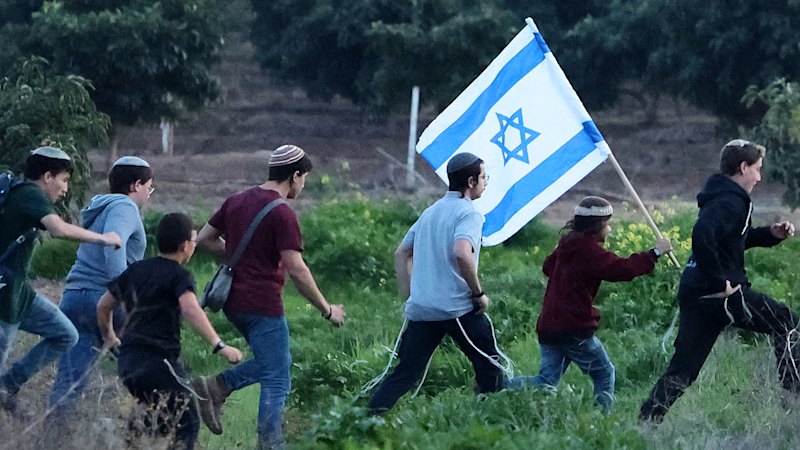
The dust in the Judean Hills does not behave like ordinary dirt. It is fine, chalky, and persistent, coating the skin like a second layer of history. For Akiva, a young man with a tangled beard and a hand-knitted yarmulke that sits defiantly on his head, this dust is a badge of honor. He isn’t interested in the glass towers of Tel Aviv or the high-tech hum of the coastal plains. He is looking for something older. Something he believes was stolen by time and modern bureaucracy.
Akiva represents the tip of a spear. He is part of a movement often labeled as Religious Zionism, but the labels are failing to keep up with the reality on the ground. For decades, this group was a predictable, if passionate, segment of the Israeli electorate—the "knitted kippah" crowd who bridged the gap between the secular state and the ultra-Orthodox world. Now, the bridge has become the destination.
The shift is not just political. It is visceral.
The quiet power centers of the Israeli state—the military high command, the civil service, the legal corridors—are seeing a demographic sea change. In the 1990s, a religious officer in the elite paratrooper units was a rarity, a curiosity to be noted. Today, walk into a graduation ceremony for the IDF’s officer training school, and you will see a sea of knitted headcoverings. These are the children of the settlements, raised on a diet of messianic duty and the conviction that the secular elite has grown tired, cynical, and detached from the soul of the land.
Consider the weight of the stone. To a secular urbanite in Haifa, a hilltop in the West Bank is a diplomatic headache, a line item in a stalled peace process. To the radical vanguard of this movement, that same hilltop is a commandment. It is a piece of a puzzle that, when completed, restores a biblical sovereignty that predates the United Nations by three millennia.
The friction between these two worlds is no longer a debate over policy. It is a struggle over the very definition of what it means to be a "Jew" and a "citizen" in the only Jewish state.
The movement’s ascent was catalyzed by a profound sense of betrayal. In 2005, when the Israeli government forcibly removed thousands of settlers from the Gaza Strip, a collective trauma took root. The religious right watched as the soldiers they had raised, the state they had sanctified, turned their bulldozers on Jewish homes. The lesson they learned was cold and clear: If you do not hold the levers of power, the state can and will betray the vision.
They stopped asking for a seat at the table. They decided to build a new table.
This isn't a shadowy conspiracy. It is a highly organized, intellectually rigorous, and emotionally charged campaign to redefine the national identity. They are spearheading a radical movement that seeks to replace the "State of Israel"—a Westphalian entity of laws and borders—with the "Land of Israel," a spiritual entity governed by a deeper, more ancient logic.
The stakes are invisible until they aren't. You see them when a local commander hesitates to clear an illegal outpost because he knows the boys on that hill are the brothers of the men in his platoon. You see them when the Supreme Court, long the bastion of secular liberalism, finds itself besieged by a government determined to strip it of its "reasonableness" standard. The movement understands that law is just a story we tell ourselves, and they are busy writing a different book.
The tension manifests in the mundane. In Jerusalem, the city is a patchwork of these competing realities. On one street, a secular woman in a tank top drinks an espresso, checking her stocks on a smartphone. Three blocks away, a billboard reminds passersby that "the Torah is the only true constitution." They share the same air, but they breathe different centuries.
The radicalization is fueled by a specific brand of optimism—a dangerous, intoxicating belief that the "Redemption" is not a distant theological concept, but a political project that can be managed with budgets and building permits. This isn't the grim, sequestered holiness of the Haredim, who often shun the state. This is a muscular, activist faith. It is a movement that likes the smell of diesel and the sound of a jackhammer.
But what happens to the dissenters? What happens to the millions of Israelis who moved to the desert to build a sanctuary for a persecuted people, only to find that the sanctuary is being remodeled into a temple they don't recognize?
The secular center is experiencing a delayed-onset panic. They are realizing that while they were busy building unicorns and NASDAQ-listed startups, the "hilltop youth" were busy building a base of operations. The movement has effectively captured the education ministry, the interior ministry, and the hearts of a generation of young people who find the sterile promises of globalism to be a poor substitute for the fire of belonging.
The movement’s leaders are no longer the fringe. They are the cabinet. They speak with the authority of people who believe they have God’s cell phone number, and they aren't interested in the nuance of international law. To them, the "international community" is a fleeting ghost. The land, however, is permanent.
Hypothetically, imagine a family in Tel Aviv. Let’s call them the Levys. For three generations, they have been the "salt of the earth." They served in the tanks in '73, they built the tech hubs in the '90s. Now, they watch the evening news and feel like foreigners in their own country. Their son is approaching draft age, and for the first time, they aren't sure if the army he is joining serves the state they believe in, or a vision of theocratic expansion they fear.
The Levys represent the "old" Israel—liberal, weary, and increasingly desperate. Akiva represents the "new"—buoyant, uncompromising, and convinced of his own righteousness.
The movement is not just about territory; it is about the hierarchy of values. In the radical Zionist worldview, the collective survival of the nation and its spiritual mission trumps individual rights, democratic norms, and the messy compromises of diplomacy. It is a return to the "Iron Wall" philosophy, but with a crown of thorns.
The transformation is sweeping because it offers something the secular world struggles to provide: a sense of cosmic purpose. In an era of atomized individuals and digital isolation, the movement offers a tribe, a mission, and a map. It tells its followers that every stone they move and every vineyard they plant is a victory in a war that has been raging since the time of the Maccabees.
This is the invisible stake. The war isn't just over the West Bank. It is over the soul of the person holding the gun.
As the sun sets over the hills, casting long, purple shadows across the valleys, the lights of the settlements begin to flicker on. They look like stars fallen to earth. From a distance, it is peaceful. But up close, you can hear the sound of a country being torn apart and stitched back together in a shape that none of its founders would recognize.
The dust never settles. It only shifts, waiting for the next wind to carry it to a new hilltop, where someone like Akiva is waiting with a shovel and a prayer, ready to claim what he believes was always his. The tragedy is that he might be right about the land, even as he loses the country.
The crown is being forged, but it feels more like a cage.