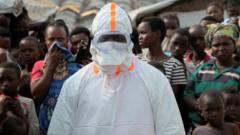
The air inside an isolation ward smells like nothing at all.
That is the first thing that strikes you. It is a sterile, scrubbed void where even the faint, reassuring hospital tang of floor wax and stale tea has been erased by negative-pressure airflow systems. Outside the double-paned observation window, London moves in its usual relentless rhythm—sirens in the distance, red double-decker buses pushing through rain, thousands of commuters jostling shoulder-to-shoulder on the Underground. Inside, time stops.
A single bed sits in the center of the room. A doctor, returning from the frontlines of a West African outbreak, lies under a thin white blanket, waiting for the lab results that will determine if their own body has become a biohazard.
Fear does not roar in a situation like this. It whispers.
When news broke that a British aid worker had been admitted to a London hospital under observation for potential Ebola exposure, the headlines did what headlines always do. They measured the threat in distance and probability. They listed protocols, named facilities, and cited official health statements. Standard. Orderly. Reassuring.
Except virus mitigation is rarely orderly when you are the human being sitting in the quarantine room.
To understand what happens in that room, you have to leave the high-tech confines of the Royal Free Hospital and travel back to the dirt tracks of West Africa. Imagine a healthcare volunteer—let’s call her Sarah, a composite based on the real doctors and nurses who step directly into epidemiological ground zero. Sarah spent six weeks in a makeshift clinic. She wore Tyvek suits that turned into personal saunas within twenty minutes. She held the hands of dying children through three layers of nitrile gloves. She saw what the filovirus does when left unchecked.
Ebola is not subtle. It attacks the vascular system, stripping away the body’s ability to clot blood, causing systemic failure with terrifying speed.
When you spend weeks living alongside a killer like that, your relationship with your own biology changes. Every headache feels like the beginning of the end. A sudden spike in ambient temperature feels like the first wave of a fatal fever. Every fatigue-heavy ache in your joints becomes an interrogation: Is this just exhaustion, or is it the virus?
When Sarah stepped onto the transport plane back home, she was not just bringing back her luggage. She was carrying the terrifying uncertainty of an incubation period that can stretch up to twenty-one days.
The public health machinery of a modern metropolis is staggering in its complexity, yet fragile in its reliance on human honesty. The entire defense network relies on one crucial moment: a weary traveler standing at an arrival gate, feeling a flush of heat in their cheeks, and choosing to speak up.
Think about that choice.
You have just returned from a war zone against a microscopic enemy. You are desperate to see your family, to sleep in your own bed, to wash off the dust and memory of the clinic. Admitting you have a fever means stepping willingly into an airlocked cage. It means self-isolation, public scrutiny, and the agonizing wait for a polymerase chain reaction test to amplify the genetic material in your blood and reveal the truth.
Yet, this aid worker made that call. They reported the symptom. The system clicked into gear.
Specialized transport vehicles were dispatched. Isolation protocols, developed over decades of biosecurity planning, flared to life. The patient was funneled through secured corridors, bypassing the general public entirely, and placed into a high-consequence infectious disease unit.
From the outside, this process looks like a clinical victory—a triumph of logistics and containment. We read the news alert on our phones, feel a brief pang of anxiety, check that the threat is controlled, and swipe the notification away.
Inside the ward, however, the experience is profoundly lonely.
Healthcare workers enter the room wearing powered air-purifying respirators. Their voices sound muffled and distant, piped through internal speakers. They move with slow, deliberate precision. There are no quick touches, no casual reassourances. Every interaction is calculated to minimize contact.
For the person in the bed, the psychological weight is crushing. You are no longer just a patient suffering from a fever; you are a potential hazard to the city outside your window. The very people who traveled thousands of miles to save lives in a global health crisis suddenly find themselves treated like a weapon that needs to be disarmed.
We like to think of modern medicine as a series of definitive answers, but in the early hours of a quarantine, there are only probabilities. Fever can mean malaria. It can mean a routine chest infection picked up on a long-haul flight. It can mean simple, bone-deep exhaustion.
The lab tests take time. The blood sample must be handled with extreme care, processed in high-containment laboratories where technicians work behind thick glass, wearing heavy suits connected to external air lines. They look for viral RNA, waiting for the fluorescent markers to bind to the target sequences.
While those machines spin, the patient waits in the absolute quiet of the negative-pressure suite.
Eventually, the call comes. The test comes back negative, or perhaps a secondary test confirms a far less threatening diagnosis. The airlock doors open. The heavy suits come off. The isolation room is powered down, scrubbed once more, and left waiting for the next suspect case.
The headlines move on within twelve hours. The news cycle hungry for fresh drama forgets the hospital bed in London.
Left behind is the quiet reality of what transpired. A human being looked at a rising number on a thermometer, recognized the duty they owed to strangers on a crowded street, and voluntarily surrendered their freedom so the rest of the city could keep moving without fear.
That is not just medical news. It is an act of profound, quiet heroism hidden inside a cold administrative protocol.