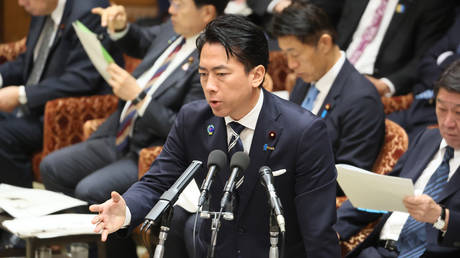
Every few months, a senior Japanese official mutters something slightly realistic about national defense, and the international press corps collectively faints onto their keyboards.
The headlines write themselves. "Japanese defense chief challenges nuclear taboo." "Tokyo flirts with atomic weaponry." "Pacifist Japan teeters on the brink of proliferation." Building on this topic, you can also read: When Vandalism Becomes Terrorism Inside the UK Battle Over Palestine Action.
It is lazy journalism. It relies on an outdated, cartoonishly simplistic view of East Asian security that hasn't been accurate since the Cold War ended. When a Japanese defense chief questions the strictures of the Three Non-Nuclear Principles—not possessing, not producing, and not permitting the introduction of nuclear weapons into Japanese territory—they aren't suddenly plotting to build a bomb in the basement of the Ministry of Defense. They are pointing out an obvious, glaring contradiction that has sat at the center of the U.S.-Japan alliance for sixty years.
You cannot rely on an ally's nuclear umbrella while simultaneously outlawing the infrastructure required to hold that umbrella open. Analysts at TIME have shared their thoughts on this situation.
The Myth of the "Nuclear Allergy"
For decades, Western analysts have treated Japan's anti-nuclear stance as a permanent, immutable law of physics, usually attributing it to a vague cultural "nuclear allergy" born from the ashes of Hiroshima and Nagasaki.
That moral trauma is real. It shaped generations of Japanese voters and remains a potent domestic political force. But treating Japanese defense policy purely as a morality play ignores the cold, hard math that actually drove Tokyo's decisions since 1945.
Japan didn't forego nuclear weapons solely out of pacifist virtue. It did so because the United States offered a remarkably cheap, credible security guarantee. Why spend tens of billions of dollars developing a domestic arsenal, enduring international pariah status, and triggering a regional arms race when Washington promised to vaporize anyone who attacked Tokyo?
In defense circles, we call this extended deterrence. It is the ultimate geopolitical bargain. Japan got to focus entirely on becoming an economic superpower, protected by American bombers and submarines, while maintaining the moral high ground of its Three Non-Nuclear Principles, introduced by Prime Minister Eisaku Sato in 1967.
Here is the dirty secret everyone in Washington and Tokyo has known since the 1970s: the third principle—"not permitting the introduction" of nuclear weapons—was a polite fiction from day one.
During the Cold War, U.S. Navy vessels routinely carried tactical nuclear weapons into Japanese ports like Yokosuka and Sasebo. Both governments operated under a "don't ask, don't tell" arrangement. Washington maintained its policy of neither confirming nor denying the presence of nuclear weapons aboard its ships, and Tokyo simply chose not to ask. Decades later, declassified documents and candid admissions from former diplomats like Edwin Reischauer confirmed what defense insiders knew all along. The taboo was already compromised because strategic necessity demanded it.
Why the Math Changed in East Asia
If you want to understand why Japanese defense chiefs are speaking more bluntly today, stop reading op-eds about Japanese nationalism and start looking at a map of missile ranges.
The security environment surrounding the Japanese archipelago has deteriorated faster than almost anywhere else on earth. Tokyo isn't dealing with a single, predictable Cold War adversary anymore. It is staring down three distinct nuclear-armed neighbors, none of whom are bound by the arms control treaties that kept the peace in the twentieth century.
First, there is North Korea. Pyongyang has moved well past crude prototypes. It possesses solid-fuel intercontinental ballistic missiles capable of hitting the U.S. mainland, alongside a growing stockpile of tactical nuclear weapons specifically designed to strike bases in South Korea and Japan.
Second, there is China. Beijing is executing the most rapid peacetime military buildup in modern history. According to Pentagon assessments, China is on track to field over 1,000 operational nuclear warheads by 2030. More importantly, China possesses an overwhelming advantage in conventional theater-range ballistic and cruise missiles—thousands of them—capable of saturating Japanese air defenses and obliterating U.S. airbases in Okinawa within hours of a conflict starting.
Third, there is Russia, which has abandoned decades of arms control agreements, openly threatened nuclear use in Ukraine, and regularly conducts joint bomber patrols with China right through the Sea of Japan.
Imagine a scenario where China decides to blockade or invade Taiwan. Beijing's primary operational goal in the opening days of that war would be to prevent the United States from intervening. The quickest way to blind and cripple American forces in the Western Pacific is to strike U.S. bases in Japan—Kadena, Yokosuka, Misawa.
If Beijing threatens to use tactical nuclear weapons against those bases, or against Japanese cities to force Tokyo out of the fight, will an American president really trade Los Angeles or Seattle to save Tokyo?
That question isn't anti-American cynicism. It is the fundamental dilemma of extended deterrence, famously articulated by French President Charles de Gaulle in the 1960s when he built France's independent nuclear force. When a Japanese defense chief questions the nuclear taboo, they aren't expressing a desire to become a nuclear superpower. They are vocalizing the exact same existential dread that kept European leaders awake during the Cold War.
Dismantling the Wrong Questions
Whenever this topic flares up, public debate immediately gets bogged down in sensationalist, binary questions.
"Is Japan going to build its own nuclear weapons?"
No. Not anytime soon, and almost certainly not at all. Critics love to point out that Japan is a "paranuclear" state—meaning it possesses massive stockpiles of separated plutonium from its civilian nuclear power program, advanced enrichment technology, and world-class space launch rockets that could theoretically be converted into ballistic missiles within months.
This is technically true and strategically irrelevant. Going nuclear isn't just an engineering problem; it is a geopolitical suicide mission for a trade-dependent island nation.
If Japan broke out of the Nuclear Non-Proliferation Treaty (NPT) to build its own bomb, the global non-proliferation regime would collapse overnight. South Korea would immediately follow suit. Taiwan would be tempted. Worse, Japan's civilian nuclear energy sector—which relies on foreign uranium and strict international cooperation agreements—would freeze instantly. Washington, whose primary foreign policy goal in Asia for fifty years has been preventing allied proliferation, would impose crippling sanctions or sever the alliance entirely. Japan would end up isolated, sanction-battered, and exposed during the vulnerable years it took to test and deploy a survivable second-strike capability.
"Does challenging the taboo mean Japan is abandoning pacifism?"
This question misunderstands what Japanese pacifism actually is. Article 9 of Japan's constitution renounces war as a sovereign right, yet Japan maintains one of the most capable, technologically advanced militaries in the world—the Self-Defense Forces.
For decades, Tokyo practiced "pacifism on the cheap," outsourcing its offensive strike capabilities and nuclear deterrence to the Americans while keeping defense spending capped at a neat 1% of GDP. That era is dead. Japan is currently doubling its defense budget to 2% of GDP, acquiring long-range Tomahawk cruise missiles for counterstrike capabilities, and restructuring its command architecture. Challenging the nuclear taboo isn't an abandonment of peace; it is the realization that weakness invites aggression in a neighborhood full of bullies.
What "Nuclear Sharing" Actually Means
When former Prime Minister Shinzo Abe suggested in 2022 that Japan should at least discuss a "nuclear sharing" arrangement similar to NATO's, the media treated it like heresy. Then, when current defense officials echo the need for deeper deterrence integration, the outrage cycle repeats.
Let's define terms precisely, because pundits routinely conflate "nuclear sharing" with "Japan getting nukes."
Under NATO's nuclear sharing model—practiced by non-nuclear states like Germany, Italy, Belgium, and the Netherlands—the United States retains absolute ownership, custody, and launch authority over tactical nuclear gravity bombs stationed on allied soil. The host nation provides the dual-capable aircraft, the pilots, and the bases, and participates in nuclear planning and consultations. At no point does the German Luftwaffe get the launch codes.
Even this model doesn't quite fit the Indo-Pacific. Gravity bombs dropped from F-35 fighter jets are largely obsolete against modern, layered Chinese air defenses. You don't fly a manned aircraft into a wall of surface-to-air missiles when you have submarines and long-range standoff weapons.
What Japanese defense insiders are actually pushing for isn't American bombs sitting in warehouses outside Tokyo. They are demanding institutionalized, operational co-planning for nuclear deterrence.
For years, Washington kept Tokyo at arm's length regarding nuclear strategy. The U.S. would say, "Trust us, you're covered," while keeping its nuclear targeting, deployment schedules, and escalation thresholds locked inside a black box at Strategic Command in Nebraska.
When a Japanese defense chief challenges the strict orthodoxy of the Three Non-Nuclear Principles, they are creating the political space necessary to tear down that wall. They want Japanese officers sitting in the room when American planners decide how to respond to a North Korean nuclear provocation or a Chinese nuclear coercion campaign. They want the option for U.S. nuclear-armed submarines to make visible port calls in Japan as a deliberate signal of resolve during a crisis—something strictly forbidden under a literal reading of the third non-nuclear principle.
The Uncomfortable Truths Nobody Wants to Admit
As someone who has watched defense ministries burn billions of dollars chasing shiny hardware while ignoring political reality, I see massive flaws on both sides of this debate.
The naive idealists in Tokyo and Washington who insist on treating the Three Non-Nuclear Principles as sacred scripture are dangerous. By refusing to even discuss nuclear posture, they hand Beijing and Pyongyang a massive asymmetric advantage. Adversaries love allies who self-deter. If China knows that Japan will throw a political tantrum at the mere mention of American tactical nuclear deployments in the region, Beijing knows the U.S.-Japan alliance has a glass jaw.
However, the hawks in Tokyo pushing for overt nuclear sharing or rapid doctrinal shifts have their own blind spots, and it is worth admitting the severe downsides of their approach.
First, domestic political blowback in Japan could wreck the entire defense modernization effort. If a Japanese defense chief pushes too hard, too fast on nuclear issues, they risk triggering massive public protests that could topple the government and stall vital conventional upgrades—like ammunition stockpiles, hardened aircraft shelters, and cyber defense—that Japan actually needs to survive the first week of a conventional war. You don't trade real conventional readiness for symbolic nuclear posturing.
Second, bringing American nuclear weapons physically onto Japanese soil—even on visiting submarines—turns Japan into an even higher-priority nuclear target without necessarily adding military capability that the U.S. doesn't already possess at sea. American Ohio-class ballistic missile submarines patrolling the Pacific already carry enough warheads to level any adversary. Putting nuclear weapons on fixed bases in Japan just creates a bullseye.
How to Read the Next Headline
The next time a Japanese defense chief makes a statement that rattles the cages of anti-nuclear activists, ignore the breathless commentary about a resurgent imperial Japan or an imminent Asian nuclear arms race.
Instead, look at the mechanics of alliance management.
- Watch the consultation mechanisms, not the hardware. The real story isn't whether Japan is enriching uranium; it's whether the U.S.-Japan Extended Deterrence Dialogue is moving from a polite academic seminar to an actual joint war-planning body.
- Look at conventional integration. Real deterrence in the Western Pacific relies on seamless integration between Japanese counterstrike missiles and American intelligence, surveillance, and reconnaissance. If Tokyo and Washington can't share targeting data in real time for conventional missiles, talking about nuclear sharing is pure theater.
- Recognize the domestic signaling. Often, blunt statements from a Japanese defense minister aren't aimed at Beijing at all. They are aimed at the Japanese public—a deliberate shock to the system designed to drag voters out of their post-war complacency and prepare them for the reality of living in a dangerous neighborhood.
Japan isn't breaking its nuclear taboo because it wants to start a nuclear war. It is dismantling a sixty-year-old diplomatic fiction because pretending nuclear weapons don't exist in East Asia is no longer a viable defense strategy.
In a region where your neighbors are building thousands of warheads and explicitly threatening to use them, clinging to comforting illusions isn't pacifism. It is negligence.


