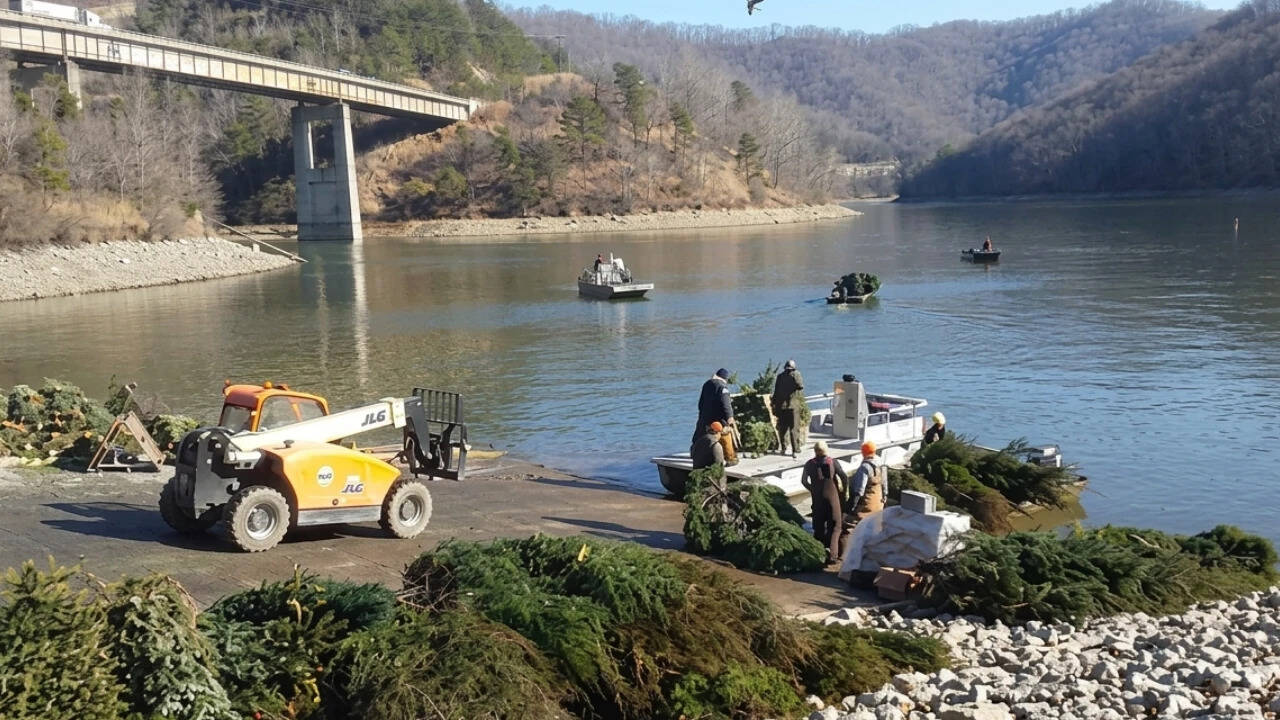
January mornings in the Bluegrass have a particular kind of damp stillness. You smell wet bark, cold mud, and the faint, metallic tang of exhaust from pickup trucks idling near a boat ramp. In your hands, if you have spent enough late winters walking reservoirs with biologists and anglers, you know the weight of a dry Fraser fir or blue spruce. The needles prick your gloves. They shed onto the floorboard of the truck. By the second week of January, a tree that held tinsel, warm light, and family arguments for six weeks looks like an apology nobody wants to clean up.
Sunk.
That single word captures what Kentucky wildlife crews do with roughly 1,700 discarded Christmas trees every year across state lakes. Instead of letting them rot in a landfill where they generate methane without doing a single ounce of ecological work, state fisheries biologists bundle them, weight them down with concrete blocks or cinder blocks, and drop them into cold water.
To a casual reader skimming a headline, it sounds like a quirky seasonal trivia item. A punchline for a local newscast. Look closer, though, and you find something far more sobering. Many of Kentucky's lakes are reservoirs—man-made bodies of water carved out of river valleys decades ago. Over time, the standing timber, brush, and stumps that once gave young fish shelter rot away or silt over. A smooth, bare lake bottom looks peaceful from a dock. Underneath, for a two-inch bluegill or a fingerling crappie, it can feel like walking across an empty airport runway with a hawk circling overhead.
What an Empty Lake Bottom Actually Costs
To understand why a pile of dead evergreens matters, I want to offer a hypothetical character—someone invented to put human skin on a quiet ecological problem. Call him Arthur, a retired machinist from eastern Kentucky who spends Tuesday mornings on a reservoir with a spinning rod and a thermos of black coffee. For thirty years, Arthur knew which coves held crappie and largemouth bass in spring. Lately, he tells anyone who asks at the bait shop that the fishing feels thinner, the bites fewer between moves.
Arthur is not imagining things, even if he blames the weather or the boat traffic. In aging reservoirs, loss of structural cover—fallen branches, brush piles, submerged timber—strips away two essential survival tools at once. Small fish lose places to hide from predators like bass and walleye. At the same time, surfaces that grow periphyton—the microscopic coat of algae, bacteria, and tiny invertebrates that forms on submerged wood—shrink. Without that living film, the bottom of the food web thins out.
Consider what happens next: when young fish cannot find cover or forage, fewer survive their first year. Fewer survivors mean fewer catchable fish two or three springs later. And when anglers stop catching fish, local bait shops, marinas, and small lakeside diners feel the pinch in their cash registers. An empty lake bottom is never just an environmental statistic; it is a slow leak in a rural economy and a quiet erosion of a way of life.
When a reservoir ages and its submerged timber decays, fish do not disappear all at once—they simply run out of places to begin.
I will admit something that surprises people when I talk about habitat work: I used to wonder if sinking Christmas trees was mostly symbolic. Putting a real tree back into nature feels good. It carries a clean, circular story—from living room corner to watery reef. Yet good intentions in conservation can easily become theater if the science does not back them up. Real conifers lose their needles in the water, and their finer branches break down faster than heavy hardwood oaks. A pine tree is not a permanent granite monument.
So why bother?
How a Dead Pine Becomes a Underwater Neighborhood
Biologists do not treat Christmas trees as a miracle cure; they treat them as a fast, renewable piece of cover that works right away. Think of a sunken conifer like a temporary pop-up shelter during a sudden storm. Within days or weeks of hitting the bottom, it breaks up the open water, creates current eddies, and gives small fish an immediate place to tuck in out of sight. As algae and tiny aquatic insects colonize the wood, larger fish—crappie, sunfish, bass, catfish—move in to hunt the edges.
It is an intuitive analogy, though it has limits. A bundle of Christmas trees will not last twenty years the way a dense brush pile of heavy oak or cedar might, which is why fisheries programs often pair evergreens with other habitat structures or repeat plantings year after year. Still, speed matters in nature. A tree dropped in winter is already offering shade, ambush points, and feeding surfaces when spring warming stirs the lake to life.
The catch—and there is always a catch—is that you cannot just toss your living room spruce off the nearest dock and call yourself a conservationist. Tinsel, ornaments, hooks, flame retardants, and synthetic trees do not belong in a lake. Tinsel looks like baitfish food to hungry fish and can harm their digestive tracts if swallowed. Ornaments break into glass or plastic. Artificial trees are made of plastics and metals that shed debris and do not decompose naturally.
If a community wants to help rather than accidentally litter, the rules are straightforward and practical.
- Strip every last bit of tinsel, garland, wire, hooks, and ornament hardware before donating a tree.
- Bring only real, cut evergreen trees—never artificial ones or flocked trees coated in chemical snow or sprays.
- Use designated drop-off sites run by state wildlife agencies or local partners rather than dumping trees on public shorelines.
- Follow local instructions on bundling or weighting if volunteers are helping build fish attractors.
Notice how simple that list is. Most environmental problems demand legislation, billion-dollar grants, or years of litigation. This one starts with checking the branches by a bright lamp to make sure a single strand of silver foil did not survive the takedown.
The Quiet Labor Behind the Scenes
If you have never watched a fisheries crew work in winter, you might picture a festive event with hot cocoa and cheering crowds. The reality is closer to commercial dock work in January. Waders get stiff in the cold. Rope burns wet palms. Concrete blocks thud against boat gunwales with a hollow sound that carries across the mist.
State agencies like the Kentucky Department of Fish and Wildlife Resources coordinate collections, organize volunteers, transport hundreds of trees, and place them in mapped locations where anglers and fish can both benefit. Sometimes coordinates are shared so anglers know where structure has been placed; other times crews build brush piles and reefs across coves and flats to diversify depth and cover.
Why put in that effort for a seasonal material? Because waste and scarcity sit right next to each other every winter. Across the country, millions of real Christmas trees are cut down every November and December for a few weeks of holiday warmth. In many towns, they end up piled at the curb or buried in dirt. Turning that post-holiday surplus into fish habitat takes surplus and turns it into shelter. It takes something finished and gives it one more season of usefulness before decay finally claims the wood.
Returning to our hypothetical friend Arthur, imagine him out on the water six months after a winter tree drop. The air is warmer now, smelling of honeysuckle and damp earth instead of winter diesel. His sonar flickers over a submerged cluster of branches—not a permanent fortress, not a cure-all for every stress on a reservoir, just a tangled pocket of wood holding life in the dark. A crappie strikes. The rod bends. For a few quiet minutes, the lake feels full again.
A dry pine branch underwater will eventually soften, lose its bark, and settle into the silt. Nothing in a lake stays forever. Yet for the small fish hiding inside its needles today, and for the person waiting on the bank for a tug on the line, temporary shelter is enough to keep the story going.