The core challenge of organizing a multi-venue sporting tournament across an entire continent does not lie in logistical transport or crowd control, but in managing the friction coefficient and energy restitution of a biological playing surface. When the World Cup expands to 104 matches across 16 stadiums spanning Canada, Mexico, and the United States, the physical variance of local environments introduces an unacceptable variable into elite athletic performance. A ball rolling across a pitch in Vancouver must encounter identical rotational resistance to one kicked in Mexico City or Miami.
Achieving this level of competitive neutrality requires moving past traditional agriculture and treating sports turf as an engineered mechanical component. Elite stadiums are closed or semi-closed thermodynamic systems, meaning that natural turf cannot survive, let alone self-repair, without systematic microclimatic intervention. Over an eight-year development lifecycle led by agronomic researchers at the University of Tennessee and Michigan State University, the approach to tournament pitch design has shifted from simple sod-laying to the deployment of modular, hybrid biological systems engineered to withstand unprecedented mechanical stress.
The Tri-Axial Performance Matrix
To standardize a playing surface across diverse geographical coordinates, engineers evaluate turf using three primary mechanical criteria. If any of these metrics deviate from established thresholds, the surface alters player biomechanics, increases soft-tissue injury risk, and disrupts ball dynamics.
- Shear Resistance and Root-Zone Tensile Strength: The ability of the turf to resist tearing when an athlete changes direction at high velocity. This is governed by root density and the structural binding of the soil matrix.
- Vertical Deformation and Energy Restitution: The depth to which a surface compresses under foot traffic and the subsequent efficiency of its rebound. Excessive deformation saps player energy and slows down the game, while insufficient deformation increases peak impact forces on joints.
- Rotational Friction Coefficient: The precise interface between a player's cleats and the turf fibers. This dictates whether a shoe will grip sufficiently to accelerate or release cleanly to prevent rotational knee and ankle trauma.
The structural limitation of standard natural grass is its vulnerability to shear failure under the force of professional athletes. When a player makes a sharp turn, the lateral force can dislodge the shallow root systems of young turf, causing divots. This problem is compounded by the fact that eight of the tournament's 16 venues are NFL stadiums designed for artificial turf, meaning they feature enclosed concrete bowls, lack natural sunlight, and have restricted airflow.
To bypass these biological limitations, the tournament relies on hybrid turf systems. This architecture integrates a synthetic matrix with living organic tissue. Millions of polypropylene or polyethylene fibers are injected roughly 20 centimeters deep into the root zone, exposing approximately 2 centimeters of synthetic fiber above the soil surface.
[Natural Grass Blades]   [Synthetic Fibers]
         \                     /
    ______\___________________/______  <- Pitch Surface
   |      :                   :      |
   |   [Sand-Based Root Zone Matrix] |  <- 20cm Depth
   |      :                   :      |
   |_____[Gravel Drainage Layer]_____|
As the natural grass seeds germinate, their roots intertwine with the synthetic fibers. This structural integration stabilizes the sand matrix, preventing the deep divots that traditionally disrupt play. The synthetic fibers act as an anchor, ensuring that even if the living grass is sheared or damaged during a match, the structural integrity of the pitch remains intact.
Microclimatic Engineering in Enclosed Arenas
Sustaining living turf inside roofed stadiums requires replicating the outdoor solar spectrum and atmospheric conditions using industrial hardware. Natural turf requires specific wavelengths of light to fuel photosynthesis and drive root development.
Spectral Radiance Engineering
Enclosed stadiums block the necessary solar radiation required for turf survival. Photosynthetically Active Radiation (PAR), specifically within the blue (400–500 nanometers) and red (600–700 nanometers) wavebands, is essential for maintaining turf density and health. Inside venues like Atlanta’s Mercedes-Benz Stadium or Dallas's AT&T Stadium, natural light levels fall far below the minimum requirement of 30 to 40 moles per square meter per day ($\text{mol}\cdot\text{m}^{-2}\cdot\text{d}^{-1}$) of Daily Light Integral (DLI).
To resolve this deficit, stadiums deploy mobile LED grow light structures. These systems articulate across the pitch surface, delivering targeted spectral emissions that match the absorption peaks of chlorophyll $a$ and $b$. By continuously measuring the DLI at various points across the pitch, ground crews can adjust the exposure times of the LED arrays, ensuring uniform turf growth even in areas permanently shaded by stadium architecture.
Sub-Base Thermodynamic Control
Air temperature and soil moisture levels dictate the metabolic rate of the turf grass. Because cool-season grasses like Kentucky bluegrass (Poa pratensis) and perennial ryegrass (Lolium perenne) struggle in the high temperatures of Southern venues, while warm-season bermudagrass (Cynodon dactylon) dormant-fades in cooler Northern climates, engineers must regulate the sub-base temperature.
Beneath the root-zone sand matrix lies an interconnected network of hydronic piping. By circulating heated or chilled water through these sub-surface loops, pitch managers can directly manipulate root-zone thermodynamics.
The system operates on a dual-mode mechanism:
- Cooling Mode: In high-temperature environments like Houston or Miami, the root zone is chilled to prevent heat stress and subsequent root dieback, keeping the turf in an optimal metabolic window.
- Heating Mode: In cooler climates, the root zone is warmed to stimulate continuous root growth and accelerate tissue repair between matches.
This system is paired with vacuum-assisted sub-surface drainage infrastructure. In the event of heavy rainfall, high-capacity pumps reverse airflow through the drainage pipes, pulling moisture downward through the sand profile at rates exceeding 100 millimeters per hour. This rapid drainage prevents surface ponding and eliminates the hydroplaning risks that ruin ball roll physics.
The Logistics of Rapid Turf Deployment
A primary constraint of the tournament's stadium distribution is that many venues must host non-sporting events or switch between alternative field layouts immediately before the matches begin. This reality makes it impossible to grow the tournament pitch in situ over several months. Instead, the pitches must be grown off-site at specialized sod farms and transported on demand.
The traditional limitation of transported sod is the instability of thick-cut turf. If the soil layer transported with the grass does not match the stadium’s sub-base sand profile, it creates an abrupt physical boundary. This layer discontinuity disrupts vertical water movement and prevents roots from penetrating into the deeper sub-base, leading to a pitch that slips under lateral load.
To eliminate this point of failure, sod farms use a harvest method known as "washed sod" or rely on a matching engineered sand profile. The grass is grown on a sand matrix that mirrors the physical specifications of the stadium's sub-base. When harvested, the sod is cut at an atypical thickness—often between 4 and 5 centimeters—to maximize the initial shear resistance of the transported mat.
[Harvested Sod Mat: 4-5cm] -> Perfect Particle Alignment -> [Stadium Sub-Base Sand]
When these heavy sod rolls are laid out inside the arena, the identical particle sizes of the sod sand and the stadium sub-base allow for immediate capillary action and rapid root integration. Within 48 to 72 hours of installation, the root system begins crossing the interface, securing the surface for immediate high-intensity use.
Quantifying Pitch Quality Control
To maintain competitive neutrality across all 16 venues, FIFA implements a strict testing protocol. Ground crews utilize specialized diagnostic equipment to measure surface properties daily, removing human bias from pitch evaluation.
| Performance Metric | Diagnostic Instrument | Target Operational Threshold |
|---|---|---|
| Surface Hardness | Clegg Impact Hammer (2.25 kg Clegg) | 70 – 90 Gravities ($g$) |
| Rotational Traction | Clegg Shear Tester / Traction Foot | 40 – 50 Newton-meters ($\text{N}\cdot\text{m}$) |
| Ball Rebound Height | Standardized Vertical Release (2m) | 0.60 – 0.85 Meters ($m$) |
| Surface Moisture Content | Time-Domain Reflectometry (TDR) Probe | 15% – 25% Volumetric Water Content (VWC) |
If a pitch registers a hardness reading above 100 $g$, the risk of player concussion and joint stress rises significantly. Ground crews respond by executing shallow tining or aeration to fracture the compacted sand matrix and restore elasticity.
Conversely, if the rotational traction drops below 35 $\text{N}\cdot\text{m}$, players will struggle to find footing, leading to slipping and compromised agility. This issue is corrected by applying targeted iron treatments or adjusting the light spectrum to encourage lateral growth, which increases the density of the turf canopy.
The Operational Playbook for Tournament Play
Managing a natural turf system under the demands of a modern multi-venue tournament requires a shift away from traditional agricultural schedules and toward continuous, data-driven maintenance. Ground crews must treat the pitch as a dynamic biological asset that responds directly to stadium usage, weather conditions, and scheduling demands.
The following operational blueprint outlines the daily maintenance routine required to maintain surface stability throughout the tournament cycle:
T-Minus 24 Hours: Baseline Calibration
- Measure volumetric water content across a 30-point grid using Time-Domain Reflectometry probes to locate dry zones or over-saturated areas.
- Deploy targeted sub-surface irrigation to bring the moisture profile within the ideal 15% to 25% window.
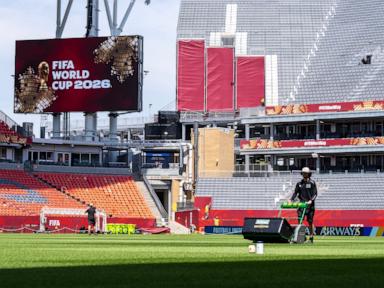
- Execute a precision cut using dual-blade reel mowers to lock in a uniform blade height of exactly 23 millimeters.
Match Day: Pre-Game and Mid-Game Adaptation
✨ Don't miss: The Brutal Truth About Irans Digital Wall- Conduct Clegg Impact Hammer testing two hours before kickoff to verify that surface hardness stays between 70 and 90 $g$.
- Apply a controlled, light top-wetting 15 minutes before kickoff to reduce surface friction, accelerating ball roll without destabilizing the root matrix.
- Deploy a division of divot-repair technicians during the 15-minute halftime window to manually restore displaced turf fragments and stamp down sheared zones.
Match +1 Hour: Accelerated Bio-Recovery
- Sweep the entire pitch with high-vacuum turf sweepers to clear organic debris, broken grass blades, and loose sand particles.
- Lock the hybrid injection systems into place and roll out the mobile LED grow-light rigs over areas that saw heavy action, such as the goal boxes and midfield.
- Engage the sub-surface ventilation system in vacuum mode to draw fresh air through the root zone, preventing anaerobic conditions and keeping the root system healthy for the next match.