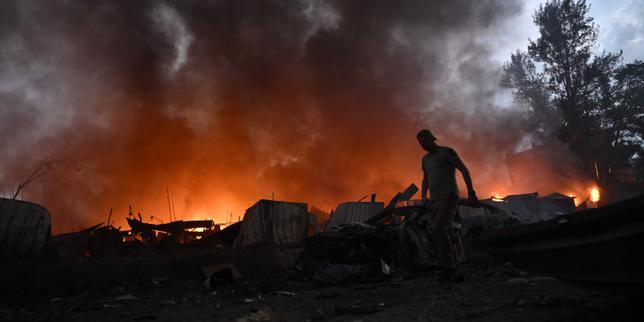
The operational reality of modern peer-to-peer warfare dictates that strategic success is determined not by territorial acquisition, but by the degradation of an adversary's critical infrastructure and command nodes. Media narratives frequently reduce complex missile and drone campaigns to simple casualty tallies or isolated incidents of structural damage. This superficial framing obscures the underlying systemic calculus: a highly calculated sequence of offensive maneuvers designed to exploit asymmetric vulnerabilities in air defense networks and energy grids.
An objective assessment of concurrent strikes—specifically, Russian ballistic missile salvos targeting the Kyiv region and Ukrainian counter-strikes striking the energy infrastructure of Sevastopol—reveals a dual-track paradigm of modern attrition. While one side leverages heavy payload ballistic assets to overwhelm capital defense systems, the other utilizes precise, low-signature strike mechanisms to isolate and paralyze militarized logistics hubs. Understanding this dynamic requires a rigorous deconstruction of missile interception physics, energy grid resilience, and the economic sustainability of prolonged aerial bombardment.
The Tri-Layered Calculus of Air Defense Saturation
The deployment of ballistic missiles against heavily defended urban centers like Kyiv operates on a deliberate strategy of air defense saturation. Modern integrated air and missile defense (IAMD) systems are structurally limited by radar tracking capacity, target engagement channels, and interceptor inventory.
[Offensive Ballistic Salvo]
       │
       ▼
[Radar Tracking Saturation] ──► [Interceptor Inventory Depletion]
       │                                     │
       ▼                                     ▼
[Kinetic Leakage Through Shield] ──► [High-Value Urban Attrition]
The offensive strategy relies on three distinct operational vectors:
- Radar Track Maximization: By launching a synchronized mix of supersonic ballistic missiles, cruise missiles, and low-cost loitering munitions, the attacker forces the defending IAMD radars to track dozens of radar cross-sections simultaneously. This overwhelms the command-and-control architecture, creating processing delays that allow high-velocity threats to penetrate the defensive envelope.
- Interceptor Inventory Attrition: Interceptor missiles utilized by advanced systems (such as MIM-104 Patriot or SAMP/T units) are finite, highly sophisticated assets with multi-month manufacturing cycles. Utilizing multi-million dollar interceptors to down low-cost drones or older missile variants represents an economically unsustainable exchange ratio for the defender.
- Kinetic Leakage Management: The primary objective of massed salvos is to achieve "leakage"—the probability that at least one high-velocity payload bypasses the terminal defense layer due to system saturation or reloading blind spots. When applied to administrative or industrial targets within a capital region, even a single-digit leakage rate yields substantial strategic disruption.
This saturation model demonstrates that raw casualty figures are a lagging indicator of defensive degradation. The leading indicator is the consumption rate of localized interceptor stockpiles relative to the replenishment velocity provided by external supply chains.
Energy Grid Vulnerability and the Mechanics of Total Blackouts
Conversely, the targeting of electrical infrastructure in occupied territories like Sevastopol highlights a different strategic imperative: the disruption of military logistics through grid destabilization. Modern military operations are entirely dependent on civil infrastructure; command centers, maintenance depots, rail networks, and radar arrays require stable, high-voltage power.
The vulnerability of an energy grid to targeted kinetic strikes is governed by the principles of cascading failure within complex networks. Electrical grids operate on a strict equilibrium between generation capacity and load demand. When critical nodes—specifically transmission substations, step-down transformers, and generation facilities—are damaged, the grid experiences immediate localized shocks.
The failure mechanics typically progress through three phases:
- Isolation of the Load Center: The destruction of key transformers cuts off the urban or military hub from the wider regional grid, forcing it to rely on local generation assets which are often insufficient or equally vulnerable.
- Frequency Instability: The sudden loss of transmission lines creates an instantaneous mismatch between power generation and consumption. If the frequency drops below a critical threshold, automated safety systems trip, shutting down functioning power plants to prevent catastrophic hardware damage.
- Black Start Failure: Once a grid experiences a total blackout, restarting it requires "black start" capabilities—using internal diesel generators or hydro stations to gradually bring main units back online. In a continuous strike environment, the specialized equipment required for a black start is frequently targeted, turning temporary outages into prolonged structural paralysis.
For a militarized port city, the loss of electrical power directly impairs the ability to refuel naval assets, operate automated air defense command loops, and maintain secure communication arrays. The strategic outcome is the functional neutralization of a logistical hub without requiring its physical destruction.
The Economic and Industrial Disparity of Precision Attrition
A critical flaw in standard conflict analysis is the failure to evaluate the industrial replenishment cycle supporting these operations. Every missile launched and every air defense interceptor fired represents a drawdowns on finite national industrial capacities.
The sustainability of an offensive missile campaign depends on the ratio of production velocity to expenditure velocity. If a military expends ballistic assets faster than its domestic defense industrial base can manufacture them, the campaign faces an inevitable culmination point. However, if the attacker has successfully shifted to a wartime economy—securing raw materials, expanding production shifts, and substituting sanctioned microelectronics with industrial-grade alternatives—the campaign can be sustained indefinitely.
The defender faces a compounding challenge. They must defend 360 degrees of sovereign airspace against localized, concentrated thrusts. This requires a diffuse distribution of air defense assets, leaving secondary and tertiary targets vulnerable. Furthermore, the economic cost of rebuilding damaged civilian infrastructure, coupled with the loss of industrial productivity during rolling blackouts, creates a severe fiscal drain that saps long-term defensive viability.
Structural Bottlenecks in Post-Strike Remediation
The true measure of a strike's effectiveness is not the immediate blast radius, but the duration of the resulting operational impairment. Infrastructure remediation in a conflict zone is bottlenecked by highly specific supply chain constraints.
Large-scale power transformers, for example, are not mass-produced off-the-shelf items. They are bespoke pieces of heavy machinery, weighing hundreds of tons, requiring specialized copper windings and core steels. The lead time for manufacturing a single high-voltage transformer under normal market conditions exceeds twelve months. In a wartime environment characterized by disrupted logistics and targeted transport routes, replacing these components becomes an extraordinary challenge.
Consequently, temporary fixes—such as rerouting power through lower-voltage civilian lines or deploying modular generators—are fragile. They create inherently unstable networks that are highly susceptible to subsequent, lower-intensity attacks. The adversary leverages this bottleneck, utilizing high-precision assets to systematically target the repair efforts, thereby compounding the original systemic damage.
Strategic Forecast for Distributed Attrition Campaigns
The intersection of urban ballistic bombardment and targeted infrastructure interdiction indicates a transition into a highly technical phase of industrial warfare. The traditional concept of achieving air superiority through the destruction of an enemy's air force has been superseded by the concept of airspace denial via localized kinetic saturation.
Future operational shifts will likely see an intensification of this asymmetry. Attackers will increasingly deploy highly integrated, multi-axis salvos combining low-observable cruise missiles with ballistic vectors to force defenders into complex target-prioritization dilemmas. Simultaneously, counter-strike strategies will focus heavily on isolating forward military bases by systematically dismantling the regional energy architectures that sustain them.
Victory in this framework will not be determined by tactical bravado or individual engagements, but by the cold mathematics of industrial throughput: which side can manufacture precision guidance systems, solid-fuel rocket motors, and high-voltage grid components at a velocity that outpaces the kinetic destruction inflicted by the other. The conflict remains, fundamentally, an unyielding race of industrial mobilization and logistics resilience.