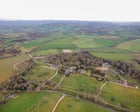
You can smell the damp earth of Somerset long before you see the stone walls. It is a heavy, ancient smell—clover crushed beneath the hoof, wet moss clinging to limestone, the faint, sweet decay of fallen apples rotting in the autumn orchards of England’s green and pleasant land. Walk these country lanes long enough, and the county begins to feel less like a geographical location and more like an heirloom. It belongs to everyone and no one, passed down through generations of tenant farmers, church parishioners, and Sunday walkers who have stepped the same mud-slicked stiles for five centuries.
Then you hit the perimeter.
It arrives quietly. A straightened verge. A newly laid stretch of Cotswold stone, fitted so tightly a blade of grass would struggle to find purchase. Security cameras perched on ancient oaks, blinking with a soft, synthetic pulse against the canopy of rooks. The local postman knows the spot well; this is where the public footpath bends away abruptly, nudged aside by steel gates that slide shut with a heavy, hydraulic sigh.
Inside those gates sits a corner of Somerset that is no longer part of Somerset at all.
This is the domain of Christo Wiese.
To understand what is happening in this quiet English valley, you have to look past the manicured lawns and the sudden influx of architectural scaffolding. You have to look at the balance sheets, the shifting tectonic plates of global wealth, and the quiet desperation of rural communities starved for investment yet terrified of erasure.
Let us be precise about the man. Christo Wiese is a South African retail tycoon, a billionaire whose fortunes were built on discount supermarkets, clothing chains, and the dizzying arithmetic of international commerce. When his name made headlines in his home country years ago following the collapse of Steinhoff—a corporate implosion that temporarily vaporized a massive portion of his personal wealth—the financial press treated it as a Greek tragedy told in balance sheets. Billions vanished overnight. Men of lesser constitution would have retreated to a quiet life of clipping coupons.
Wiese did not retreat. He rebuilt, he restructured, and he looked outward. He looked, specifically, to the rolling hills of southwest England.
Real estate has always been the ultimate fallout shelter for the ultra-wealthy. When stocks jitter and currencies lose their spine, dirt remains. But what is happening in Somerset is not merely a portfolio diversification strategy. It is something older, grander, and far more intimate. It is the construction of a private kingdom.
Over recent years, entities linked to Wiese have quietly stitched together parcels of land in Somerset, acquiring historic manors, working farms, and residential properties with the methodical patience of a chess grandmaster. To the casual observer driving down the A303, it looks like normal rural turnover—an old estate changing hands, a wealthy buyer moving in. But map the acquisitions out, plot the deed transfers, and a different picture emerges.
It is a sprawling, contiguous expanse of English countryside brought under a single banner. One man's estate.
Consider what it feels like to live in the shadow of this transformation if you are a local. Imagine waking up in a village where your grandfather farmed potatoes, only to find that the local deer park, the ancient bridleway you used to ride your bicycle down as a teenager, and the abandoned stone barn on the hill have all been absorbed into a private security zone.
Change in the countryside is rarely loud. It does not announce itself with sirens. It arrives in the rustle of legal documents, the sudden appearance of "Private Property" signs where none existed for two hundred years, and the quiet departure of families who can no longer afford to rent a cottage because the surrounding acreage has been inflated into a playground for transnational capital.
There is a profound psychological friction at play here. On one side stands the romantic myth of rural England—an open landscape shared by all, stitched together by common law and ancient rights of way. On the other stands the reality of twenty-first-century global capitalism, where land is not a community anchor, but an asset class.
Wiese’s Somerset acquisitions are a masterclass in this modern enclosure movement. In the eighteenth century, the British Parliament passed Enclosure Acts that fenced off common land for private farming, sparking riots and altering the social fabric of the nation forever. Today, we do not need Acts of Parliament. We simply need liquidity.
When a billionaire buys a valley, he is not just buying soil and stone. He is buying silence. He is buying privacy at a scale that borders on the feudal. In a world hyper-connected by fiber-optic cables, satellite tracking, and the relentless hum of social media, the ultimate luxury is the ability to make yourself entirely invisible.
You can walk for miles along the perimeter of the Wiese estate and hear nothing. The local sheep graze on pastures that are technically private. The wind blows through beech trees that have been pruned by arborists on a retainer. It is breathtakingly beautiful. It is also completely inaccessible.
This creates a peculiar tension in the local pubs of Bruton and Frome. Over pints of bitter, locals debate the merits of the billionaire’s footprint. Some argue that the investment is a godsend—that the restoration of historic manors provides jobs for local builders, stonemasons, and landscape gardeners who would otherwise struggle to find high-end work. There is truth in this. A crumbling Tudor roof does not fix itself; an overgrown estate requires an army of hands to keep the wilderness at bay.
Others, however, feel a creeping sense of alienation. They see the county seat shifting away from the people who were born there. When houses are snapped up at prices that bear no relation to local wages, the community hollows out from the inside. The village school gets fewer pupils. The local shop stocks artisanal sourdough instead of sliced white bread. The fabric frays.
We have seen this script before. It is the Cotswoldization of the West Country—a process whereby rural authenticity is commodified, packaged, and sold back to the highest bidder, leaving behind a sterile theme park for the wealthy punctuated by empty houses that stay dark nine months out of the year.
Yet, to paint Christo Wiese’s Somerset venture purely as a villainous land grab is to misunderstand the man and the motivations driving him. To step into the shoes of someone who has built, lost, and reclaimed a multi-billion-dollar empire is to understand a very particular kind of paranoia. When you have survived the financial turbulence that Wiese has navigated, safety becomes an obsession. Not just physical safety, but legacy safety.
A South African billionaire planting roots in the deepest, safest clay of the English countryside is performing an ancient ritual. He is anchoring his wealth to the earth. Stocks can crash. Governments can levy taxes. Currencies can hyper-inflate. But Somerset limestone has stood since the Jurassic period. It will outlast us all.
And perhaps that is what makes the whole affair so haunting.
Walk past the gates at dusk. The light over the Somerset levels turns that bruised, magnificent purple that Turner spent a lifetime trying to capture on canvas. The rooks are settling into the high branches, their cawing echoing across the valley like old iron chains dragging over stone. For a moment, looking at the stillness of the fields, the manicured hedges, the absolute perfection of the landscape, you can understand the impulse. Who wouldn't want to carve out a quiet corner of Eden and lock the door behind them?
The trouble is that Eden was never meant to be gated.
When the last light fades and the security cameras blink on in the gathering dark, casting red and green infrared beams across the ancient grass, the landscape feels smaller. The history belongs to the deed-holder. The horizon has a boundary line.
The billionaire sits inside his manor, surrounded by quiet, by art, by the immense weight of accumulated capital. Outside, in the damp English mist, the rest of us keep walking along the redirected footpath, watching our step, wondering how much farther the fence line will creep before morning.