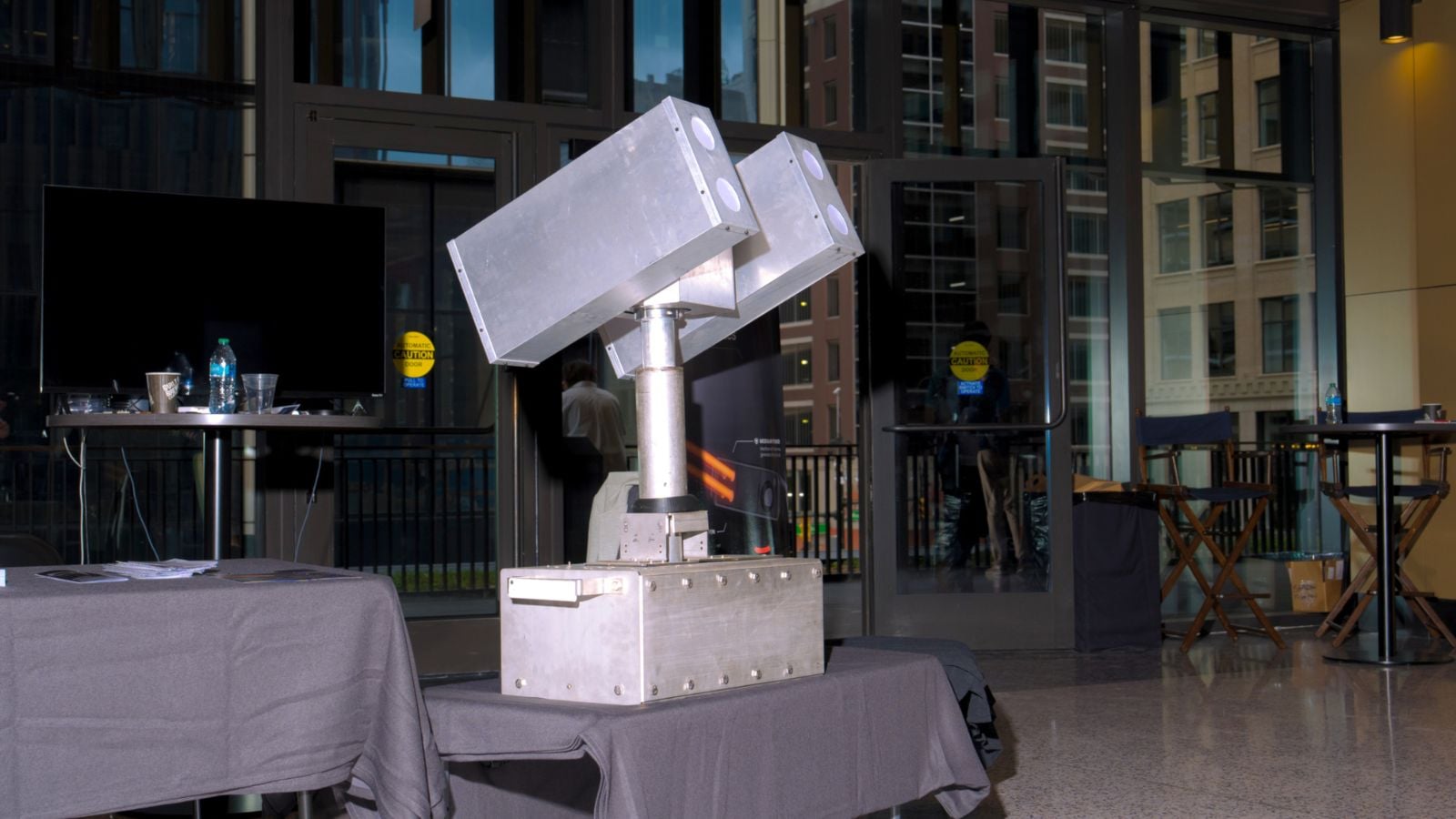
The math of modern warfare has reached a breaking point in the Red Sea and the Persian Gulf. For eighteen months, the United States Navy has been trading $2 million Standard Missiles for $20,000 Iranian-made Shahed drones. It is a fiscal hemorrhage that no superpower can sustain indefinitely. To fix this, the Pentagon is finally pushing high-energy lasers out of the laboratory and onto the front lines of Operation Epic Fury.
The promise is intoxicating: a "magazine" that never runs dry, powered by the ship’s own engines, firing shots that cost about as much as a gallon of milk. But behind the sleek headlines of the HELIOS and DragonFire systems lies a more complicated, grittier reality. Lasers are not the magic wands the public has been led to believe they are. They are temperamental, weather-dependent, and currently struggling against the very environment they were sent to dominate.
The Invisible Magazine and the Cost Curve
The primary reason the U.S. is obsessed with directed energy is simple exhaustion. In the first 100 hours of recent escalations, the U.S. spent an estimated $3.7 billion on operations and munitions. When a swarm of thirty drones approaches a carrier strike group, the commander faces a harrowing choice: fire tens of millions of dollars in interceptors that take months to manufacture, or risk a billion-dollar hull.
Lasers change the calculus by shifting the burden from logistics to electricity. A system like the 60-kilowatt HELIOS (High Energy Laser with Integrated Optical-dazzler and Surveillance) recently installed on the USS Preble doesn't require a re-supply ship. As long as the ship’s gas turbines are spinning, the weapon is "loaded."
In recent engagements, the HELIOS has reportedly downed several one-way attack drones. It doesn't "blow them up" in a Hollywood-style explosion. Instead, it focuses a beam of infrared light onto a specific point—a fuel tank, a wing spar, or the optical sensor—until the material structurally fails. It is a silent, surgical kill.
The Middle East Climate Problem
If lasers are so efficient, why aren't they on every deck? The answer is written in the air of the Middle East. High-energy lasers are fundamentally light, and light hates the atmosphere.
In the Gulf of Aden, the air is a thick soup of salt spray, humidity, and fine quartz dust. Each of these particles scatters and absorbs the laser’s energy. On a clear day, a 60-kilowatt beam might burn through a drone at five kilometers. In the haze of a Red Sea afternoon, that effective range might drop to less than two kilometers.
"Atmospheric propagation remains the primary constraint," notes a recent defense analysis. "In high humidity, the beam essentially boils the water in the air, creating a pocket of turbulence that further de-focuses the light."
This means that while a laser is "cheap," it is also short-ranged and fickle. If an Iranian swarm attacks during a dust storm or heavy fog, the laser stays in the rack while the expensive SM-6 missiles are forced to do the heavy lifting.
Current Deployments and Hardware
| System | Platform | Power Output | Status |
|---|---|---|---|
| HELIOS | Arleigh Burke Destroyers | 60 kW+ | Operational / Testing |
| DragonFire | Type 45 Destroyers (UK) | 50 kW class | Accelerated Deployment |
| DE M-SHORAD | Stryker Vehicle | 50 kW | In-Theater Assessment |
| Iron Beam | Land-based (Israel) | 100 kW | Final Integration |
The Army’s Muddy Reality
While the Navy deals with salt spray, the Army is testing the DE M-SHORAD (Directed Energy Maneuver-Short Range Air Defense) in the deserts of Iraq and Syria. Mounted on a Stryker armored vehicle, this 50-kilowatt laser is designed to protect ground troops from the "rain" of mortar shells and small commercial drones used by Iranian-backed militias.
The transition from a stable ship deck to a bouncing, vibrating armored vehicle has been brutal. The optics required to keep a laser beam focused on a coin-sized spot miles away are incredibly delicate. Dust gets into the lens housings; heat from the desert sun competes with the massive heat generated by the laser’s own power cells.
The Army's recent reports are cautiously optimistic but admit a hard truth: the technology is currently a prototype being tested in a live fire zone because we don't have time for a traditional decade-long rollout. We are essentially "beta-testing" these weapons while people are shooting back.
The Swarm Dilemma
The most significant overlooked factor is the "dwell time." A missile can be fired, and the radar can immediately lock onto the next target. A laser, however, must stay "on target" for several seconds to burn through the casing.
If fifty drones are coming at you simultaneously, and each one takes five seconds to kill, the last few drones will reach your position long before the laser can cycle through the list. This is why lasers are being integrated as a "layered" defense. They handle the first few targets to save the expensive missiles for the rest of the pack. They are a component of the shield, not the shield itself.
The Rare Earth Bottleneck
There is a final, darker irony to the U.S. laser program. These weapons rely on ytterbium-doped fiber optics and high-end semiconductors made with gallium.
Currently, China controls the vast majority of the global supply chain for these specific materials. As the U.S. ramps up laser production to counter Iranian threats—threats often fueled by Chinese components—the Pentagon finds itself in a strategic vice. We are building our most advanced defensive weapons using materials sourced from our primary global competitor to fight proxies of our regional adversary.
The U.S. military is currently moving toward 150-kilowatt and even 300-kilowatt systems, which would provide enough power to melt the nose cones of incoming cruise missiles. But until the issues of atmospheric interference and "dwell time" are solved, the $2 million interceptor remains the king of the deck. The laser is currently an apprentice: promising, cheap, but prone to failing exactly when the weather turns foul.
Would you like me to analyze the specific manufacturing bottlenecks of ytterbium and how it impacts the U.S. military's 2027 procurement goals?