The mud along the Las Piedras River in southeastern Peru remembers everything.
If you walk the wet clay banks at dawn, before the tropical sun bakes the earth into cracked terracotta, you see the heavy, splayed tracks of a tapir. You see the delicate, star-shaped imprints of a jaguar that came down to drink in the dark. And occasionally, if you are standing in the exact wrong place at the exact right time, you see the bare, wide footprints of a human being who does not know the word for Peru, does not use money, and wants nothing to do with you.
They are the Mashco Piro.
For decades, the world knew them mostly as ghosts—the largest uncontacted Indigenous tribe left on Earth, estimated at roughly 750 people moving quietly through the dense canopy of the Madre de Dios region. They are nomadic hunter-gatherers who have actively, fiercely rejected the modern world since the late nineteenth century, when rubber barons enslaved, tortured, and slaughtered their ancestors by the thousands. Their isolation is not a romantic accident of geography. It is a calculated, generational act of self-defense.
Now, the legal walls meant to keep the modern world out are starting to crack.
In a move that has sent shockwaves through human rights organizations and environmental circles, Peruvian authorities have signaled a willingness to reconsider the territorial protections surrounding the Madre de Dios Territorial Reserve—the very buffer zone established to keep loggers, miners, and missionaries away from the Mashco Piro. On paper, it is framed as a bureaucratic review, a reassessment of land-use boundaries and economic development in a resource-rich region. On the ground, in the humid shadow of hundred-foot mahogany and shihuahuaco trees, it sounds a lot like the distant whine of a chainsaw.
The Architecture of an Invisible Wall
To understand why a regulatory shift in Lima threatens the survival of people hundreds of miles away, you have to understand how an uncontacted tribe actually lives.
Imagine your entire home—your kitchen, your pharmacy, your hardware store, your ancestral graveyard—has no fences, no property deeds, and no locked doors. Instead, your survival depends on a continuous, unbroken expanse of forest roughly the size of a small country. You follow the seasonal migrations of white-lipped peccaries. You harvest turtle eggs from exposed river sandbars during the dry months of July and August. You gather medicinal bark from trees that take three centuries to mature.
Because the Mashco Piro do not build permanent villages, outsiders often make a fatal mistake. They look at a satellite map of Madre de Dios, see thousands of square miles of unbroken green canopy with zero roofs or roads, and think: Nobody lives here.
That illusion is the exact mechanism by which Indigenous territories are erased.
In 2002, after years of relentless campaigning by Indigenous federations like FENAMAD (the Native Federation of the Madre de Dios River and Tributaries), the Peruvian government created the Madre de Dios Territorial Reserve. It spanned more than 829,000 hectares—over two million acres—specifically designated for Indigenous peoples in isolation and initial contact, known legally in Peru as PIACI. The law was simple in theory. No timber concessions. No oil exploration. No roads.
Yet even then, the lines drawn on maps in Lima did not match the reality of the Mashco Piro's footsteps. Large swathes of their ancestral territory were left outside the reserve's official borders and carved up into logging concessions. For years, timber companies operated right up to the invisible edge of the sanctuary, building networks of dirt roads deep into the jungle to haul out ironwood and cedar.
Consider what happens next when a logging road cuts through an isolated forest.
It is never just about the trees. First come the bulldozers, scraping away the topsoil and driving away the game the tribe relies on to eat. Then come the loggers themselves, bringing machetes, metal pots, and commercial food—items that draw curious or desperate members of the tribe closer to the camps. And riding silently in the lungs and bloodstreams of those loggers are the deadliest weapons of the twenty-first century: the common cold, influenza, measles, and COVID-19.
A Hypothetical Walk to the Edge of the Trees
Let us step away from policy papers for a moment and construct a hypothetical scenario—a composite built from documented encounters along the Las Piedras River over the past decade.
Picture a young Mashco Piro man, whom we will call Kuri, though we do not know the names they give themselves. It is August, the height of the dry season. The river has dropped twenty feet, exposing wide, sun-bleached beaches where yellow-spotted river turtles bury their eggs. Kuri’s family group, perhaps thirty people in total, has walked for three days to reach this bend in the water. This beach has fed their clan for ten generations.
Except this year, the forest behind the beach is silent.
Two miles upstream, a timber crew has spent the dry months clearing a haul road. The heavy machinery has driven the peccaries deep into the swamp. The river water is silty with runoff. When Kuri and two other men emerge from the tree line onto the gravel bar, their bodies painted with red achiote seed paste, carrying seven-foot bamboo-tipped bows, they are not looking for a fight. They are looking for food.
Across the water, a group of timber workers or river travelers spots them. Someone pulls out a smartphone. Someone else throws a bunch of bananas or a plastic bag of rice onto the sandbar, thinking it is an act of charity.
In that single, seemingly harmless exchange, a biological fuse is lit.
Kuri picks up the bag. On the plastic, or in the air between them, lingers a rhinovirus—a mild sniffle to a man from Puerto Maldonado, a four-day headache at worst. Kuri brings the food back to his camp. Within forty-eight hours, he develops a fever. Because the Mashco Piro have lived in isolation for over a century, their immune systems have zero ancestral memory of modern respiratory pathogens. There are no antibodies waiting to fight the invader.
Within a week, the fever sweeps through the camp. Elders who hold the oral history of the clan, who know which vines cure snakebites and which constellations signal the rains, are the first to suffocate from secondary pneumonia. Half the group dies on the forest floor within a month. The survivors scatter in terror, abandoning their dead, carrying the pathogen to the next clan they meet.
History tells us this is not an exaggeration. In the early 1980s, when Shell Oil explored the nearby Camisea region and opened roads that loggers quickly followed, contact with the previously isolated Nahua people wiped out roughly fifty percent of their population in a matter of years. Entire lineages vanished before a single doctor ever reached them.
The Pressure Cooker in Lima
If the stakes are so violently clear, why would Peru reconsider protections now?
To answer that honestly, you have to step out of the jungle and look at the economic and political pressures gripping Peru. Over the past several years, the country has weathered severe political instability, sluggish economic growth, and fierce regional demands for infrastructure and jobs. In Madre de Dios, a region already scarred by illegal gold mining and narcotics trafficking, legal forestry is often pitched by local politicians and business lobbies as the "responsible" economic engine.
Timber associations and regional lawmakers have argued for years that the PIACI reserves lock away billions of dollars in hardwood resources based on what they claim is exaggerated evidence. Some local officials have gone so far as to publicly question whether uncontacted tribes even exist in the numbers anthropologists claim, dismissing reports of Mashco Piro sightings as fabricated obstacles designed by foreign NGOs to stall regional development.
I remember standing on a muddy dock in Puerto Maldonado years ago, listening to a local timber middleman complain over warm beer about the conservation laws. He wasn't a cartoon villain twirling a mustache. He was a tired man with calloused hands, three kids to feed, and a truck payment due. To him, the forest was a warehouse of wood sitting idle while his town struggled for paved roads and reliable electricity. "We have families right here who are hungry," he told me, gesturing toward the dark wall of trees across the Madre de Dios river. "Why do ghosts get more land than my children?"
That tension is the true heart of this crisis. It is easy to condemn resource extraction from an air-conditioned office thousands of miles away. It is much harder when you look into the eyes of workers who see the jungle as their only ladder out of poverty.
Yet empathy for struggling workers cannot erase a fundamental moral and legal truth: you do not solve poverty by engineering an extinction.
In 2023 and 2024, the political push to weaken Peru's PIACI law reached a fever pitch, with congressional bills introduced to strip the Ministry of Culture of its authority to create reserves and hand that power to regional governments—the very bodies most beholden to local mining and logging interests. While intense international outcry and tireless lobbying by Indigenous leaders stalled the most extreme versions of those bills, the pressure never went away. Instead, it shifted into administrative terrain: reviewing boundaries, delaying the expansion of reserves that scientists had already approved, and quietly opening the door to re-evaluating existing protections.
The Paradox of Visibility
Here is the cruelest irony facing the Mashco Piro today: the more they are forced out of the shadows, the more danger they are in.
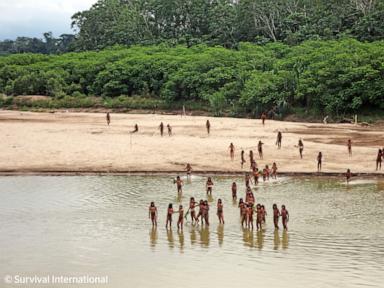
Over the past decade, sightings of the Mashco Piro along the Las Piedras and Madre de Dios rivers have surged. In 2024, Survival International released rare, startling photographs showing dozens of Mashco Piro men, women, and children gathered on a riverbank just a few miles from active logging concessions. They were visible in broad daylight, watching the river, standing near the edge of trees marked for harvest.
Critics of the reserves seized on those photos as proof that the tribe was "emerging" and ready for contact.
Anthropologists and Indigenous monitors who actually work on the rivers read the images very differently. They saw distress. When an uncontacted group appears repeatedly in the open, shouting across rivers or taking tools from empty camps, they are not asking to join modern society. They are reacting to compression. Their territory is shrinking from the outside in. Illegal loggers are creeping up the tributaries from the south; drug traffickers are cutting trails from the west; legitimate timber concessions are inching closer to their core hunting grounds. The Mashco Piro are being pushed out of the deep interior toward the riverbanks, like animals driven toward a clearing by a brush fire.
Sometimes, that collision turns violent. Over the years, encounters between the Mashco Piro and outsiders have resulted in arrows fired at boats, deaths of loggers who strayed too deep into restricted zones, and retaliatory terror among river communities. Every arrow fired is then weaponized in political debates in Lima as proof that the tribe is "hostile" and needs to be pacified or moved—a grotesque inversion of cause and effect.
What the Forest Knows
There is another layer to this story that rarely makes it into economic impact assessments, though it affects every person reading these words.
The territories protected for the Mashco Piro are among the most intact carbon sinks on the planet. Satellite data consistently shows that Indigenous-managed and PIACI-protected lands in the Amazon experience dramatically lower rates of deforestation than state parks or private concessions. Why? Because the most effective forest guardians on Earth are the people whose lives literally depend on keeping the canopy unbroken.
When Peru reconsiders protections for the Mashco Piro, it is not merely making a localized zoning decision. It is tampering with a biological lock that holds back the collapse of the southwestern Amazon. Once logging roads penetrate a primary forest, they act like arteries for secondary destruction. Illegal gold miners follow the timber tracks, poisoning the rivers with mercury. Land speculators burn the cleared edges for cattle pasture. Within ten years, a cathedral of biodiversity that took ten thousand years to assemble is reduced to scrubland and red mud.
I still think about the smell of that forest after a late afternoon downpour—the heavy, sweet rot of fallen fruit, wet cedar bark, and ozone rising off the river. It is an overwhelming, almost suffocating abundance of life. In that environment, human beings are small, fragile things. The Mashco Piro have survived there not by conquering the jungle, but by learning its rules so intimately that they became invisible within it.
We, on the other hand, have spent centuries forgetting how to live anywhere without paving it over first.
The Line in the Clay
Right now, the fate of the Mashco Piro hangs on decisions made in quiet rooms far from the sound of howler monkeys and rushing brown water. International observers, the Inter-American Commission on Human Rights, and Peruvian Indigenous organizations are watching closely, warning Lima that any rollback of PIACI protections violates both Peru’s own constitution and international treaties it has ratified.
Whether the Peruvian government holds the line or yields to the pressure of timber concessions will determine more than the quarterly output of tropical hardwood. It will decide whether one of the last truly free peoples on Earth gets to remain on their own terms, or whether their centuries-long resistance ends in a fever ward on the edge of a logging road.
Down on the Las Piedras River, the water rises and falls with the rains. Every evening, the mist settles low over the gravel bars, swallowing the trees whole. Somewhere just beyond the wall of green, behind a curtain of vines and ferns that no outsider has ever parted, bare feet are pressing silently into the wet clay—and the forest is closing behind them, erasing every trace that they were ever there.