The red brake lights stretch down a two-lane farm-to-market road outside Austin like a bleeding artery, three miles long, at seven in the morning on a Saturday in May.
Inside a dusty silver pickup truck—let us call the driver Marcus, a composite of a thousand exhausted parents I have stood beside in line at Texas trailheads—the air conditioning hums against the rising heat. Two kids sit in the back with fishing poles wedged between their knees. A cooler full of bologna sandwiches and melting ice sits in the bed. Marcus has been driving since five-thirty. He booked his day-use pass forty-two days ago on a state website that crashed twice before taking his credit card, and even with that digital golden ticket, he is sitting behind forty other trucks waiting for a single ranger at a wooden kiosk to wave him through.
At seven-fifteen, the gate swings shut. A yellow sign goes up. Park Full.
Behind Marcus, a minivan with Dallas plates executes a slow, defeated three-point turn in the gravel shoulder, kicking up a cloud of white limestone dust that hangs in the air like smoke. Inside that van is a family that drove three hours to see water they do not own.
That dust is the real story of modern Texas.
When the Texas Parks and Wildlife Department announced the opening of a new 3,000-acre state park along the Colorado River—funded through the historic $1 billion Centennial Parks Conservation Fund—most headlines treated it like a ribbon-cutting at a suburban shopping center. Three thousand acres. One billion dollars. A ribbon snipped by officials in starched shirts under a canvas tent while cameras clicked and generators hummed in the grass.
Numbers like that are easy to print and impossible to feel. They slide off the brain like rain off a waxed hood. To understand what those three thousand acres actually mean, you have to stop looking at press releases and start looking at barbed wire.
The Myth of the Wide-Open State
Say the word Texas to someone in Chicago or London, and they picture an endless horizon. They see cattle drives, open range, Big Bend cliffs, and dusty highways unspooling into eternity without a fence post in sight. It is one of the most durable illusions in American culture, sold on postcards and belt buckles for a century and a half.
Here is the truth that catches newcomers off guard: Texas is roughly ninety-five percent privately owned.
Read that figure again. Ninety-five percent.
Of the 171 million acres that make up the Lone Star State, almost every square inch belongs to a ranch, a timber company, a real estate developer, a family trust, or an investment fund. Unlike western states such as Nevada, Utah, or Wyoming—where the federal government holds vast stretches of national forest and Bureau of Land Management land that anyone with a pair of boots can walk onto for free—Texas entered the Union in 1845 retaining ownership of its public lands. Over the next century, the state sold or granted nearly all of it away to pay off war debts, fund railroads, and build schools.
For generations, that arrangement worked well enough because Texas was mostly empty. You knew a guy whose uncle had a ranch near Llano, or you slipped under a loose strand of wire at a low-water crossing to cast a line for bass, and nobody made a fuss.
Then the boom arrived.
Over the past twenty years, Texas added nearly nine million new residents—more than the entire population of Virginia, dropped straight onto the Texas Triangle between Dallas-Fort Worth, Houston, San Antonio, and Austin. Every single day, bulldozers scrape away another patch of blackland prairie and post oak savanna to pour concrete slabs for master-planned subdivisions, warehouse distribution hubs, and toll roads. Land that once sold for two thousand dollars an acre now trades for fifty thousand, or half a million if it sits near a highway interchange.
I remember the first time I felt the walls closing in. It was a Tuesday afternoon in October, seven years ago, along a stretch of river I had kayaked since college. Where there had once been a gravel bar shaded by ancient pecans, there was now a fresh twelve-foot wrought-iron fence running straight down into the water, topped with cameras and a bright blue sign warning of criminal trespass. A concrete retaining wall was already going up on the bluff above it.
The river was still technically public—under Texas law, the beds of navigable streams belong to the people—but every path to reach it had been bought, gated, and locked. A river you cannot touch might as well be on Mars.
What Happens When a State Runs Out of Breathing Room
When you pack thirty-one million people into a state where only five percent of the land is public, pressure builds in quiet, corrosive ways.
First, the parks you already have begin to love themselves to death. Enchanted Rock turns away hundreds of cars before nine in the morning. Garner State Park, where generations of Texas families have danced on the concrete slab by the Frio River every summer since the 1940s, books out its campsites five months to the second after reservations open. Trails erode down to bare, fractured bedrock. Septic systems strain. Wildlife retreats deeper into shrinking pockets of brush, cut off from migration corridors by eight-foot high-fence game ranches and six-lane highways.
Second, access to nature becomes a luxury good. If you have six figures to spend on a deer lease, or if you own five hundred acres in the Hill Country, the Texas outdoors is still a paradise. You can watch painted buntings at your feeder over morning coffee and cast a dry fly into private spring-fed creeks at dusk.
If you live in a two-bedroom apartment off Interstate 35 and work forty-five hours a week installing HVAC systems, your slice of Texas shrinks to a concrete balcony, a crowded municipal pool, and whatever sliver of park space hasn't hit capacity by sunrise.
That divide is toxic. It hollows out a shared civic identity. How do you ask people to care about water conservation, aquifer recharge, or endangered songbirds when their children have never once waded into a clear river without paying an admission fee or ducking under a "No Trespassing" sign? You cannot love what you are locked out of.
Anatomy of a Billion-Dollar Course Correction
Which brings us back to that billion-dollar fund and those three thousand acres along the Colorado River.
In November 2023, Texas voters did something remarkable in an era when nearly every ballot measure turns into a partisan knife fight. By a margin of more than seventy-six percent—passing in rural ranching counties and dense urban precincts alike—Texans approved Proposition 14, creating the Centennial Parks Conservation Fund.
Think of that billion dollars not as a checking account to be burned through in a single legislative session, but as an endowment—a permanent engine designed to buy land from willing sellers before concrete swallows it forever.
Why does the structure of that money matter so much? Because real estate deals in Texas do not wait for biennial budget cycles. When a three-thousand-acre riverfront ranch hits the market after a fourth-generation landowner passes away, private developers show up within forty-eight hours with wire transfers ready to clear. Historically, the Texas Parks and Wildlife Department had to beg lawmakers for one-off appropriations, watch the land get carved into five-acre "ranchettes," and walk away empty-handed.
With dedicated capital on hand, the state can finally move at the speed of the market.
Consider what three thousand acres along the Colorado River actually buys when you walk the ground instead of reading a balance sheet.
Three thousand acres is roughly four and a half square miles—nearly four times the size of New York's Central Park. Along the lower Colorado, as the river winds southeast out of the limestone ledges of the Balcones Escarpment toward the coastal plains, that acreage isn't just flat pasture. It is a living tapestry of ecosystems stitched together by water—Wait. Strike that word. Look at the land itself: towering bottomland hardwoods where bald eagles nest in winter; high bluffs overlooking sweeping oxbow bends; spring-fed tributaries filtering runoff before it reaches the main channel; open prairie pockets where native bluestem grass still grows waist-high when the spring rains hit.
Every mile of river frontage preserved inside that park boundary is a mile of shoreline that will never be armored with bulkheads, stripped of riparian shade trees, or fenced off behind guardhouses.
The Invisible Mechanics of a Living River
To understand why riverfront acreage carries ten times the ecological punch of dry upland pasture, picture a sponge lying beside a concrete driveway.
When a six-inch Texas gully-washer slams into a paved subdivision, water has nowhere to go. It shoots off roofs and asphalt into storm drains, carrying motor oil, lawn fertilizer, and microplastics straight into the nearest creek at destructive speed. Downstream towns flood. Topsoil washes toward the Gulf of Mexico.
Now picture that same six-inch storm hitting three thousand acres of intact river bottomland.
The canopy of bur oaks, pecans, and sycamores breaks the force of the falling rain. Deep root systems—some native Texas grasses send roots twelve feet straight down into the clay—act like millions of vertical straws, pulling water deep into the earth to recharge depleted aquifers. The floodplain spreads the surge out wide and slow, dropping silt and filtering nutrients naturally before the water eases back into the river channel clear and cool.
A state park on a river is not merely a playground. It is critical infrastructure disguised as scenery.
And yet, opening the gates is only the beginning of a far messier conversation—one that catches even passionate conservationists off guard.
The Hard Truth Nobody Puts on the Brochure
Let us be honest about something that gets glossed over in celebratory speeches: buying land and opening a park are two wildly different battles, and the second one often takes years.
When the state acquires a working ranch or a timber tract, it isn't inheriting a finished recreation area. It is inheriting barbed-wire cross-fences, abandoned oilfield roads, rusted stock tanks, invasive species like giant reed and feral hogs, and zero public infrastructure. There are no composting restrooms, no safe river put-ins, no emergency access lanes for ambulances when a hiker breaks an ankle in July heat, and no archaeological surveys to protect the Native American campsites that almost always cluster along Texas riverbanks.
I have walked newly acquired state tracts before they opened to the public, and the experience can be sobering. You expect a pristine wilderness; instead, you find piles of old tires in a dry creek bed and three miles of dilapidated fencing that has to be rolled up by hand before a single trail can be blazed.
Then comes the delicate balancing act every park planner loses sleep over. Put in too many paved roads, giant parking lots, and RV hookups, and you destroy the very quietude people drove two hours to find. Put in too few, and you recreate the exact same bottleneck Marcus sat in at seven in the morning—a velvet-rope wilderness accessible only to those fast enough on a keyboard to snag a reservation six weeks ahead.
There is no formula that solves that tension cleanly. Every trail alignment is a compromise between human hunger for access and the quiet needs of the creatures that already live there.
What Happens Next Along the Water
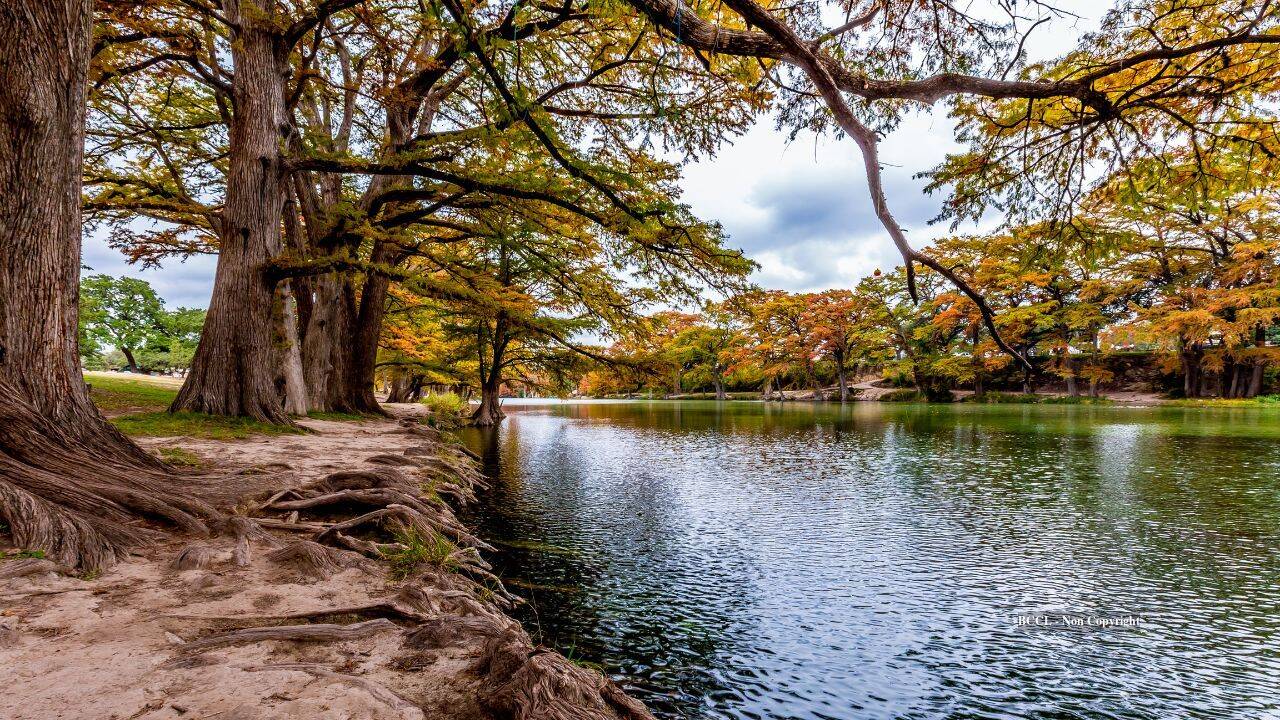
Still, stand on the high bank of the Colorado River just before sunset on an evening in late autumn, and the doubts quiet down.
The limestone bluffs across the water turn the color of warm honey. A great blue heron lifts off a submerged cypress knee with slow, heavy wingbeats, skimming six inches above the green current until it disappears around the bend. Somewhere back in the post oaks, a barred owl tests its voice before dark.
No bulldozers are idling at the fence line. No "Coming Soon: Luxury Riverfront Estates" billboard blocks the skyline.
For a state that spent more than a century selling off its birthright, three thousand acres is not a cure-all. Texas still lags far behind most states in public parkland per capita, and the population curve shows no sign of flattening. One billion dollars, large as it sounds on paper, will have to be stretched with surgical discipline across fast-growing corridors from the Piney Woods to the Panhandle before land prices climb entirely out of reach.
But look again at that truck waiting outside the park gate at dawn.
Imagine Marcus pulling up to a newly opened entrance along the Colorado River next spring. The ranger waves him through without a reservation bottleneck. His kids tumble out onto grass that belongs to them—not because their family's name is on a deed at the county courthouse, but because millions of strangers voted to tax themselves to keep a piece of Texas wild and open.
They walk down a dirt trail through the pecans, rig up two cheap spin-casting rods on a sunlit gravel bar, and wade ankle-deep into cold, moving water.
Nobody owns the river. Nobody checks their name at the bank. And for the first time all week, nobody is behind a fence.