Red.
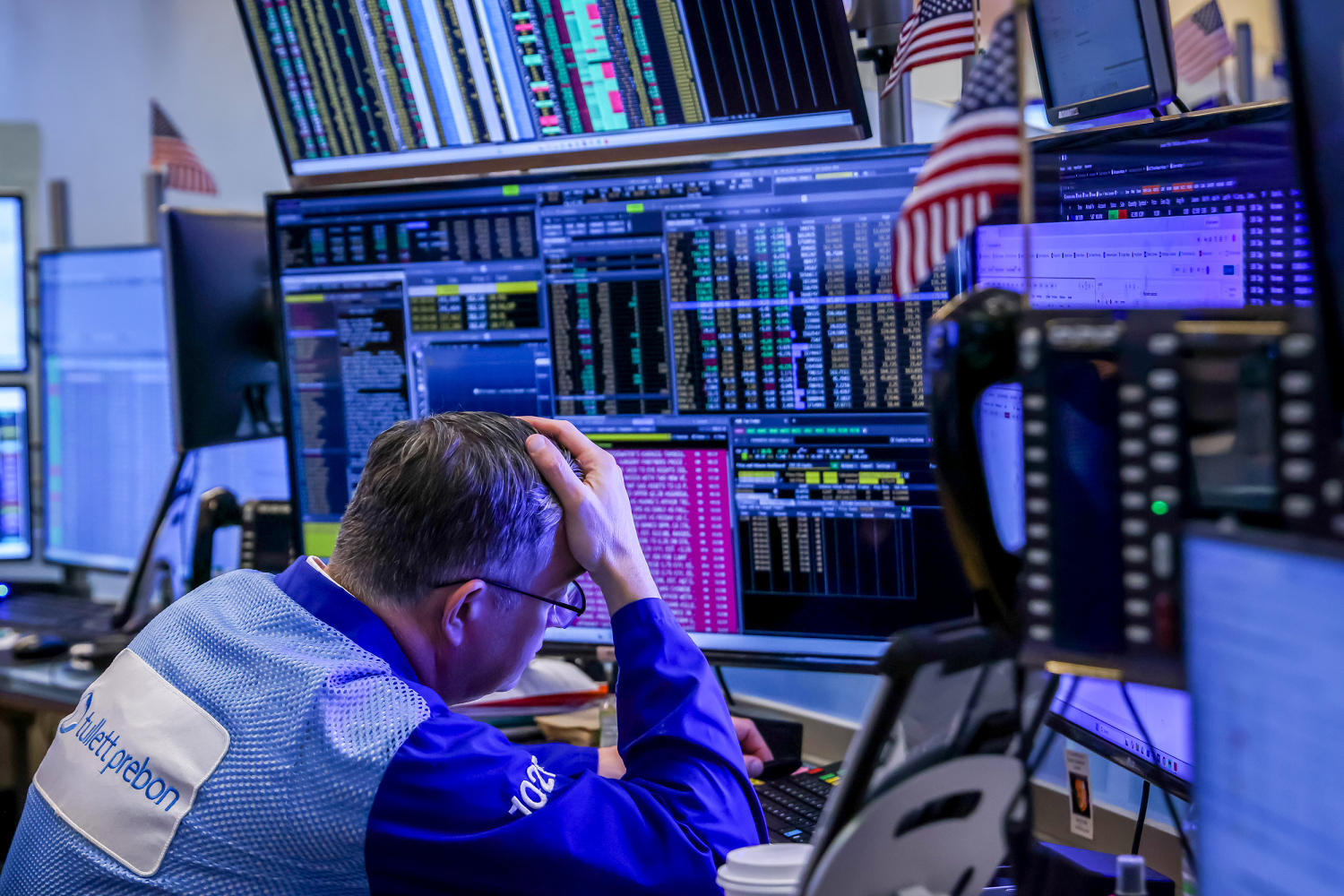
That is the first thing you notice when the opening bell rings on a morning like this, long before the financial pundits find their voices or the institutional algorithms finish chewing through the press release. It is a specific, retinal-burning shade of crimson that bleeds across the dual monitors of every trading desk from lower Manhattan to Canary Wharf, turning rows of neat ticker symbols into a sudden, synchronized arterial spray.
At 7:02 AM Eastern Time, a single filing hit the wire. Jensen Huang, the co-founder, chief executive, and unmistakable soul of Nvidia, was stepping down.
Within four minutes, three hundred billion dollars evaporated into the ether.
To understand why the departure of one man in a signature black leather jacket could trigger a tremor strong enough to drag down the S&P 500, the Nasdaq Composite, and the retirement accounts of millions of teachers, firefighters, and software engineers who have never once thought about semiconductor lithography, you have to look past the ticker tape. You have to look at what happens when an entire global economy builds its cathedral on the shoulders of a single architect—and that architect suddenly walks out the door.
The Architecture of a Single Point of Failure
I remember sitting in a cramped, windowless conference room in San Jose back in 2016, watching an early demonstration of neural network training on a cluster of Pascal-architecture graphics cards. At the time, the room smelled of burnt drip coffee and dry-erase markers. Half the analysts present thought Nvidia was still just a video game company riding a temporary wave of cryptocurrency mining. They looked at the balance sheets, nodded politely, and missed the seismic shift happening right beneath their loafers.
Huang did not miss it. He had bet the company on CUDA—a software layer that turned graphics processors into parallel-computing engines—nearly a decade earlier, enduring years of brutal stock stagnation and Wall Street skepticism to build a moat so wide nobody could swim across it.
Fast forward to the present, and that moat has become the foundation of modern computing. When Nvidia stock falls after a shock announcement like a CEO resignation, the market isn't merely repricing a chipmaker. It is panicking over the sudden removal of the load-bearing wall holding up the entire artificial intelligence boom.
Consider a hypothetical scenario to make the scale concrete. Imagine a master watchmaker in a Swiss valley who, over thirty-three years, didn't just design the gears for every major timepiece on earth, but also invented the alloys, trained the apprentices, and personally negotiated the delivery of every mainspring. Now imagine that watchmaker hangs up his loupe on a Tuesday morning. The factory still has the blueprints. The machines still hum. Yet every jeweler from Geneva to Tokyo immediately freezes their orders, suddenly terrified that the magic lived in the man's fingertips rather than the steel.
That is the exact psychological contagion gripping the trading floors right now.
When Gravity Returns to the Trading Floor
Meet Marcus, a composite character modeled on the dozens of mid-level portfolio managers I have spoken with during market routs over the past two decades. Marcus manages a four-billion-dollar growth fund out of Boston. For the last three years, his job looked effortless. Whenever quarterly earnings approached, he stayed overweight on Nvidia, collected his alpha, and slept soundly.
This morning, Marcus didn't even finish his espresso.
By 9:35 AM, Nvidia shares were down nearly eleven percent in heavy volume, dragging down peers like Broadcom, AMD, and Taiwan Semiconductor Manufacturing Company in a classic sympathetic sell-off. Because Nvidia has grown so massive—accounting for an outsized percentage of the market-capitalization-weighted indices—its sudden drop acted like an anchor tied to the ankle of the broader market. Even companies that sell groceries, insurance, and industrial tractors found their share prices ticking downward as automated index-selling kicked in.
"You don't hedge against a founder vanishing," Marcus told me over the phone, the clatter of a mechanical keyboard audible behind his voice. "We model supply chain disruptions in Taiwan. We model export controls. We model interest rate hikes from the Federal Reserve. Nobody has a line item in their spreadsheet for what happens when the guy who willed a three-trillion-dollar ecosystem into existence decides he's done."
His voice carried that distinct, metallic edge of a man realizing that all his sophisticated risk models were built on a quiet, unspoken assumption of permanence. Wall Street loves to pretend it deals in pure mathematics, in discounted cash flows and forward price-to-earnings ratios. In truth, the market is a deeply superstitious creature. It craves a face. It wants a myth.
The Invisible Weight of Founder-Led Empires
History offers a sobering playbook for moments when a visionary founder steps aside at the absolute zenith of their power, and none of the chapters are easy to read.
Think back to August 2011, when Steve Jobs resigned as chief executive of Apple. Even though the succession plan had been telegraphed for months, and even though Tim Cook had already been running day-to-day operations with surgical precision, Apple's stock still buckled in after-hours trading. Investors wrestled with a haunting question: can an operational genius sustain the alchemy of a product visionary?
Or look further back, to 2000, when Bill Gates handed the CEO reins of Microsoft to Steve Ballmer. What followed was a "lost decade" for Microsoft's stock—not because the company stopped making money, for its revenues tripled, but because the market lost faith in the company's ability to see around the next corner.
Nvidia's position today is arguably even more precarious than Apple's in 2011 or Microsoft's in 2000. Why? Because the pace of hardware iteration in artificial intelligence leaves zero margin for hesitation.
Under Huang, Nvidia compressed its product cycle from two years down to a relentless annual cadence—Hopper, Blackwell, Rubin—forcing competitors into a breathless sprint just to catch up to last year's silicon. That velocity wasn't merely an engineering triumph; it was a cultural dictatorship enforced from the top. Huang famously maintained a flat organizational structure with dozens of direct reports, eschewing traditional corporate bureaucracy in favor of raw, unfiltered speed.
When you remove the central nervous system of a flat organization, the limbs don't immediately know which way to run.
The Anatomy of the Contagion
To understand why the broader market is weighing down alongside Nvidia, you have to follow the money through the plumbing of modern finance. It isn't just emotional panic; it is mechanical reality.
First, there is index concentration. Over the past few years, the largest technology stocks have swallowed an unprecedented share of the S&P 500. When a company represents roughly six to seven percent of an entire benchmark index, a ten percent drop in that single stock automatically shaves more than half a percent off the entire market before a single other share changes hands. Passive index funds—the retirement vehicles of ordinary savers—are forced to rebalance, selling across the board to maintain their weightings.
Second, there is capital expenditure anxiety. For the last twenty-four months, hyperscalers like Microsoft, Alphabet, Meta, and Amazon have poured hundreds of billions of dollars into data center infrastructure, buying Nvidia GPUs as fast as TSMC could fabricate them. Shareholders tolerated those staggering capital outlays because they believed Nvidia's roadmap guaranteed an exponential return on compute.
Now, boardrooms in Seattle and Menlo Park are asking a terrifying question: if Nvidia's execution stumbles during a leadership transition, does the entire AI buildout hit a wall?
Consider the ripple effects on a hypothetical mid-sized cloud infrastructure startup in Austin—let's call them Aether Compute. Three months ago, Aether raised two hundred million dollars in debt, using their allocation of next-generation Nvidia chips as collateral. Today, their lenders are calling. The value of their collateral hasn't changed on paper, yet the perceived certainty of the ecosystem around that collateral has suddenly cracked. Multiply Aether Compute by five hundred startups, sovereign wealth funds, and enterprise data centers around the globe, and you begin to feel the cold draft blowing through the credit markets.
The Myth of the Indispensable Man
I have to be honest here, because pretending otherwise would be a disservice to anyone trying to make sense of their portfolio right now: nobody truly knows whether this sell-off is a historic buying opportunity or the beginning of a structural unwinding.
Anyone on financial television telling you with absolute certainty that "Nvidia's bench is deep enough to absorb this" or that "the AI bubble has officially popped" is guessing. Markets hate uncertainty far more than they hate bad news. Bad news can be priced in. A leadership vacuum at the center of the most important technological shift since the internet cannot be neatly modeled in an Excel cell.
Yet, if we step back from the blinking red screens and take a slow, steady breath, a quieter truth emerges beneath the noise.
A company is not a single human being, no matter how towering the shadow he casts.
Inside Nvidia's Santa Clara headquarters—the gleaming, triangular glass-and-steel spaceship designed to resemble a polygon—tens of thousands of engineers are still sitting at their desks. The compilers that make CUDA indispensable to four million developers worldwide did not vanish at 7:02 AM. The networking switches, the custom interconnects, the supply agreements locked in through 2028—all of it remains bolted to the floor.
More importantly, the demand driving the semiconductor supercycle is no longer dependent on one CEO's salesmanship. Sovereign nations are building domestic AI clusters out of sheer geopolitical survival. Pharmaceutical companies are folding proteins on GPU clusters to discover new cancer therapies. Autonomous vehicles, robotics, and climate modeling all hunger for parallel compute. The train has left the station; the only question is whether the new engineer in the cab can keep it running at two hundred miles per hour.
The Silence After the Bell
By 3:45 PM, the frantic volume on the New York Stock Exchange begins to ebb, settling into that heavy, exhausted hum that always follows a day of forced liquidations. The S&P 500 is nursing a bruising loss. Financial headlines are already drafting breathless obituaries for the bull market, pairing photos of stunned floor traders rubbing their temples with dramatic charts pointing straight down.
It is easy to get swept up in the theater of it all. Watching tens of billions of dollars vanish from market capitalization feels visceral, almost violent, like watching a skyscraper buckle in slow motion.
But prices are not value. Prices are merely the collective mood of millions of anxious humans voting in real time with their savings.
Somewhere in Silicon Valley tonight, the fluorescent lights in a hardware verification lab are still buzzing. A twenty-eight-year-old chip architect, wearing a faded company hoodie and nursing a lukewarm can of sparkling water, is staring at a timing diagram on a screen, trying to shave three picoseconds off a memory bus before tomorrow morning's tape-out deadline. She doesn't care about the S&P 500. She isn't watching the CNBC ticker. She is just solving the next impossible physics problem in front of her, one transistor at a time.