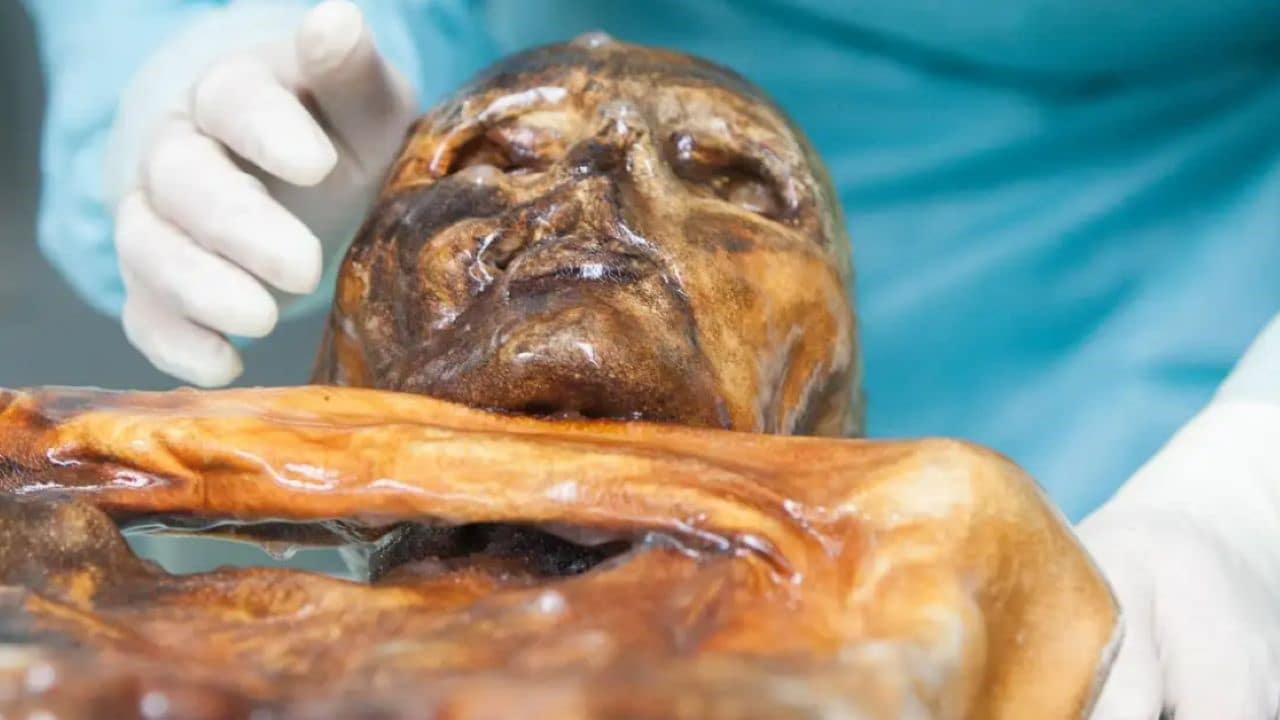
A frozen corpse pulled from an Alpine glacier does not typically double as a biological factory. For more than three decades, the scientific establishment operated under the comfortable assumption that Ötzi, the 5,300-year-old "Iceman" natural mummy, was a safely neutralized historical artifact. Kept at a rigid minus six degrees Celsius inside a highly controlled preservation chamber in Bolzano, Italy, the Copper Age hunter was supposed to be suspended in time. That assumption has just been shattered.
A groundbreaking study published in the journal Microbiome reveals that Ötzi is not a static relic, but a waking, evolving ecosystem. Researchers have discovered that cold-adapted yeasts and specialized microbial populations inhabiting the mummy are not merely intact; they are metabolically active, replicating, and actively consuming their environment.
This discovery fundamentally upends the physics of museum conservation. It also forces us to confront a deeply unsettling reality: the world’s most thoroughly studied ancient human is slowly, quietly altering from within.
The Illusion of the Inert Time Capsule
When German tourists stumbled upon Ötzi in the Eastern Italian Alps in 1991, the preservation strategy focused entirely on halting decay. The body was placed in a specialized chamber designed to mimic the sub-zero glacial environment that kept his skin, organs, and clothing intact since his violent death by an arrow wound.
To prevent fungal contamination during initial handling, conservationists treated the body with phenol, a harsh chemical disinfectant meant to sanitize the tissue.
The strategy was viewed as a triumph of modern archival science. By freezing the specimen and applying chemical barriers, biological time was supposed to stop.
The new metagenomic analysis conducted by Eurac Research shows that biological time merely downshifted. By sampling skin swabs, tissue fragments, and the brownish runoff water collected when the mummy was briefly thawed to four degrees Celsius for analysis, microbiologists mapped out three distinct, competing microbial worlds.
- The Ancient Ghost Microbiome: Gut bacteria that lived inside Ötzi during his lifetime, offering a pristine snapshot of pre-industrial human digestion.
- The Glacial Opportunists: Cold-loving, psychrophilic organisms that colonized the cadaver during its five millennia under the ice.
- The Anthropogenic Interlopers: Modern bacteria and fungi introduced by human hands and museum air over the last 35 years.
The true shock was not the presence of these genetic signatures, but their behavior. When scientists attempted to culture the microbes in a laboratory setting, four distinct species of cold-adapted yeasts—including Glaciozyma and Mrakia—did something dead cells cannot do. They grew. They multiplied into thriving, active colonies.
The Genomes That Refused to Die
To prove these yeasts weren't just modern surface contaminants, the research team analyzed the structural integrity of the microbial DNA. True ancient genetic material shows specific, unmistakable signs of chemical degradation and fragmentation accumulated over thousands of years.
The yeast samples collected from deep within the mummy showed a baffling paradox. Alongside heavily degraded ancient DNA tracks, samples taken in 2019 contained longer, pristine genetic fragments with far fewer signs of age-related damage than identical samples harvested from the mummy in 2010.
There is only one scientifically viable explanation for this pattern. The yeast is actively synthesizing new DNA. It is dividing and replicating inside the museum vault.
Even more alarming is the dramatic shift in population dynamics over the last decade. In 2010, the yeast Glaciozyma was a minor, quiet component of the mummy’s superficial ecology. By 2019, it had aggressively proliferated, completely dominating the fungal community.
This is evolution occurring in real time inside a deep-freeze archive. These psychrophilic organisms have adapted to thrive in the exact sub-zero, highly humid conditions engineered to keep the mummy stable.
To complicate matters, these resilient yeasts have developed the ability to metabolize phenol—the very chemical deployed by early conservationists to sterilize the body. What was meant to be a poison barrier has effectively been transformed into a food source for a hunger that has waited 5,000 years.
The Pre-Industrial Gut and the Modern Crisis
While the waking yeasts present an immediate structural threat to the physical mummy, the dormant bacteria preserved within Ötzi’s digestive tract offer a stark, troubling indictment of modern human health.
By analyzing the anaerobic environment of the intestinal tract, researchers successfully mapped a Copper Age microbiome untouched by modern intervention. The Iceman’s gut contained highly specialized bacterial strains tailored to digest coarse, fiber-rich, unrefined wild grains and game meat.
These specific bacterial lineages are entirely absent from the bellies of modern, industrialized populations. They have been completely eradicated by antibiotics, hyper-sanitized environments, and heavily processed diets.
The only places on Earth where matching bacterial profiles can still be found are among isolated indigenous tribes in deep South America and parts of Africa, as well as in 3,000-year-old fossilized feces preserved in the salt mines of Hallstatt, Austria.
This revelation shifts the narrative from pure archaeology to clinical medicine. The rapid disappearance of these ancient microbes from the Western digestive tract directly correlates with the modern explosion of autoimmune disorders, chronic inflammatory diseases, and metabolic dysfunction. Ötzi’s internal ecosystem serves as a living baseline, showing exactly what modern lifestyle choices have erased from human biology.
The Sourdough Proof
The absolute confirmation of viability came when the research team decided to test the metabolic limits of the recovered yeast outside the sterile confines of the lab. Utilizing the cultured yeast strains extracted from the mummy’s runoff water, the scientists attempted to initiate fermentation.
The experiment was not immediately successful. It took three months of precise environmental manipulation in a refrigerated environment to coax the prehistoric organisms into standard metabolic performance.
The result was a perfectly risen, functional sourdough loaf.
While making bread with 5,300-year-old yeast provides a spectacular proof of concept, it underscores a dangerous reality. The organisms are fully capable of breaking down organic matter, extracting nutrients, and generating gas. If they can do this to flour in a kitchen experiment, they can do it to the ancient collagen, muscle fiber, and skin tissue of the host body they currently inhabit.
Rethinking the Limits of Preservation
The discovery that Ötzi is a living interface between ancient biology and modern conservation science invalidates the current standard operating procedures for global museums. If a climate-controlled room set to minus six degrees Celsius cannot stop biological activity, then no organic artifact on Earth is genuinely safe.
The threat is not an external rot that can be washed away with disinfectants. It is an internal, decentralized breakdown driven by specialized organisms that consider extreme cold their natural habitat.
Independent specialists have already raised valid counter-arguments regarding the timeline of this colonization. Some argue that the data from 2010 to 2019 is too brief a window to definitively prove these yeasts have been actively multiplying for the entire 5,300-year deep freeze. They suggest these cold-loving fungi may be relatively recent colonists that entered the body during brief, historical thawing events in the glacier or during early recovery phases.
Even if these organisms are recent immigrants rather than ancient companions, the core problem for the South Tyrol Museum of Archaeology remains unchanged. The current preservation paradigm is failing to maintain stasis.
Halting this internal consumption will require an entirely new class of preservation technology. Conservationists may be forced to move beyond simple temperature control and experiment with dynamic gas regulation, total oxygen deprivation, or novel biochemical inhibitors designed to target psychrophilic fungi without damaging ancient human protein structures.
The Iceman has spent 35 years answering our questions about how ancient humans lived, what they wore, and how they died. Now, the microscopic residents of his body are forcing a much more urgent inquiry into how we protect the past from the relentless, adaptive survival of the present.