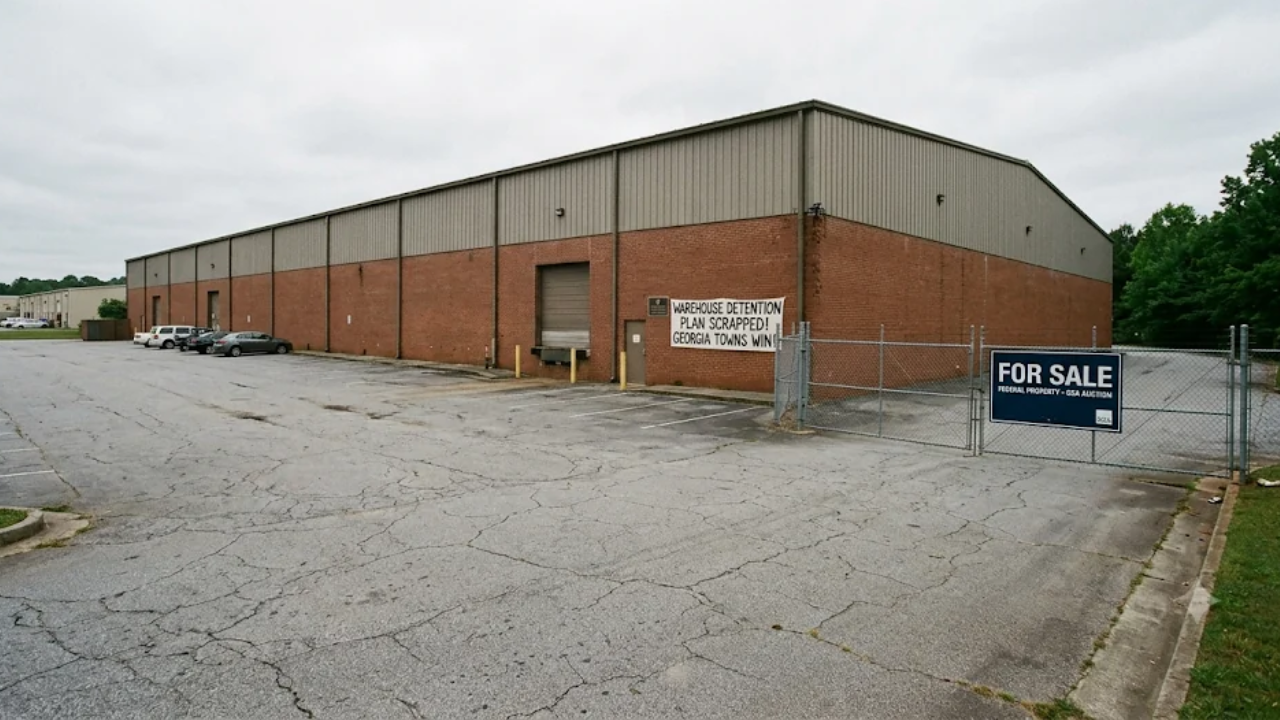
The narrative surrounding the sale of those massive Georgia warehouse properties—originally optioned for Immigration and Customs Enforcement (ICE) detention centers—is a complete fairy tale.
If you read mainstream coverage, you’re told a inspiring story of grassroots organizing. Local activists held signs, attended county commission meetings, pressured local officials, and forced giant private prison contractors to pull out and list the properties for sale.
It makes for great press releases. It’s also commercially illiterate.
Having spent two decades tracking commercial real estate assets, institutional capital flows, and municipal zoning disputes, I can tell you that public outrage almost never kills a multi-million-dollar land acquisition. What killed these detention center conversions wasn't public conscience—it was industrial yield math, capital expenditure spikes, and shifting supply chain logistics.
Local opposition didn't win. Wall Street simply calculated a better exit strategy.
The Cap Rate Illusion: Why Private Prison Operators Actually Walked Away
Mainstream reports assume that private prison developers like GEO Group or CoreCivic fold the moment local pressure gets loud. That assumption misunderstands how institutional land acquisition operates.
When a developer options 100-plus acres of light industrial zoning, they expect NIMBYism. They budget for it. They hire lobby groups, file preemptive lawsuits against local zoning boards, and run out the clock until municipal legal budgets dry up. Activism is accounted for as a baseline line item in site selection risk assessments.
What isn't accounted for is a sudden shift in net operating income (NOI) mechanics.
Converting a standard Class-A distribution warehouse into a secure detention facility requires massive capital expenditures. We are talking specialized HVAC systems, retrofitted security perimeters, reinforced floor slabs, and dedicated medical processing infrastructure. When these projects were first penciled out years ago, interest rates were near zero, and construction debt was cheap.
Fast forward to the actual development phase:
- Debt Service Costs: High interest rates doubled the cost of servicing construction loans.
- Capital Expenditure Inflation: Building materials and specialized retrofitting costs surged by 30% to 40%.
- Government Contract Yields: Federal per-bed per-day reimbursement rates failed to track pace with inflation, compressing projected cap rates from a lucrative 8.5% down to a sub-par 5.2%.
Imagine a scenario where a private equity group backs a facility buildout expecting a 12% internal rate of return. If supply chain inflation and soaring debt service drag that return down into single digits, the asset instantly loses its investment rationale.
The operators didn't throw in the towel because they were ashamed of the optics. They abandoned the sites because keeping the land tied up in zoning litigation while paying elevated debt service ruined their internal rate of return.
The Industrial Real Estate Boom Made Warehouses Too Valuable to Detain People In
There is an even bigger structural shift that local coverage completely ignores: the astronomical rise of Southeast logistics pricing.
Georgia—specifically the corridors radiating out from the Port of Savannah along I-95 and I-16, down through Metro Atlanta along I-85—has become ground zero for dry-goods distribution and regional logistics.
During the initial site options for these detention facilities, big-box industrial space in secondary Georgia markets was trading at reasonable per-square-foot valuations. Fast-forward to the current market, and industrial land values in these freight corridors have surged dramatically.
+-----------------------------------------------------------------------+
|                       THE ASSET REALLOCATION LOGIC                    |
+-----------------------------------------------------------------------+
|                                                                       |
|   OPTION A: ICE Detention Center                                      |
|   - High legal opposition                                             |
|   - Custom buildout costs ($$$$)                                      |
|   - Regulatory & political risk                                       |
|   - Capped federal return                                             |
|                                                                       |
|   OPTION B: Logistics & E-Commerce Hub                                |
|   - Low regulatory resistance                                         |
|   - Standardized Class-A shell                                        |
|   - Blue-chip tenant demand                                           |
|   - Uncapped market rent growth                                       |
|                                                                       |
|   VERDICT: Flip the property to industrial logistics markets.         |
+-----------------------------------------------------------------------+
When an asset owner looks at an industrial parcel today, they face a stark choice:
- Spend four years in county court fighting local commissioners to secure a conditional use permit for a controversial federal contractor.
- Flip the exact same parcel to a third-party logistics firm, a cold-storage operator, or a regional distribution center at record-high price-per-acre rates with zero municipal resistance.
It isn't a moral decision. It’s an arbitrage strategy.
Selling or listing these sites as standard industrial properties allows owners to monetize massive land appreciation realized over the last several years without taking on operational or political risk. Calling this a "victory for community resistance" ignores the fundamental reality that site owners are making out like bandits on the open industrial market.
The Flawed Premise of "Community Victory"
The standard narrative around these Georgia warehouse listings claims that stopping a site buildout stops federal detention expansion altogether.
This is where the public discourse is most misguided.
Federal law enforcement agencies and their contracted partners operate on macro-regional allocations, not single-site dependencies. When a site option in one county is listed for sale, capital does not vanish; it reallocates.
+-----------------------------------------------------------------------+
|                    CAPITAL DISPLACEMENT PIPELINE                      |
+-----------------------------------------------------------------------+
|  [Site A: Opposed/High Cost]  ---> Capital Withdrawn                  |
|                                         |                             |
|                                         v                             |
|  [Site B: Unincorporated Site] <--- Reallocated to Low-Resistance Zone|
|  - Existing Facilities Expanded                                       |
|  - Intergovernmental Agreements (IGSAs) Utilized                      |
+-----------------------------------------------------------------------+
Here is what actually happens when high-profile sites get listed for sale:
1. Capital Shifts to Unincorporated, Low-Resistance Jurisdictions
Instead of fighting suburban county seats where voters are organized, developers pivot to unincorporated rural areas or jurisdictions where the tax base is desperate for industrial infrastructure.
2. Existing Facility Densification
Rather than building new facilities, contractors expand bed counts at existing rural facilities through Intergovernmental Service Agreements (IGSAs) with local county sheriffs. These agreements bypass traditional public municipal review processes almost entirely.
3. Out-of-State Migration
Capital moves to neighboring states with lower municipal hurdles and more aggressive industrial tax incentives.
By celebrating the sale of a single warehouse site as a absolute win, activists overlook the fact that the underlying demand for facility beds simply gets absorbed elsewhere—often in regions with even less oversight and worse facility conditions.
Stop Asking "Who Stopped the Project?" Start Asking "Who Bought the Debt?"
If you want to understand where industrial real estate and municipal infrastructure are actually heading, stop reading political rally signs and start reading real estate deeds and municipal bond prospectuses.
The real questions we should be asking about the Georgia warehouse sales have nothing to do with town hall speeches:
- What are the debt terms on the land resale? If the properties are being sold at a discount relative to current industrial land values, why?
- What zoning concessions were granted during the sale transition? Did local county boards quietly grant light-industrial variances to the buyers to get the detention center off the table?
- Where did the initial capital commitment go? Which municipal bonds or private equity funds held the original notes, and how quickly was that capital deployed into secondary facilities?
When you look past the surface noise, the reality is clear: developers didn't lose in Georgia. They realized their capital had higher-yielding, lower-risk opportunities in a booming regional logistics market.
Until analysts and observers start following the money instead of the press releases, they will continue mistaking corporate portfolio optimization for social triumph.
The warehouse isn't empty because the community spoke out. The warehouse is empty because logistics tenants pay better rent with fewer headaches.
Learn the difference.