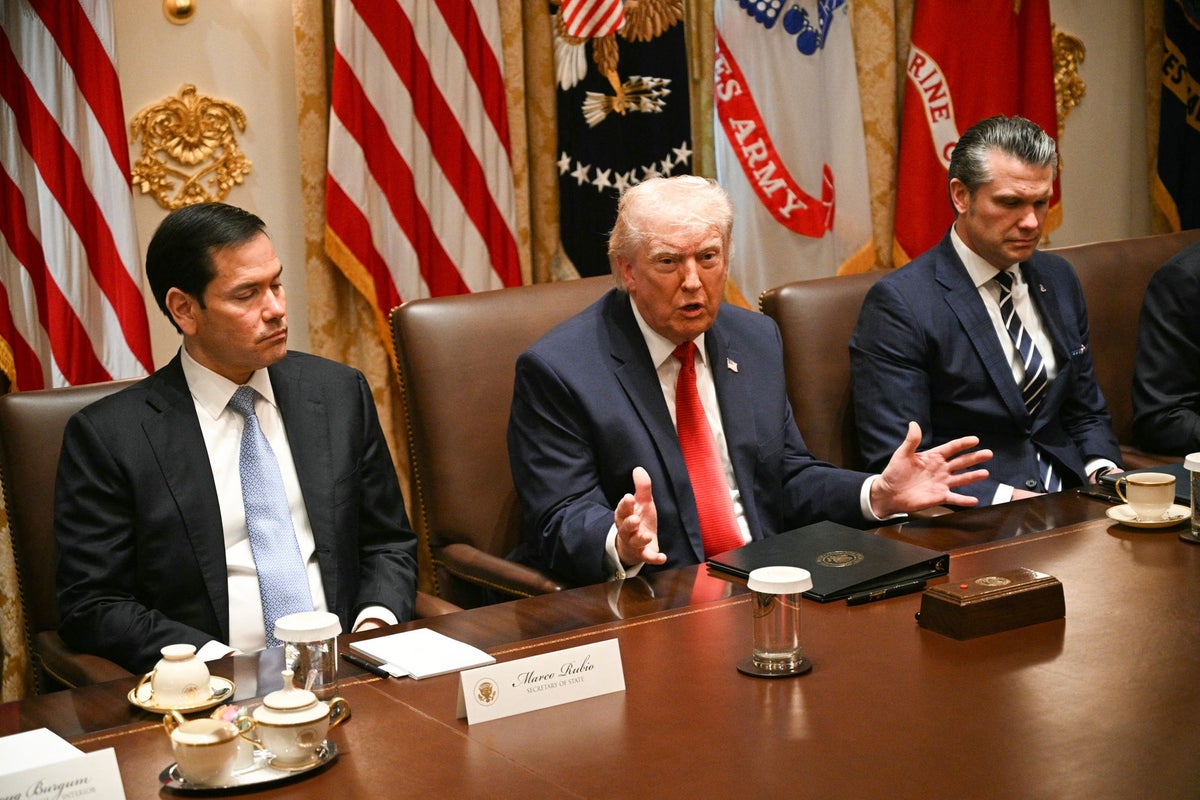
The official reason was weather. Low clouds and visibility supposedly grounded the helicopters meant to ferry the Cabinet to the Catoctin Mountains. However, the decision to scrub the high-profile retreat at Camp David and relocate it to the West Wing says more about the friction of governing than it does about the flight patterns of Marine One. While the public face of the administration cited safety and convenience, the move highlights a recurring pattern of centralized control that often trumps the symbolic value of a presidential getaway.
For decades, Camp David has served as the ultimate pressure valve for the executive branch. It is where Eisenhower hosted Khrushchev and where Jimmy Carter brokered the Middle East peace accords. It is a place designed for deep work, away from the prying eyes of the Washington press corps and the incessant ringing of secure landlines. When a President cancels a rare field trip to the woods in favor of the familiar confines of 1600 Pennsylvania Avenue, they aren't just avoiding rain. They are choosing the comfort of the bunker over the unpredictability of the wild.
The Weather Excuse and the Logistics of Power
Meteorology is the oldest cover story in the book. While it is true that the VH-92A and its predecessors in the Marine Helicopter Squadron One (HMX-1) fleet operate under strict safety minimums, the White House has access to ground motorcades that can make the trip in under two hours. The "bad weather" narrative serves as a convenient exit ramp for a logistical operation that had likely become more trouble than it was worth.
Organizing a full Cabinet retreat is a nightmare of scheduling and security. You have over twenty high-ranking officials, each with their own security details, communications teams, and essential staff. Moving that entire apparatus to a remote mountain facility requires weeks of advance work by the Secret Service and the White House Military Office. If the internal chemistry of a Cabinet is already strained, or if the legislative calendar is packed, the desire to spend a weekend in rustic cabins evaporates quickly.
The shift back to the White House suggests a preference for the "Situation Room" atmosphere over the "fireside chat" ideal. In the West Wing, the President has total home-field advantage. The staff is already there. The secure lines are hardwired. There is no need to worry about who is sitting next to whom on a bus or whether a Secretary is wandering off for an unscripted moment with a colleague.
The Myth of the Team Building Retreat
Corporate America loves the idea of the off-site. The theory is that if you get the leadership team into a room without their phones, they will magically align on a single vision. In reality, Cabinet secretaries are often the heads of massive, competing bureaucracies. The Department of Defense and the State Department do not suddenly find common ground because they shared a meal in the woods.
Security Over Substance
Camp David is a military installation, not a resort. It is run by the Navy. The rooms are comfortable but not opulent. For a Cabinet composed of individuals used to private jets and five-star suites, the rustic charm can wear thin. More importantly, the facility lacks the immediate, high-bandwidth infrastructure of the White House. While the President can run a war from the mountain, doing so requires a massive effort from the White House Communications Agency.
When the meeting moves back to the White House, the "retreat" becomes just another series of meetings. The psychological shift is profound. Attendees are no longer guests at a presidential residence; they are subordinates reporting to the office. This reinforces the hierarchy and ensures that the agenda remains strictly under the control of the Chief of Staff and the inner circle of advisors.
Transparency and the Press Gap
One of the primary advantages of Camp David is the exclusion of the media. There is no "stakeout" area. Reporters are kept at a distance, usually in a nearby town like Thurmont. This allows for a level of candor that is impossible in Washington. By moving the event back to the White House, the administration essentially invited the media back into the fold. Even if the meetings are closed, the "pomp and circumstance" of officials arriving at the North Portico creates a spectacle that the mountain air would have stifled.
The Financial Reality of the Pivot
Critics often point to the cost of these trips. A single flight of Marine One costs thousands of dollars per hour in maintenance and fuel. When you multiply that by the support aircraft and the pre-deployment of assets, a Camp David weekend carries a heavy price tag. Relocating to the White House saves millions in operational costs, even if those savings are rarely the primary driver of the decision.
However, the "savings" are often offset by the loss of the intangible benefits of a retreat. There is a reason every President since FDR has used the facility. It provides a change of perspective. Without it, the administration risks becoming an echo chamber, trapped in the same halls where they spend sixty hours a week. The decision to stay in D.C. is a decision to stay in the fray.
Bureaucratic Friction and the Path of Least Resistance
The West Wing is a small, cramped, and intensely high-pressure environment. It is designed for crisis management, not strategic planning. When a large-scale meeting is forced into this space, it often loses its intended depth. The participants are too close to their own offices. They are tempted to slip out for "urgent" calls. They are distracted by the proximity of their daily grind.
The move back to the White House is the ultimate path of least resistance. It satisfies the immediate need to hold the meeting while removing the logistical hurdles of the mountain trip. But it also signals a lack of priority for the "deep work" that retreats are supposed to facilitate. If the weather was truly the only factor, a motorcade would have been the answer. The fact that it wasn't suggests that the appetite for the retreat had already soured.
The Power of the Home Court
In the annals of presidential history, the location of a meeting is often as important as the minutes. Holding a Cabinet meeting in the Cabinet Room is an act of tradition. Holding it at Camp David is an act of intentionality. When an administration retreats from the retreat, it is a signal that the optics of the "working President" at the White House are more valuable than the optics of the "contemplative President" in the mountains.
The move also eliminates the risk of "bad optics" associated with a luxury-adjacent getaway during a time of national or international stress. Even though Camp David is a military site, the public often perceives it as a vacation spot. By staying in the White House, the President avoids the "vacationing while the world burns" headline, a trope that has haunted every executive since the dawn of the 24-hour news cycle.
A Pattern of Centralization
This isn't an isolated incident. Across multiple administrations, we have seen a trend toward keeping the Cabinet on a shorter leash. The rise of the "Czar" system—where specialized advisors within the White House oversee specific policy areas—has diminished the autonomy of Cabinet Secretaries. In this context, a retreat is almost an anachronism. Why spend time building bonds with a Secretary of Agriculture or a Secretary of Labor if the real decisions are being made by three people in the Oval Office?
The White House is the center of the solar system. Everything else is a satellite. By pulling the Cabinet back into the center, the administration reinforces the idea that the only room that matters is the one the President is currently standing in. The "bad weather" may have provided the excuse, but the gravity of the West Wing provided the motivation.
Strategic planning requires distance. It requires the ability to look at the horizon rather than the immediate obstacles. By staying in the city, the Cabinet remains focused on the obstacles. They remain focused on the news cycle, the legislative hurdles, and the immediate political threats. The mountain would have offered a view of the forest. The White House only offers a view of the trees.
The logistical shuffle is a reminder that in the world of high-stakes politics, convenience is often the enemy of clarity. The Cabinet didn't just miss a trip to the woods; they missed an opportunity to step out of the shadow of the monument and into a space where the weight of the office could be shared, if only for a weekend. Now, they are back in the bunker, where the walls are thick, the lights are always on, and the weather is whatever the communications team says it is.