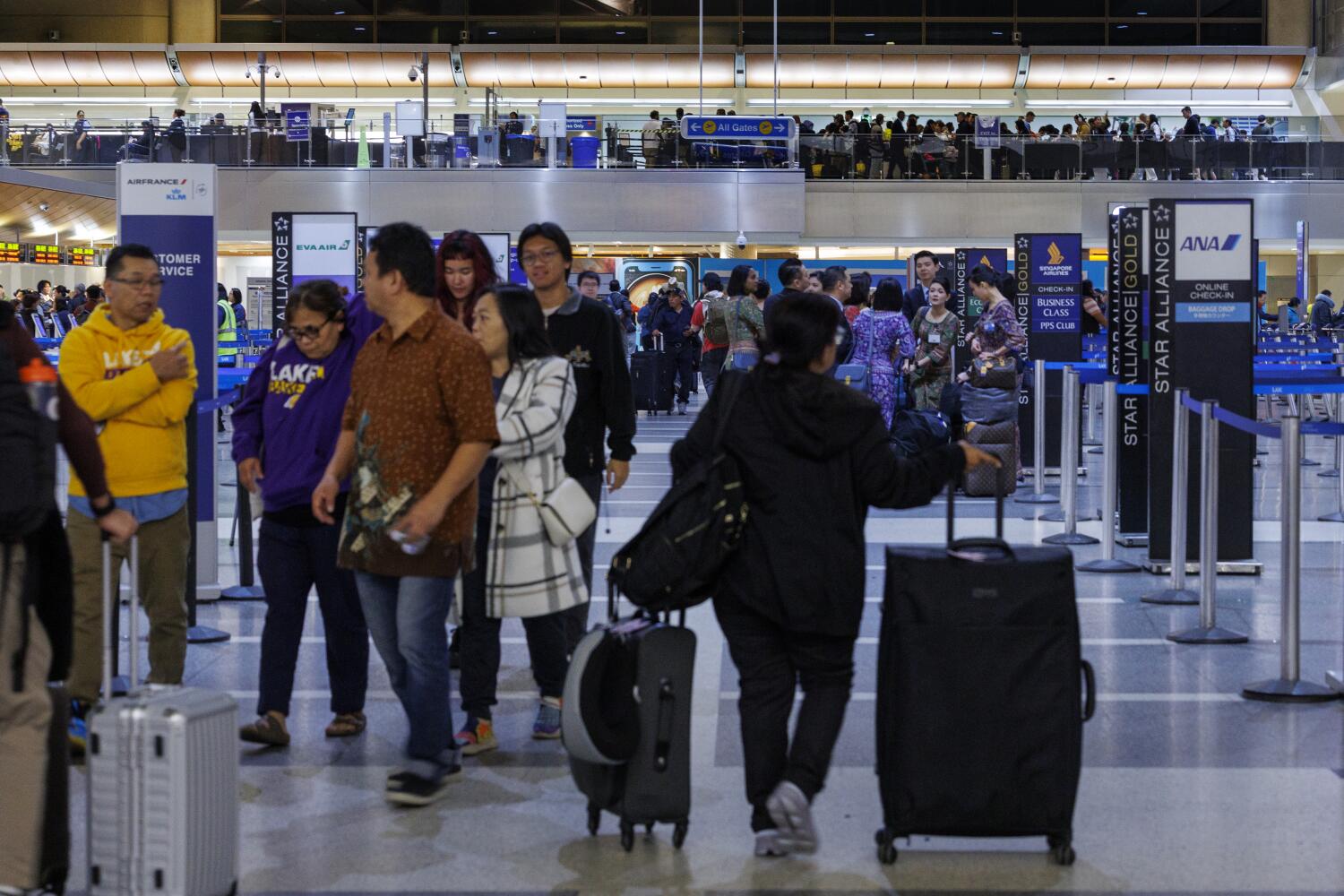
The confirmation of a fourth measles case in Los Angeles County represents more than a localized health update; it is a clinical demonstration of how high-traffic infrastructure functions as a force multiplier for pathogens with an $R_0$ value between 12 and 18. When an infectious individual traverses a global transit hub like Los Angeles International Airport (LAX) followed by high-density public dining spaces, the secondary attack rate—the probability that an infection occurs among susceptible persons within a specific group—shifts from a theoretical model to a breakdown in municipal biosecurity.
The Transmission Calculus of R0 18
Measles is not merely "contagious." It is one of the most efficient biological transmission engines known to modern medicine. To understand the risk profile of the current L.A. County cases, one must analyze the physical behavior of the Morbillivirus. Unlike pathogens that require direct contact or large respiratory droplets that settle quickly, measles is truly airborne. It remains suspended in the air for up to two hours after an infected individual has vacated a room.
The logistical challenge of the LAX exposure is defined by three specific variables:
- Aerosol Persistence: The virus survives in microscopic nuclei that bypass standard surgical masks and remain viable in stagnant air pockets within terminals or restaurant booths.
- The Prodomal Window: The four-day period before the characteristic maculopapular rash appears is when viral shedding is at its peak. During this phase, the individual often presents with non-specific symptoms—fever, cough, coryza—which are easily dismissed as common respiratory fatigue, leading to high-frequency movement through public spaces while at maximum infectivity.
- Immunity Gaps: The efficacy of the MMR vaccine is approximately 97% after two doses. In a massive urban population, the 3% non-responder rate, combined with those who are unvaccinated or immunocompromised, creates a "kindling effect" where the virus finds enough susceptible hosts to sustain a transmission chain despite high overall community numbers.
Mapping the Exposure Topology
The specific locations identified in the L.A. County Department of Public Health investigation—Tom Bradley International Terminal and several local eateries—reveal a high-risk exposure topology. Transit hubs are designed for maximum throughput, which, from an epidemiological standpoint, is a design for maximum cross-contamination.
The LAX Bottleneck
The "exposure window" at an airport is not limited to the time spent on an aircraft. The primary risk zones are high-stagnation points:
- Security Queues: Slow-moving lines create prolonged proximity between the index case and hundreds of unique individuals.
- Gate Seating: HVAC systems in older terminal sections may not provide the necessary air exchange rates to clear viral aerosols within the two-hour window of viability.
- Customs and Immigration: These areas represent a "mixing bowl" where travelers from various global regions—with varying levels of baseline immunity—converge in enclosed spaces.
Gastronomic Micro-Climates
The risk at the identified restaurants (such as those in the Brentwood or Westwood areas) is governed by different mechanics. In these settings, the "Attack Rate" is influenced by table proximity and the duration of exposure. A person sitting at an adjacent table for 45 minutes faces a significantly higher viral load than a transient passerby in an airport terminal. Furthermore, restaurant environments often lack the HEPA-grade filtration found on modern aircraft, making the indoor air quality a primary determinant of secondary cases.
The Mathematical Necessity of Post-Exposure Prophylaxis (PEP)
For individuals identified in these exposure windows, the window for intervention is narrow and governed by the biological clock of viral replication. The strategy moves from "containment" to "mitigation" through two primary PEP mechanisms:
- MMR Vaccination: If administered within 72 hours of exposure, the vaccine can induce an immune response faster than the wild virus can replicate to a level of clinical disease. This is effectively a race against the incubation period.
- Immune Globulin (IG): For high-risk individuals—infants under 12 months, pregnant women, or the severely immunocompromised—IG provides passive immunity. This must be administered within six days of exposure.
The logistical failure in most public health responses is the time-lag between exposure and public notification. If an individual visited LAX on a Friday but the case is not confirmed and publicized until the following Wednesday, the 72-hour window for vaccine-based PEP has already closed for the majority of the exposed population. This creates a mandatory shift toward "Symptom Monitoring and Voluntary Quarantine" as the only remaining control measures.
Structural Vulnerabilities in Public Health Surveillance
The recurrence of measles in a major metropolitan area like Los Angeles exposes three fundamental cracks in the contemporary biosecurity framework.
The Eradication Paradox
Because measles was declared eliminated in the United States in 2000, clinical awareness among younger healthcare providers has waned. This leads to "Diagnostic Delay." A physician who has never seen a physical case of Koplik spots (the white lesions on the inner cheek that precede the rash) may misdiagnose the prodromal phase as a standard flu or COVID-19 variant. Every day of diagnostic delay equates to hundreds of additional potential exposures in a city as dense as Los Angeles.
The Displacement of Herd Immunity
Herd immunity is not a flat percentage across a state; it is a localized metric. While California may boast high overall vaccination rates, "pockets of susceptibility" exist within specific neighborhoods or social circles. When an infectious individual enters one of these pockets, the effective $R_0$ remains high, allowing for localized outbreaks that the broader "average" immunity cannot prevent. This is the "Sub-population Risk Variance" that complicates municipal planning.
The Information Asymmetry of Modern Travel
Public health departments currently rely on the "Press Release and Passive Recall" method. They list times and locations and hope the public remembers their whereabouts. This is an inefficient data retrieval system. The integration of digital transit data (anonymized flight manifests or digital payment records) could theoretically allow for direct-to-consumer alerts, but privacy regulations and fragmented data silos currently prevent this level of precision in contact tracing.
Quantifying the Economic and Operational Burden
An outbreak of this nature imposes a significant "hidden tax" on the regional economy. The cost is not just in medical treatment but in operational friction:
- Public Health Labor: Dozens of investigators are diverted to manual contact tracing, requiring hundreds of man-hours to interview the index case and contact potential exposures.
- Healthcare Surge: Emergency departments see an influx of the "worried well"—individuals who were at the same locations but are likely immune—which slows the triage of actual medical emergencies.
- Workforce Attrition: Mandatory 21-day quarantines (the maximum incubation period) for unvaccinated exposed individuals result in lost productivity and staffing shortages in the service and travel sectors.
The Path to Resilience
To move beyond the current reactive posture, urban centers must adopt a "Built-Environment Biosecurity" framework. This involves upgrading the air handling units (AHUs) in high-traffic infrastructure to meet MERV-13 or higher standards, which are capable of capturing a significant percentage of viral aerosols.
Furthermore, the "Diagnostic Frontline" must be reinforced. Rapid molecular testing for measles—similar to the PCR infrastructure scaled during the COVID-19 pandemic—needs to be readily available in urgent care settings to reduce the time-to-confirmation.
The strategic imperative for L.A. County residents who were present at the exposure sites is a binary decision matrix:
- Verify Immunization Records: A "presumed" vaccination status is insufficient in a high-consequence exposure. Locate physical or digital records of two MMR doses.
- Monitor for the "Three Cs": Cough, Coryza (runny nose), and Conjunctivitis (red eyes). If these appear within 21 days of the exposure date, the individual must transition to immediate self-isolation and tele-health consultation to prevent further facility-level exposures.
The containment of the fifth, sixth, and seventh cases depends entirely on the speed of the current "Ring Vaccination" strategy and the accuracy of the public's self-assessment. Without these, the geographic spread will continue to follow the transit lines of the 405 and the departure boards of LAX.
The immediate move for any organization operating in these high-traffic zones is to mandate a "Health-First" sick leave policy that removes the economic penalty for staying home during the prodromal phase. Reducing the "presenteeism" of infectious individuals is the only way to lower the effective $R$ value in a city that never stops moving.
Identify your vaccination status via the California Immunization Registry (CAIR) before seeking physical entry to a healthcare facility if symptoms are present. This prevents the waiting room from becoming the next transmission node.