The light at the south pole of the Moon does not fall from above. It grazes the horizon, casting shadows that stretch for miles across the gray, pulverized crust. If you stood there, the sun would look like a brilliant coin sliding along the rim of a jagged black crater, never rising, never setting, just burning in a permanent, blinding squint.
For three billion years, those shadows have not moved. Inside them lies a cold so absolute that atoms practically stop vibrating.
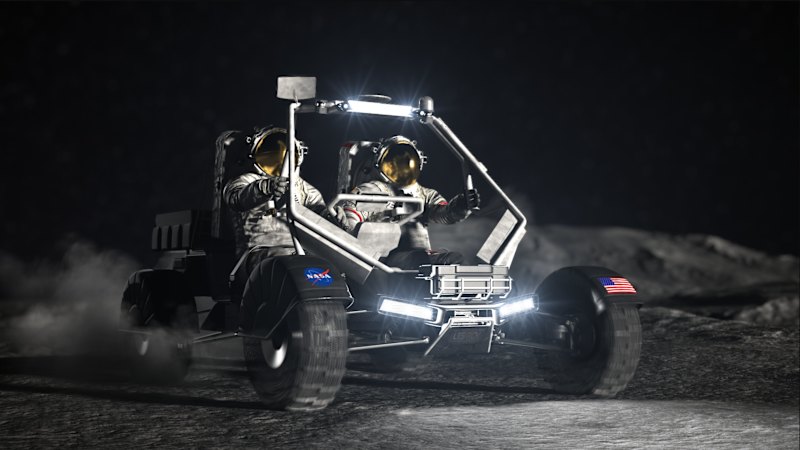
Now, look closer at the rim of Shackleton Crater. In the middle of this monochrome wasteland, a small cluster of metallic domes glints against the dark. A plume of dust kicks up as a rover rolls silently through the vacuum. Inside the lead structure, a life support system hums—a steady, rhythmic click-hiss that keeps the air breathable. This is not a temporary campsite. It is Artemis Base Camp, humanity’s first permanent foothold on another world.
Right now, this base exists only as blueprints, budget lines, and intense arguments in the windowless conference rooms of Washington, Houston, and Huntsville. But the machinery is already being forged. NASA is no longer planning a quick sprint to grab some rocks and plant a flag. We are going back to stay, and the shift from temporary exploration to permanent habitation is changing everything we know about surviving the cosmos.
The old space race was about national pride. This one is about survival, resources, and logistics. It is the story of how we learn to live off a land that wants to kill us.
The Tyranny of the Gravity Well
To understand why NASA is building a lunar base, you have to understand the brutal mathematics of leaving Earth. Rockets are mostly fuel. To lift a single pound of water, food, or steel out of Earth’s massive gravity well requires an exponential amount of propellant.
Imagine trying to go on a cross-country road trip, but there are no gas stations, no grocery stores, and no rest stops along the way. You have to pack every single drop of fuel, every meal, and every gallon of water you will need for the entire round trip into the back of your truck before you leave your driveway. Your truck becomes so heavy that it can barely move, requiring a massive, terrifying engine just to get down the street.
That is how we went to the Moon in 1969. It was a brilliant, desperate logistical nightmare.
The Artemis program turns that logic upside down through a strategy known as in-situ resource utilization. In plain terms: living off the land. By establishing a permanent base at the lunar south pole, NASA plans to stop dragging everything from Earth and start harvesting it from the Moon itself.
The prize is hidden inside those permanently shadowed craters. Satellite data has confirmed that these pockets of eternal darkness contain billions of tons of water ice. On Earth, water is life; in space, water is everything.
Break a molecule of water apart and you get hydrogen and oxygen. Liquid hydrogen is rocket fuel. Liquid oxygen is what keeps astronauts breathing and burns that fuel. If we can mine the ice at the lunar south pole, the Moon ceases to be just a scientific destination. It becomes a cosmic gas station. Rockets leaving Earth can travel light, refueling at the Moon before pushing out into the deeper waters of the solar system.
A Day in the Gray
Let us look at what life will actually look like for the first crew assigned to this lonely outpost. Consider a hypothetical mission commander named Sarah, an engineer who has spent three years training for a six-month stint at the bottom of the Moon.
Sarah wakes up to the sound of simulated birdsong, a necessary psychological trick to keep her circadian rhythms from collapsing in a place where the day-night cycle lasts 28 Earth days. Her bedroom is a small berth inside the Habitation Element, a thick-walled cylinder buried under a mound of lunar soil.
That soil, called regolith, is the first line of defense. The Moon has no atmosphere and no magnetic field. It is constantly bombarded by solar radiation and a relentless drizzle of micrometeorites traveling at twenty miles per second. Without several feet of gray dirt packed over her living quarters, Sarah would absorb a lifetime allowance of radiation in a matter of months.
Getting dressed is a half-hour chore. The spacesuit of the Artemis era is not the floppy canvas garment worn by Neil Armstrong. It is a hard-shelled, high-tech pressure vessel with bearing joints that allow her to bend over and pick up rocks without hopping around like a cartoon character.
As she steps through the airlock, the silence hits her. The Moon is a world without sound. There is no wind to rustle a flag, no distant rumble of traffic, no rustle of clothing. Every sound Sarah hears—her own breathing, the whir of the suit's cooling pumps, the crackle of the radio—comes from inside her helmet.
Her task for the morning is checking the automated solar arrays. Because the base is at the south pole, the sun hits the mountain peaks at a near-flat angle. By placing solar panels on these high ridges, the base can catch nearly continuous sunlight, powering the life support systems through the long lunar night.
But the environment is incredibly hostile to machinery. Lunar dust is not like beach sand. On Earth, wind and water roll sand grains around until they are smooth and round. On the Moon, there is no weather. The dust particles are jagged, sharp glass fragments created by billions of years of meteorite impacts. It sticks to everything via static electricity. It chews through mechanical seals, scratches visor glass, and smells like burnt gunpowder when dragged inside the habitat.
Every tool, every joint, and every vehicle must be engineered to survive this abrasive blizzard.
The Gateway in the Sky
The base on the ground is only half of the architecture. Hanging in a bizarre, halo-shaped orbit high above the Moon is the Gateway.
Think of the Gateway as a mini-space station that acts as an orbital command post, a temporary home for astronauts arriving from Earth, and a staging ground for landers heading down to the surface. It is a critical node in a complex celestial dance.
A typical mission unfolds in stages that require flawless synchronization.
- The Launch: Astronauts blast off from Florida aboard the massive Space Launch System (SLS) rocket, riding inside the Orion spacecraft.
- The Transit: Orion spends several days traveling through the void, eventually docking with the Gateway orbiters.
- The Descent: The crew transfers to a commercial landing craft—such as SpaceX’s Starship Human Landing System or Blue Origin’s Blue Moon lander—which carries them down to the base camp at the south pole.
- The Return: After weeks on the surface, the lander blasts off, rendezvous back at the Gateway, and the crew boards Orion for the hot ride home to an ocean splashing.
This setup sounds overly complicated. Why not just fly straight to the surface?
The answer comes down to sustainability. By breaking the journey into modular pieces, different aerospace companies can build specialized vehicles for different parts of the trip. A lander never has to survive the fiery re-entry into Earth's atmosphere; it just shuttles back and forth between the lunar surface and orbit, getting reused dozens of times. The Orion capsule never needs to land on the Moon; it just acts as a deep-space lifeboat.
It is an ecosystem built for endurance rather than speed.
The Geopolitical Clock
There is an underlying tension to all this engineering. Walk through the halls of NASA or talk to defense analysts, and you will quickly realize that the timeline is being driven by more than just scientific curiosity.
We are in a race.
In 2026, China is actively pursuing its own lunar exploration program, targeting the exact same south pole craters. Their timeline mirrors the American schedule with unnerving precision. They, too, want a permanent robotic research station that will eventually transition into a human outpost.
The reason for the geographical overlap is simple: the spots with continuous sunlight and accessible ice are incredibly rare. There are only a handful of prime locations on the rim of Shackleton Crater where you can set up solar panels and still be within driving distance of water ice.
This creates a brand-new geopolitical challenge. Under the Outer Space Treaty of 1967, no country can claim sovereignty over the Moon. You cannot plant a flag and declare a crater to be American or Chinese territory. But you can claim an "operational safety zone" around your base to prevent other nations from interfering with your equipment or kicking up destructive dust plumes with their rockets.
Whoever gets their boots on the ground first will effectively dictate the rules of engagement for the local area. NASA’s answer to this is the Artemis Accords, a set of bilateral agreements between the United States and dozens of other nations, establishing frameworks for peaceful cooperation, transparent science, and the shared utilization of space resources.
Yet, agreements are only as strong as the presence backing them up. The rush to the south pole is a scramble for the high ground of the 21st century.
The Long Road to Redder Sands
It is easy to get bogged down in the politics and the hardware, to view the lunar base as an expensive exercise in national branding or an elite playground for scientists. But the true stakes are much larger, and far more profound.
The Moon is a classroom.
A three-day trip from Earth is the perfect place to make mistakes. If a life support system breaks down at Artemis Base Camp, the crew can abort, hop into a lander, and be back in an Earth hospital within a week. The communication delay is a mere 1.3 seconds, allowing engineers on Earth to troubleshoot problems in near-real time.
We need this safety net because the ultimate goal is much farther away.
A mission to Mars is not a three-day sprint; it is a three-year voyage into deep space. There is no turning back halfway through. There is no quick rescue mission. The communication delay can be up to twenty minutes each way, meaning the crew must be entirely autonomous.
If we try to fly directly to Mars without testing our systems on the Moon first, we are gambling with human lives on an unprecedented scale. We need to know how human bodies handle partial gravity for months at a time. We need to know if our closed-loop water recyclers can run for years without breaking down. We need to learn how to 3D-print replacement parts out of alien dirt.
The lunar base is where we will answer those questions.
The View from the Rim
Let us return to Sarah, standing on the edge of that dark crater at the bottom of the world.
Her work day is coming to an end. Before she turns her rover back toward the glowing habitat, she stops and looks up at the sky.
If you look up from the Earth, the Moon seems clean, white, and distant. But if you look up from the Moon, Earth is a fragile, breathtaking marble of blue and swirling white swirl, hanging low on the horizon, four times larger than the Moon appears to us. You can see the entire planet at a single glance. Every person who ever lived, every war ever fought, every empire that ever rose and fell, occurred on that tiny blue dot.
From the south pole, the Earth looks like it is wobbling slightly, dipping just below the mountain peaks before rising again, a constant, silent companion in the black sky.
The base camp behind her is small, vulnerable, and incredibly expensive. It is a monument to human ingenuity, but it is also a reminder of our fragility. We are a species that spent hundreds of thousands of years wandering across our own continents, learning to survive in deserts, tundras, and deep jungles. Now, we are taking our first collective step into an environment that is genuinely, structurally indifferent to our existence.
The gray dust beneath Sarah’s boots does not care that she is there. The cold inside the crater will not thaw for her. But as the lights of the habitat twinkle against the ancient rock, it is clear that the silence of the Moon has been permanently broken. We have arrived, we have built a home, and we are not leaving.