The air inside a humanitarian supply warehouse in Bunia does not smell like medicine. It smells like dry cardboard, diesel exhaust from the idling flatbeds outside, and the red dust of the northeastern Democratic Republic of the Congo that finds its way through every gap in the sheet-metal walls.
For a man in his sixties, managing a logistics hub in the Ituri province is not a job of grand, heroic gestures. It is an endless exercise in counting. You count boxes of disposable gloves. You count plastic aprons. You count the liters of fuel needed to keep the generators running so the diagnostic labs do not go dark in the middle of the night.
But in June, the counting got harder. The boxes were leaving faster than they were coming in.
By July, the red dirt outside was dry, the wind was high, and the warehouse manager—an American citizen whose name has been kept quiet by a protective family—began to feel the first, heavy drag of a fever.
Most people think of Ebola as a disease of the frontlines, something that strikes the doctors in their yellow protective suits or the nurses who wipe sweat from a patient’s brow. But the virus does not care about your job description. The warehouse manager did not treat patients. He did not touch the sick. Yet, somewhere between the heavy crates of supplies and the daily interactions required to keep an aid operation breathing, the Bundibugyo strain found him.
And that is when the world began to shrink.
The Ghost in the Supply Room
To understand the panic that quietly rippled through the humanitarian community when this logistics worker tested positive, you have to understand the specific cruelty of Bundibugyo.
Unlike the more common Zaire strain of Ebola, for which we now have highly effective vaccines, Bundibugyo is a ghost. There is no approved vaccine for it. There is no standard, widely available cure. When it gets into your bloodstream, you are playing a game of biological roulette where the house has a terrifyingly high statistical advantage. Since the Democratic Republic of the Congo declared this outbreak—its seventeenth—in mid-May, the virus has torn through the region with a quiet, lethal momentum. Over 1,900 people have been infected. More than 700 are dead.
When a frontline doctor gets sick, you can trace the exposure. You know which room they were in. You know which patient’s line they were changing.
But when the guy managing the cardboard boxes gets sick, the ground beneath your feet begins to feel liquid. It means the virus is moving through the shadows, riding on surfaces, or jumping through brief, seemingly harmless encounters that no one thought twice about. It means the sterile bubble of the logistics office was never actually sterile.
For days, the World Health Organization kept him under close watch in Bunia. They did what they could, monitoring his vitals in a makeshift isolation ward while the political machinery of two hemispheres began to grind.
But a sixty-something body fighting a hemorrhagic virus needs more than monitoring. It needs the kind of intensive, organ-supporting therapy that can only be found in a room where the air pressure is kept lower than the hallway, where every drop of sweat is treated as high-level biohazard waste, and where the doctors look like astronauts.
The logical destination should have been home. The United States.
But home had just closed its doors.
The Do Not Board List
There is a cold utility to geopolitics that clinical science can never quite reconcile.
As the warehouse manager's fever climbed, a series of urgent, closed-door discussions took place in Washington. The outbreak in Central Africa was widening. It had already slipped into new provinces, creeping into Haut-Uele and Tshopo. To those sitting in air-conditioned offices on Constitution Avenue, the map looked like it was catching fire.
The response was swift, defensive, and entirely devoid of sentimentality.
The White House quietly issued a directive: any American citizen currently in the Democratic Republic of the Congo, or anyone who had recently departed, would be placed on a strict "do-not-board" list for commercial flights returning to the United States. If you wanted to come home, you had to spend twenty-one days—the full incubation period of the virus—in a third country first. No exceptions.
Consider the reality of that decision for the two dozen Americans who were preparing to board flights home that week. Suddenly, their passports were effectively frozen. They were stuck in limbo, supported by the State Department in hotels and holding patterns, watching the news to see if their bodies would betray them before the three weeks were up.
For the sick warehouse manager, a twenty-one-day wait in a transit lounge was a death sentence.
He could not fly commercial. And the United States government was intensely reluctant to bring an active, highly infectious Ebola patient onto American soil, even on a private medical evacuation charter.
So they called Germany.
It was not the first time they had made that call. Only a few weeks earlier, in May, another American—a physician who had been treating patients in the DRC—was evacuated to Berlin. He spent two grueling weeks inside the high-containment unit of the Charité hospital, suspended in a state of suspended animation while German doctors kept his organs functioning until his immune system could finally clear the virus. He survived. He walked out.
Germany had the beds. They had the specialized, pressurized suits. Most importantly, they had the geographic advantage: a flight from eastern Congo to Frankfurt is hours shorter than a transatlantic journey to Atlanta or Omaha. In a disease where multi-organ failure can trigger in the span of a single afternoon, those hours are the only currency that matters.
3:00 AM on the Frankfurt Tarmac
The specialized medical evacuation plane landed in Frankfurt in the dead of night.
It was 3:00 AM. The airport was mostly dark, the usual roar of commercial travel reduced to a low, metallic hum. On the tarmac, a convoy of emergency vehicles waited with their blue lights flashing, casting long, pulsing shadows across the wet concrete.
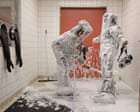
The transition was choreographed down to the second. There was no rush, because rushing leads to tears in protective suits. Men and women in heavy, yellow, positive-pressure garments moved with a slow, deliberate grace, transferring the patient from the isolation pod in the aircraft to a specially equipped ambulance.
Their communication did not happen through spoken words, which are muffled by layers of plastic and filters. Instead, they spoke through wireless headsets built into their helmets, their breath loud and rhythmic in each other's ears.
By morning, the patient was sealed inside Station 68 at the Frankfurt University Hospital.
The hospital staff quickly went on the defensive, issuing public statements to calm a nervous city. The patient represents no danger to the general population, they wrote. The risk of transmission is very low.
These statements are technically true, but they always sound like a whisper against a gale. The people of Frankfurt went about their Tuesdays, buying pretzels and boarding subways, while only a few hundred meters away, behind thick glass and double-sealed doors, a man from Indiana or Ohio or Texas lay in a bed, his body fighting a civil war.
The Supply Chain of Survival
We like to think of medical progress as a series of breakthroughs, of brilliant scientists in pristine labs discovering the magic bullet that cures the incurable.
But the truth is much grittier. Survival in an outbreak is a logistics problem.
If you do not have the fuel for the generator, the diagnostic machine cannot tell you if the fever is malaria or Ebola. If you do not have the truck to haul the clean water, the clinics cannot wash their sheets. If you do not have the warehouse manager to organize the pallets of personal protective equipment, the doctors enter the hot zone naked.
In the Democratic Republic of the Congo, a new clinical trial has just begun. For the first time, patients are being enrolled in a study to test the efficacy of experimental therapeutics like remdesivir and an antibody cocktail called MBP134 against the Bundibugyo strain. It is a historic effort, put together in a record-breaking six weeks.
But those drugs do not materialize out of thin air. They travel in temperature-controlled boxes. They require customs clearance, dry ice, and a tracking number. They require someone to stand in the heat of Bunia, checking a clipboard to make sure the shipment hasn't spoiled.
The man now lying in Frankfurt spent his life making sure those boxes arrived.
As he begins his treatment under the watchful eyes of doctors who speak to him through thick glass and intercoms, the cargo flights continue to land in Ituri. The red dust continues to settle on the metal roofs of the warehouses.
The machinery of global health is vast, expensive, and deeply flawed. It can shut a border in an afternoon, and it can fly a single sick man across continents in the middle of the night. But at its core, it still relies on the quiet courage of people who are willing to go to the places where the air smells of diesel and cardboard, just to make sure there are enough gloves to go around.