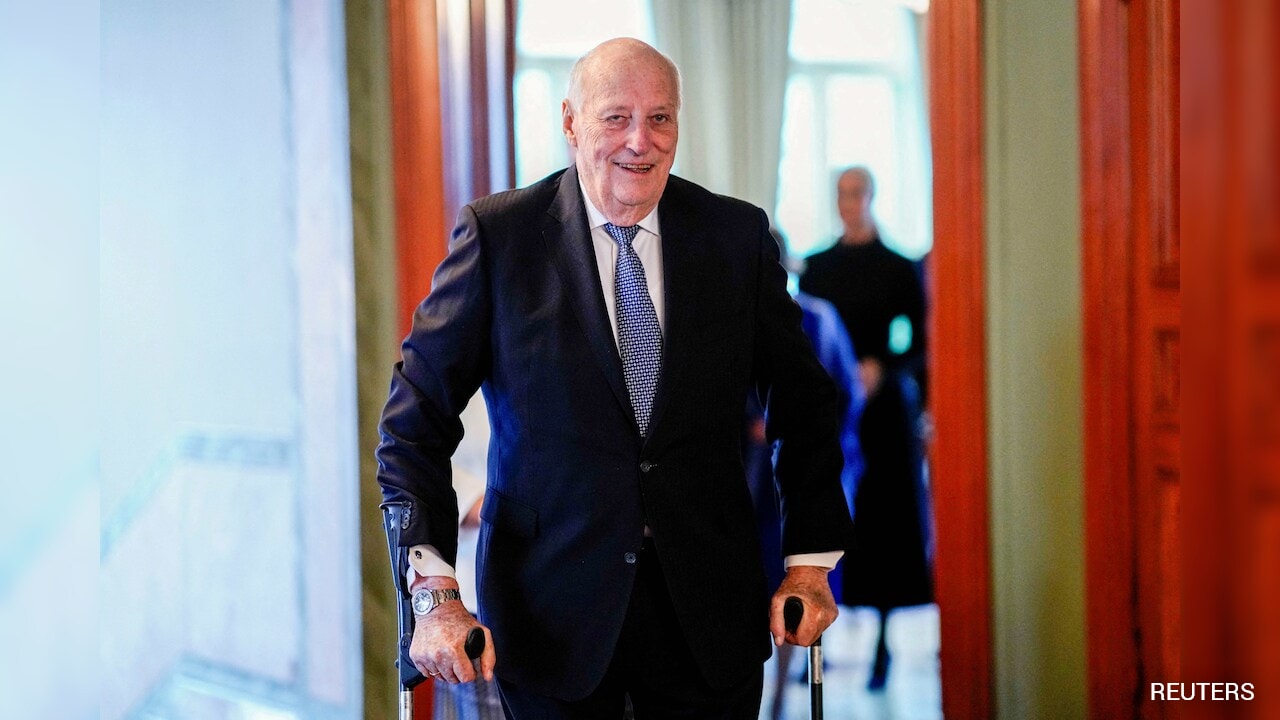
King Harald V has spent more than thirty years walking slowly. Not from weakness, but from the deliberate weight of a man who knows that every step he takes on the marble floors of the Royal Palace in Oslo is watched, weighed, and measured by a nation that treats its monarchy less like a ruling house and more like a quiet, enduring family member.
When you stand outside the palace on a damp Scandinavian morning, the air smells of wet pine and distant salt. You realize something strange about the Norwegians. They do not revere their royals with the breathless, terrified awe of old empires. Instead, they treat them with the polite, slightly protective affection one might reserve for an aging uncle who still insists on driving a vintage station wagon.
Yet, beneath that calm, egalitarian surface, an invisible clock is ticking.
Monarchies are fragile machinery. They run entirely on bloodlines and timing. And when the crown passes, the machinery does not merely shift gears; it groans under the sudden, massive weight of public grief and institutional reinvention.
Let us be entirely honest about what happens next. King Harald’s eventual passing will not just trigger a constitutional protocol written in dry, legalistic Norwegian administrative code. It will rip open a moment of profound emotional vertigo for a country that has known no other modern sovereign of his particular warmth. For decades, Harald has been the steady hand on the tiller—sailing his boats, marrying for love against the fierce resistance of convention, and weeping openly at national memorials. He made the crown human.
And that is precisely where the anxiety begins for his successor.
To understand the succession is to look past the genealogical charts and into the messy, breathing reality of crown prince Haakon and crown princess Mette-Marit.
Imagine standing in the grand hall of the palace on the day the transition officially begins. The flags at half-mast snap sharply in the Oslo wind. The television cameras zoom in with microscopic precision. Every micro-expression on Haakon’s face will be analyzed by millions. Did he blink too slowly? Does his voice tremble when he takes the oath before the Storting?
Constitutionally, the mechanics are starkly simple. Article 6 of the Norwegian Constitution dictates that the crown passes directly to the eldest eligible child. No elections. No debates. No campaigns. Crown Prince Haakon will wake up one morning as the heir and go to sleep as King Haakon VIII.
Or will he?
There is a subtle, persistent whisper in the legal corridors of Oslo that rarely makes international headlines. Could Haakon step aside? Could the crown leapfrog a generation? It is a fascinating hypothetical scenario, one born of modern anxieties about mental health, public scrutiny, and the heavy cross of hereditary public life. Mette-Marit’s ongoing struggle with chronic pulmonary fibrosis adds a layer of quiet, human vulnerability that no medieval constitutional framer could have anticipated. When a queen consort struggles for breath, the crown feels heavier on everyone.
Yet, history and law tell us this: abdication is not the Norwegian way. Haakon has been trained for this exact second since the day he was old enough to understand what a sovereign represents. His entire life has been an apprenticeship in listening.
To watch Haakon interact with ordinary citizens at a remote fjord community is to witness a masterclass in modern royal diplomacy. He does not posture. He leans in. He listens with his whole body, hands clasped behind his back, nodding with the slow, deliberate rhythm of a man who understands that his job is not to rule, but to reflect.
When the transition comes, the immediate ripple effects will touch every corner of Scandinavian society. The coins in our pockets will change profiles. The national anthem will carry a slightly different emotional resonance when sung for a new sovereign. The royal court will undergo a subtle generational shift. Princess Ingrid Alexandra, young, poised, and acutely aware of the century she is inheriting, will suddenly find herself just one heartbeat away from the throne.
We forget that crowns are not just pieces of gold locked in a vault. They are emotional lightning rods. In a world tearing itself apart with polarized politics and algorithmic rage, an ancient hereditary institution offers something intoxicatingly simple: continuity. It tells a fractured populace that some things remain true across generations.
Harald understood this better than anyone. He stayed on the throne through heart surgeries, cancer scares, and personal family tragedies not because he clung to power, but because he knew that his presence was the invisible glue holding a certain national self-image together.
When that glue finally softens, the nation will grieve. But then, the sun will rise over the Oslofjord. Haakon will put on the heavy wool coat. He will walk down the long, silent corridor. And the quiet machinery of the North will turn once more, carrying an old kingdom into a very modern tomorrow.
.png?width=2560&name=Google Logo Evolution LM (3).png)

