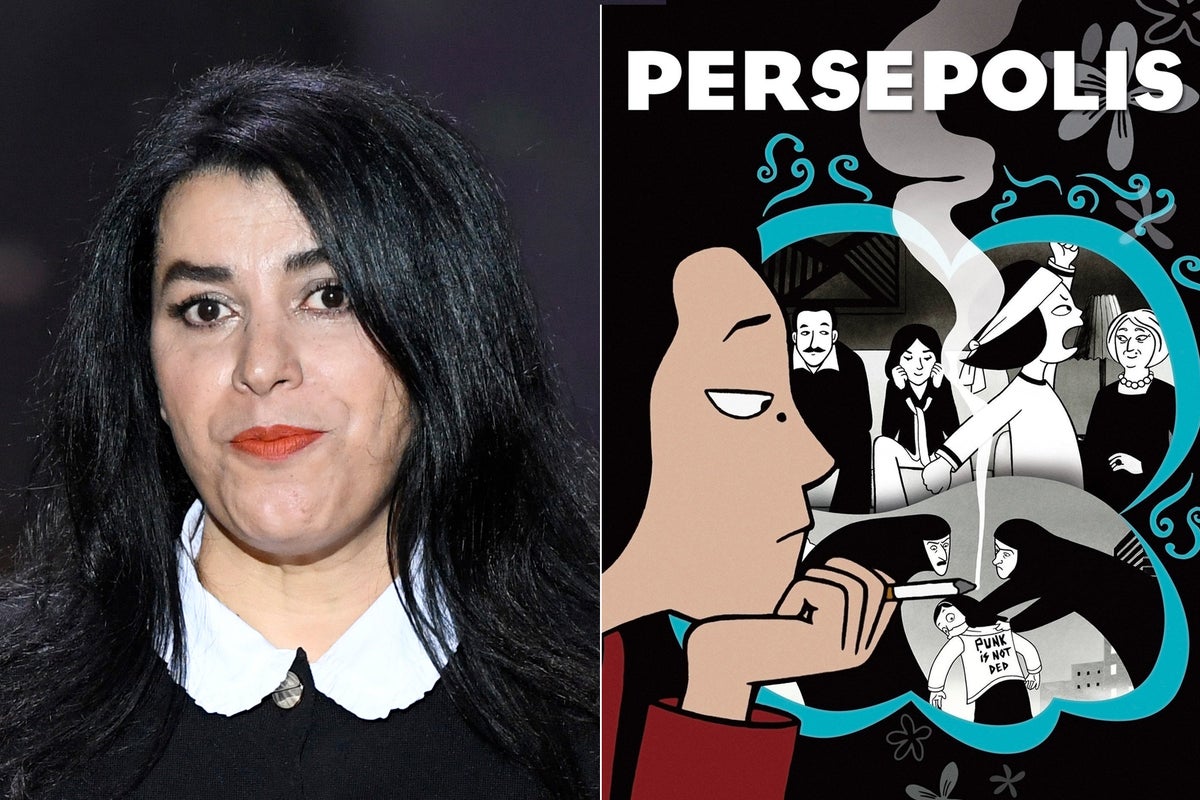
The world doesn't just need more artists. It needs more troublemakers who know how to draw. Marjane Satrapi is exactly that. When people think about Iran, they often see a blur of headlines, protests, and geopolitical tension. Satrapi changed that with a pen and a bottle of ink. She took the massive, terrifying weight of the Islamic Revolution and turned it into something human, funny, and deeply painful. If Iran loses her voice, it loses one of the few bridges left between a misunderstood culture and the rest of the planet.
You've probably seen Persepolis. Even if you haven't read the graphic novel, you know the style. Those stark black-and-white panels aren't just an aesthetic choice. They’re a manifesto. By stripping away color, Satrapi forced us to look at the people behind the politics. She made a young girl’s rebellion against a headscarf feel as universal as a teenager in London or New York arguing with their parents about punk rock. That’s her magic. She didn't make a "foreign" story. She made a human one. For another perspective, read: this related article.
The power of the monochromatic lens
Most Westerners grew up seeing Iran through a grainy news filter. It was all angry chants and burning flags. Satrapi flipped the script. She showed us the living rooms. She showed us the secret parties, the contraband Kim Wilde tapes, and the smell of jasmine on her grandmother's breast. This isn't just "content." It's cultural preservation.
Her work serves as a living archive of a generation that was almost erased. When we talk about the tragedy of losing an artist like Satrapi, we aren't just talking about a person. We're talking about the loss of a specific kind of memory. She remembers the Iran that existed before the walls went up, and she chronicles the struggle of those trying to breathe behind them now. Further reporting on the subject has been published by Rolling Stone.
Why the Oscar nomination changed everything
When Persepolis grabbed that Academy Award nomination in 2008, it wasn't just a win for animation. It was a massive middle finger to the idea that Iranian stories are niche. It proved that a story about a girl in Tehran could resonate in Hollywood and beyond. Satrapi didn't play it safe. She didn't make a weepie melodrama designed to win sympathy. She made a funny, biting, and often self-critical movie.
That honesty is rare. Most people trying to represent an oppressed culture feel the need to make everyone look like a saint. Satrapi doesn't do that. Her characters are flawed. They’re selfish. They’re scared. That makes them real. Losing that kind of unfiltered honesty would be a massive blow to the global understanding of the Middle East.
Writing the history of the marginalized
Satrapi’s departure from the scene would leave a void that "official" histories can't fill. Textbooks focus on dates and leaders. Satrapi focuses on the girl who bought Nikes on the black market.
There's a specific kind of bravery in her work. She lives in exile in Paris, but her heart clearly beats in Tehran. This dual existence gives her a perspective that’s vital for 2026. We live in a world that loves to put people in boxes. You're either "Western" or "Eastern." Satrapi laughs at that. She’s both. She’s neither. She’s just Marjane.
Her influence stretches far beyond the drawing board. Think about the "Woman, Life, Freedom" movement. The spirit of those protests is all over Satrapi’s work from twenty years ago. She predicted the breaking point. She drew the blueprints for how to resist with dignity and humor.
The shift from ink to film
She didn't stop at comics. Films like Chicken with Plums and The Voices showed she could handle live action with the same weird, wonderful energy. But even when she's directing Ryan Reynolds in a dark comedy about a talking cat, that Iranian sensibility remains. It’s a mix of fatalism and fierce joy.
Critics sometimes miss the point of her later work. They want her to keep making Persepolis over and over. But an artist’s job is to evolve. Her move into different genres shows that an Iranian woman isn't limited to talking about her trauma. She can tell any story she wants. That’s true liberation.
A void no one else can fill
Let’s be real for a second. There aren't many Satrapis out there. The Iranian diaspora is full of talent, but few have her combination of global reach and raw, punk-rock energy.
If she stops creating, we lose a primary source of truth. We lose the person who reminds us that the people living under the most restrictive regimes are often the most vibrant, creative, and hilarious people on earth. Her work is a constant reminder that governments are not their people.
What her legacy demands of us
The tragedy isn't just about the end of a career. It's about the silence that follows. When a voice as loud as hers goes quiet, the propaganda on both sides gets a little bit louder.
You should go back and read Persepolis tonight. Don't do it because it’s a "classic." Do it because it’s still relevant. Look at the way she draws her father’s face when he’s worried. Look at the way she handles the death of her Uncle Anoosh. These aren't just drawings. They’re ghosts.
To honor what she’s built, stop consuming "the news" as your only source of truth about the world. Seek out the graphic novels, the indie films, and the personal memoirs. Support the artists who are currently in Iran risking everything to post a sketch on Instagram. Satrapi paved the road. Now, it’s on us to keep driving down it.
The next time you see a headline about Tehran, think about the girl in the denim jacket. Think about the grandmother with the jasmine. That’s Satrapi’s gift to us. She gave a face to the faceless. Losing that perspective would be more than a tragedy; it would be a triumph for the people who want us to stay divided. Don't let that happen. Keep her stories alive by sharing them with someone who still thinks the world is black and white. Use her work to start a conversation that has nothing to do with nuclear deals and everything to do with what it means to be free.