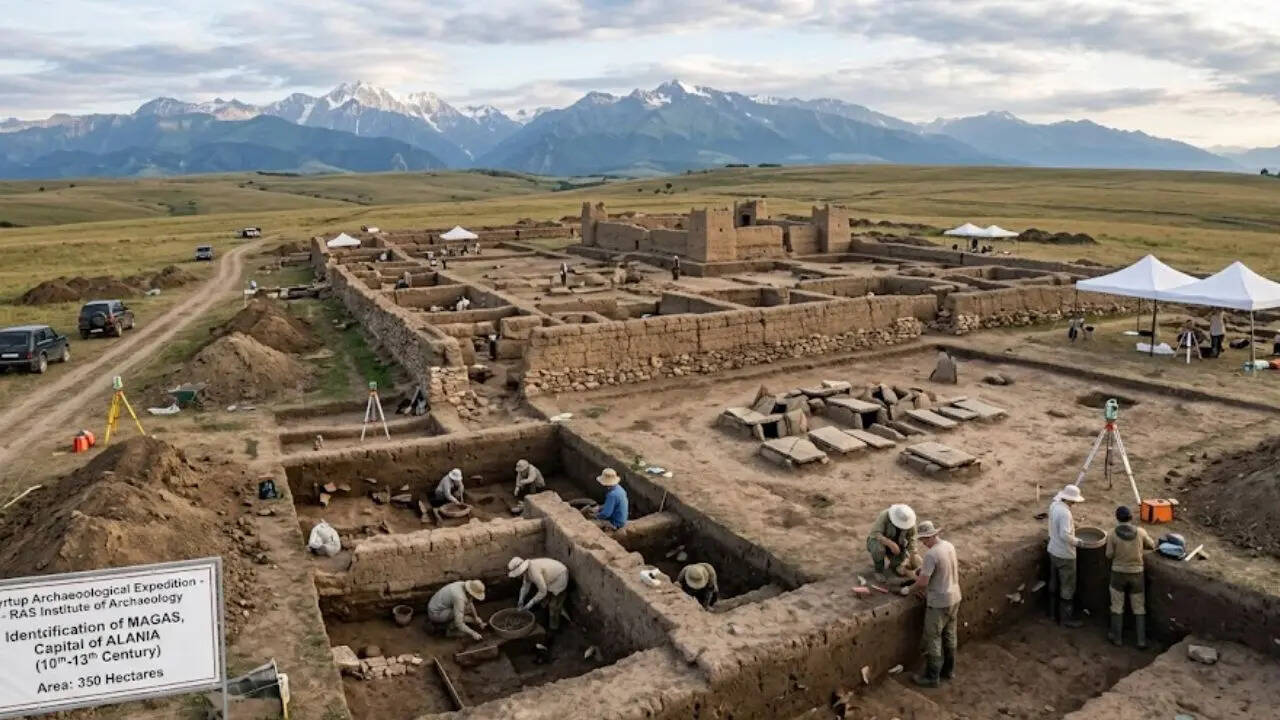
Archaeology has a fetish for "lost cities." We love the Indiana Jones narrative—the brush-clearing moment where a sprawling metropolis emerges from the dirt, rewriting history books in a single afternoon. The recent headlines about a 350-hectare "missing city" of Magas beneath Chechen soil are the latest victim of this romantic delusion.
Everyone is repeating the same script: archaeologists found a massive urban center, it’s definitely the Alania capital, and it changes everything we know about the North Caucasus.
They are wrong. Not because the dirt is empty, but because they are fundamentally misinterpreting what a "city" was in the medieval Caucasus and how LIDAR data actually works. We aren't looking at a missing city. We are looking at a fundamental misunderstanding of nomadic sedentary transitions and the desperate need for a nationalistic "founding myth" anchored in stone.
The LIDAR Illusion
The hype train is fueled by Light Detection and Ranging (LIDAR). It’s a brilliant tool. It strips away vegetation and reveals the bones of the earth. But LIDAR is not a time machine, and it’s certainly not a census taker.
When the media reports a "350-hectare city," they imply a dense, urban population equivalent to a medieval Paris or Constantinople. I’ve spent years looking at these surveys. In the North Caucasus, a "settlement" of that size rarely means a packed grid of houses.
It usually means a series of interconnected defensive enclosures, livestock pens, and seasonal camps spread across a massive footprint. Calling this a "city" in the Greco-Roman sense is a category error. It’s like looking at a modern 500-acre ranch in Texas and claiming it’s a skyscraper.
The "missing city" isn't missing because it was hidden; it’s "missing" because it likely never existed as the centralized urban hub the headlines claim. The Alans were a semi-nomadic confederation. Their power wasn't in bricks; it was in horses and trade routes. Attempting to pin them down to a 350-hectare "metropolis" ignores the very fluidity that made them a regional powerhouse.
The Magas Obsession
Every few years, a different site in the North Caucasus is declared the "Real Magas." Ingushetia claims it. North Ossetia claims it. Now, the discovery near Sernovodskoye has Chechen researchers making the play.
This isn't just science; it’s high-stakes geopolitical branding. To own the site of Magas—the city famously besieged by the Mongols in 1239—is to own the historical legitimacy of the region.
The problem? The historical record of Magas is frustratingly vague. Persian and Chinese chronicles describe a fortress, a center of resistance, and a place of slaughter. They don't describe a 350-hectare urban sprawl. By inflating the scale of the find to "metropolitan" proportions, archaeologists are trying to force the physical evidence to match the legendary status of the name.
If we look at the actual data—the density of ceramic scatters and the thickness of cultural layers—what we often find are intermittent occupations. A site can be 350 hectares in extent but only have 10 hectares of actual habitation at any given time. The rest is infrastructure: ditches, walls for herding, and buffer zones.
The Fortress Trap
The competitor articles focus on the "fortified" nature of the find. Huge ditches. Massive ramparts. They see these as proof of a capital city.
I see them as proof of a failed state.
Building massive fortifications across 350 hectares isn't a sign of a thriving, confident civilization. It’s a sign of a population in a state of constant, panicked siege. In the 13th century, the Mongols weren't just an army; they were a weather pattern of destruction. If the Alans were digging trenches this large, they weren't building a "city" for commerce—they were building a massive, desperate corral for their people and their only real assets: cattle.
We need to stop using the word "city" as a synonym for "importance." A massive enclosure doesn't mean a high level of social complexity. Sometimes, it just means you have a lot of dirt and a lot of people who are terrified of being trampled by the Golden Horde.
The Data the Media Ignored
If you want to understand the Sernovodskoye site, stop looking at the 3D maps and start looking at the soil chemistry.
True urban centers leave a specific chemical footprint: high phosphorus levels from concentrated human waste, organic decay, and industrial activity (like smithing). When you analyze these "massive" Caucasian sites, the phosphorus spikes are often localized in tiny pockets.
The "350-hectare city" likely consists of:
- A central citadel: Where the elite actually lived.
- Extensive "Kosh" areas: Seasonal enclosures for livestock.
- Agricultural terraces: Often mistaken for street layouts in low-resolution scans.
By conflating these into a single "city," we are lying to ourselves about the demographic reality of the medieval Alans. We are projecting our modern, Western definition of "urban" onto a culture that valued mobility above all else.
The Failure of "Traditional" Archaeology
The "lazy consensus" in archaeology is to dig a trench, find a pot, and extrapolate a civilization. This "Missing City" narrative is the result of that linear thinking.
We should be asking why this site was abandoned so thoroughly that it "disappeared." If it were a 350-hectare powerhouse, the economic gravity of the location wouldn't just vanish. People stay where the infrastructure is.
It disappeared because it wasn't a city. It was a temporary consolidation point. Once the Mongol threat broke the Alanic social structure, the site had no reason to exist. It wasn't a hub of trade that could survive a regime change; it was a military necessity that became a liability.
Stop Asking "Where is Magas?"
People keep asking, "Is this the real Magas?"
It’s the wrong question. The right question is: "Why are we so desperate for the Alans to have a city?"
The obsession with finding a capital city stems from a 19th-century view of history where "civilized" people live in stone houses and "barbarians" live in tents. By "uncovering" Magas, researchers feel they are elevating the Alans to the status of the Romans or the Persians.
[Image comparing nomadic encampment layouts with traditional urban grids]
This is an insult to the Alans. Their sophistication wasn't in urban planning; it was in their ability to dominate a mountain corridor and manage a transcontinental trade network without the overhead of a bloated, vulnerable metropolis.
The Actionable Truth
If you are following this discovery, ignore the "missing city" labels. Look for the following instead:
- Carbon Dating of the Ramparts: If the walls were built in a single generation, it’s a defensive project, not an evolving city.
- Genetic Analysis of the Burials: If the population is diverse, you have a trade hub. If it’s localized, you have a garrison.
- Micro-botanical remains: What were they eating? A city of 350 hectares needs a massive, stable grain supply. If the evidence shows a meat-heavy, nomadic diet, the "city" is a ghost.
Stop falling for the "Hidden for Centuries" clickbait. The earth doesn't hide cities; it absorbs them. What we found in Chechnya is a fascinating, massive archaeological complex that tells a story of defense and survival. Calling it a "missing city" is a cheapening of the actual history for the sake of a headline.
Burn the maps that call this a metropolis. Start drawing the maps of a fortified refugee camp on a scale we’ve never seen before. That is a much more interesting—and much more terrifying—story.
-02.png?format=1500w)