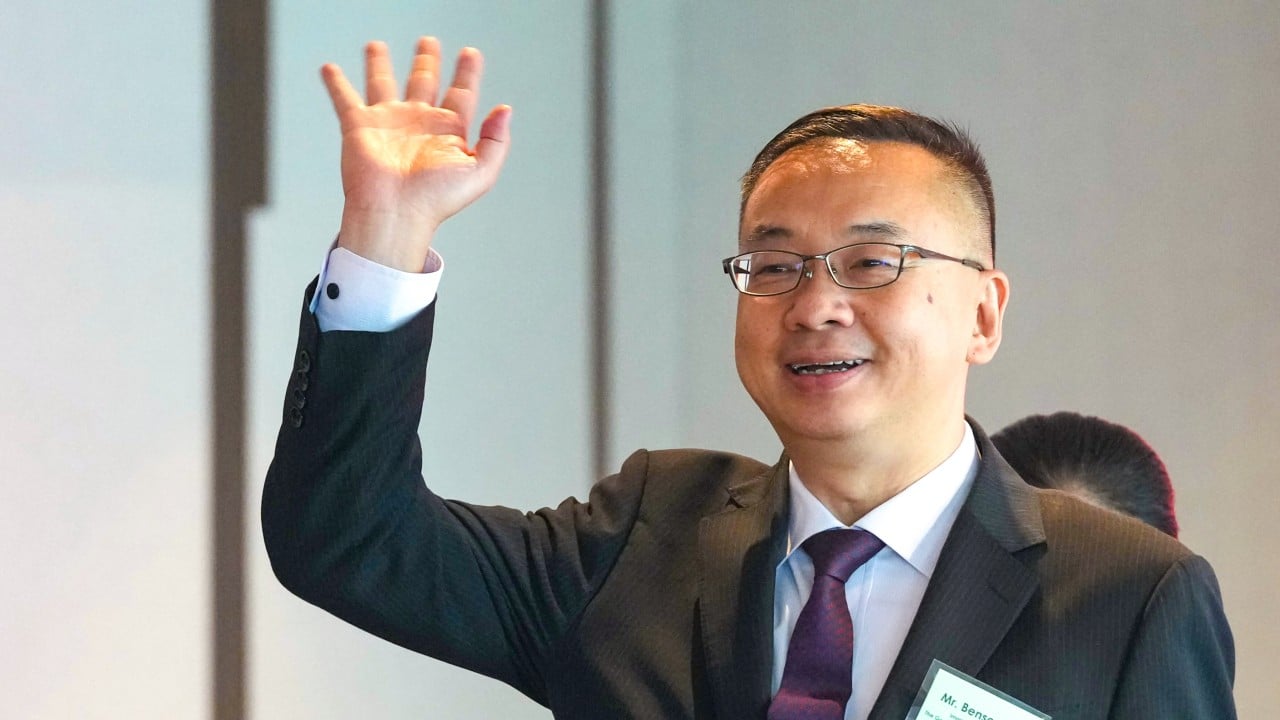
The desk is cluttered with files that represent more than just paperwork. Each folder is a life, a boundary, a decision that ripples through the transit hubs of a city that never sleeps. Benson Kwok Joon-fung sits behind that desk, the Director of Immigration for Hong Kong, a man whose career was supposed to reach its natural finish line this year. In a city governed by strict civil service timelines and the predictable ticking of a retirement clock, the rules usually dictate a quiet exit, a gold watch, and a successor waiting in the wings.
But the clock has stopped.
The Hong Kong government recently took the rare step of granting Kwok a service extension. He will remain in his post well past the standard retirement age of sixty. While a press release might frame this as a simple administrative adjustment, the reality is far more weighted. It is an admission that in a period of unprecedented transition, some hands are too steady to let go of the wheel.
The Weight of a Border
Immigration in Hong Kong is not merely about checking passports at a kiosk. It is the heartbeat of a regional hub. To understand the stakes, one must look at the sheer volume of movement. Imagine a Monday morning at the Lo Wu Control Point. Thousands of people surge forward—students crossing for school, businessmen clutching laptops, families hauling suitcases. This is a delicate machinery. If it stutters, the economy chokes.
Kwok took the mantle in September 2023, stepping into a role that requires a strange alchemy of law enforcement grit and diplomatic finesse. He isn't just managing staff; he is managing the gateway of the Greater Bay Area. When the government looks at the current roster of senior officials, they see a gap. Stability is currently the most valuable currency in the city. To replace a director now would be to introduce a variable when the goal is a constant.
The extension of a department head’s service is a move reserved for "exceptional circumstances." It suggests that the internal pipeline for succession might be experiencing a momentary squeeze, or perhaps more likely, that the specific challenges currently facing the department require a continuity that a new appointee simply could not provide.
The Invisible Strain of Talent Wars
Hong Kong is currently locked in a fierce, silent competition with Singapore, Dubai, and London to attract the brightest minds in tech, finance, and medicine. The Immigration Department is the frontline of this battle. Under Kwok’s brief tenure, the city has rolled out various talent schemes, such as the Top Talent Pass Scheme (TTPS), designed to lure graduates from the world’s elite universities.
Processing these applications is a gargantuan task. It requires a department that can move at the speed of business while maintaining the rigor of national security. A hypothetical applicant—let’s call her Sarah, a data scientist from Toronto—doesn't see the bureaucrats in the towers of Wan Chai. She only sees a portal. If that portal is slow, she goes to Singapore. If the rules are unclear, she stays in Canada.
Kwok’s extension ensures that the architects of these talent traps remain in place to fine-tune the mechanisms. Changing the leadership mid-stream risks a bureaucratic slowdown that the city cannot afford. The stakes are human. They are about whether a hospital gets a world-class surgeon this year or next. They are about whether a startup chooses a coworking space in Kowloon or a tech park in Palo Alto.
The Changing Guard
There is a psychological cost to staying on. For Kwok, it is a postponement of the quiet life. For the officers beneath him, it is a ceiling that remains closed for just a bit longer. In any high-stakes organization, the "youth quake"—the rise of the next generation—is necessary for innovation. Yet, the government has signaled that for now, experience outweighs the need for fresh blood.
The civil service is often described as a well-oiled machine, but machines don't have intuition. Kwok has spent decades rising through the ranks. He knows the scent of a forged document and the nuance of a diplomatic shift. He was there during the lean years of the pandemic when the borders were ghost towns, and he is here now as the floodgates have reopened.
Consider the logistical nightmare of the last twenty-four months. The department had to pivot from total closure to a rapid, high-pressure reopening. This wasn't a return to the old ways; it was the birth of a new system, one integrated more deeply with mainland China's digital infrastructure. Kwok didn't just witness this change; he presided over it. To remove him now would be like changing the lead engineer of a bridge while the concrete is still setting.
The Pulse of Wan Chai
Walk through the Immigration Tower in Wan Chai and you will feel a frantic energy. It is one of the few government buildings where the public's anxiety is palpable. People are there to claim their identities, to seek permission to stay, to bring their loved ones home. The Director’s office sits above this fray, but the decisions made there dictate the temperature of the lobby below.
The decision to keep Kwok in his seat isn't just about his personal merit. It reflects a broader trend in Hong Kong's governance: a preference for the "safe pair of hands." In a landscape that has shifted dramatically over the last five years, the authorities are wary of any unnecessary friction.
What does a man do when he is told he cannot leave? For some, it is a burden. For a man like Kwok, who has spent his entire adult life within these walls, it is likely viewed as a final, grueling tour of duty. There is a certain gravity to being told you are indispensable. It is a compliment wrapped in a command.
The Silent Agreement
The public rarely thinks about the Director of Immigration until something goes wrong. We don't think about the air we breathe until it’s thin. We don't think about the border until the line doesn't move. By extending Kwok’s service, the administration is betting that the public prefers the silence of a system that works over the headlines of a leadership shakeup.
There is a historical precedent for this, though it remains rare. Usually, the deputy steps up, the director retires to a board position or a quiet garden, and the cycle continues. This break in the cycle tells us that we are living in an era of the "long transition." The city is still finding its footing in a post-2019, post-pandemic reality.
Behind the dry announcements and the formal titles, there is a man who is clearing his calendar for another year. He is looking at the same view of the harbor, knowing that his departure—and the rest that comes with it—has been pushed over the horizon. The files on his desk aren't going anywhere, and for now, neither is he.
The ferry crosses from Tsim Sha Tsui to Central, cutting a white wake through the green water. Onboard, hundreds of people are moving, their pockets filled with IDs and permits processed by the department Kwok leads. They don't know his name. They don't know he’s staying past his time. They only know that when they tap their cards at the turnstile, the gate opens.