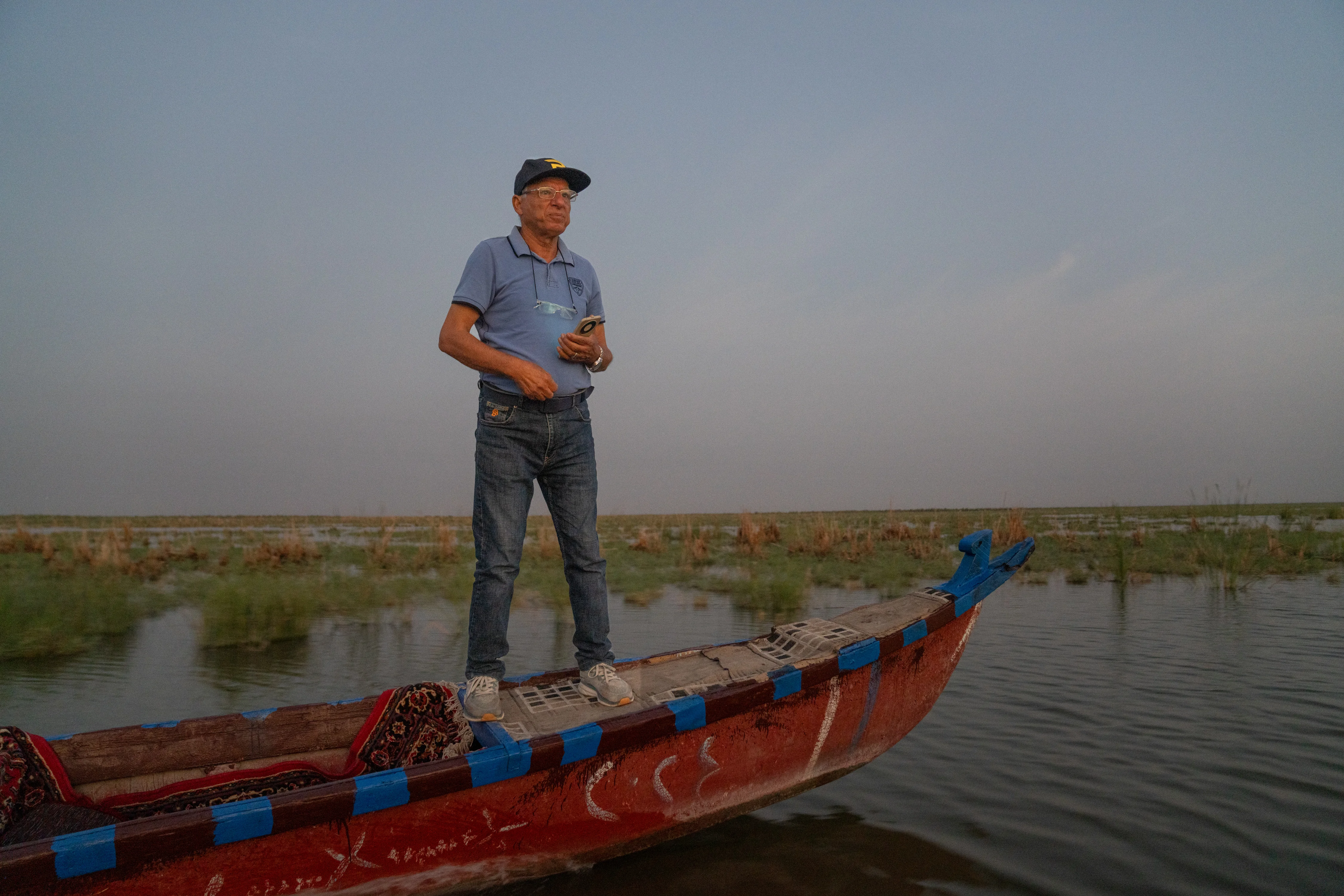
The water in southern Iraq does not taste like water anymore. It tastes like salt, rust, and the slow, suffocating weight of oil.
Stand on the edge of the Mesopotamian Marshes at noon, and the heat presses down on your skull like a heavy iron plate. For thousands of years, this was the cradle of civilization, a sprawling, emerald labyrinth of reeds and waterways where the Tigris and Euphrates rivers finally met the sea. Today, vast stretches of it look like the cracked, grey skin of a dying elephant. The reeds are brittle. The buffalo are gaunt, their ribs pressing against hides caked in dried mud that used to be bottomless water. Don't miss our recent post on this related article.
And in the middle of this shrinking Eden stands Jassim al-Asadi.
He is not a soldier. He does not carry a rifle, wear fatigues, or command a battalion. He is an engineer in his sixties with a weathered face, a gentle voice, and an obsession that nearly got him killed. For decades, Jassim has fought to save the Iraqi marshes from drought, upstream dams, and the unchecked greed of oil conglomerates and armed factions. In February 2023, that obsession landed him in the back of a blindfolded van, dragged off a Baghdad highway by men with guns, and subjected to fifteen days of torture at the hands of Iran-backed militias. To read more about the history here, USA Today provides an excellent breakdown.
They broke his body to break his voice. They failed.
To understand why a quiet environmentalist became a high-value target for some of the most dangerous paramilitary groups in the Middle East, you have to understand what water means in Iraq. Water is not merely a resource here. It is power. It is currency. And when it disappears, the people who point out why it is disappearing become enemies of the state—or rather, enemies of the shadow state that actually runs things.
The Architecture of a Disappearing World
Imagine your bank account is draining every single day, not because you are spending money, but because your neighbors upstream have quietly tapped into your direct deposit, and the local gangsters are siphoning off whatever is left in the vault. That is the hydrological reality of southern Iraq.
Historically, the Mesopotamian Marshes covered roughly 20,000 square kilometers—an area nearly the size of New Jersey. They acted as the lungs and kidneys of the region, filtering pollutants, cooling the blistering summer air, and sustaining the Ma'dan, the Marsh Arabs, whose way of life dates back to the ancient Sumerians.
Saddam Hussein tried to murder the marshes in the 1990s. Seeking to punish the Marsh Arabs for a 1991 uprising, his regime built a massive network of canals and dikes to divert water away from the wetlands, reducing them to less than ten percent of their original size. It was one of the worst engineered ecological disasters in human history. When the regime fell in 2003, local communities and environmentalists like Jassim al-Asadi took sledgehammers and bulldozers to the embankments. The water rushed back. Life returned. For a brief, intoxicating moment, it seemed like the garden had been resurrected.
Then came the new threats. They were quieter than Saddam's artillery, but infinitely harder to fight.
Upstream, Turkey and Iran embarked on aggressive dam-building campaigns, choking off the Tigris and Euphrates before the rivers could even reach the Iraqi border. Inside Iraq, climate change turned summers into a furnace, with temperatures routinely crossing 50 degrees Celsius, evaporating whatever shallow water remained.
But the real problem lies elsewhere. Nature and neighboring countries were only half the story. Inside Iraq's borders, a web of corruption, illegal fish farming, unregulated oil extraction, and militia-controlled water theft was bleeding the marshes dry. Powerful armed groups, many aligned with Tehran, carved up territory in the south. They diverted water to private agricultural projects and illicit aquaculture ponds, leaving the ancient wetlands—and the families who depended on them—to choke on dust.
Jassim al-Asadi saw all of it. Through his organization, Nature Iraq, he didn't just document the ecological collapse; he named the culprits. He went on television. He spoke to international journalists. He laid out the maps, the flow rates, and the ugly truth about who was stealing the rivers.
In a country where silence is the ultimate survival strategy, Jassim kept talking.
Fifteen Days in the Dark
February 1, 2023. Morning traffic on the highway leading into Baghdad.
Jassim was driving to a meeting when two pickup trucks boxed him in. Armed men in civilian clothes swarmed his vehicle. Within seconds, a hood was pulled over his head, his hands were bound, and he was shoved into the back of a car. No warrant. No badge. Just the cold, familiar choreography of an Iraqi abduction.
For the next two weeks, Jassim ceased to exist in the eyes of the world.
His captors took him to an undisclosed location, a concrete cell where time dissolved into a blur of pain and interrogation. According to accounts Jassim later shared with investigators and reporters, the men who held him belonged to Kataib Hezbollah, one of the most powerful Iran-backed militias operating in Iraq. They didn't ask him about espionage or terrorism. They asked him about his work. They accused him of being an agent for Western embassies, a traitor who was embarrassing Iraq and its allies by exposing the environmental devastation in the south.
They beat him with pipes. They used electric shocks. They hung him by his wrists until his shoulders screamed in agony.
Think about the sheer absurdity of that scene for a second. A sixty-something water engineer, a man whose greatest weapon is a clipboard and a depth gauge, being electrocuted in a dark room because he insisted that rivers should flow to the sea. It reveals everything you need to know about the fragility of authoritarian power. When your entire empire is built on theft and denial, a man telling the truth about dead fish becomes an existential threat.
Outside that cell, Jassim’s family and colleagues refused to let him vanish quietly. Usually, when someone is taken by the militias in Baghdad, families are terrified into silence, warned that going to the press guarantees a death sentence. Jassim’s brother, Nazim, took the opposite gamble. He went public. Environmentalists, human rights groups, and international diplomats began asking questions. The pressure mounted on Prime Minister Mohammed Shia al-Sudani’s government, which had promised to rein in lawless armed groups.
On February 16, battered, bruised, and severely traumatized, Jassim was dumped on the side of a road. He was alive.
Most people, after surviving fifteen days of torture in a militia black site, would pack a suitcase, board the first flight out of Baghdad, and spend the rest of their lives tending a quiet garden in Europe or North America. Nobody would blame them. You only get one body, and Jassim had already given more than enough of his to the mud of southern Iraq.
He stayed.
The Invisible Stakes of a Dying Wetland
Why stay? Why walk back into the same heat, the same dust, and the exact same crosshairs?
To answer that, you have to walk through the village of Chibayish with a hypothetical fisherman—let’s call him Tariq—whose family has lived on the water since before the Ottoman Empire had a name.
For Tariq, the disappearance of the marshes isn't an abstract climate statistic or a policy brief for a UN conference. It is the sudden, terrifying realization that his twelve-year-old son will never know how to pole a mashoof canoe through dense reeds at dawn. It is watching his water buffalo, the sole financial asset his family owns, grow sick from drinking stagnant, hypersaline water that burns their insides. When the water dies, Tariq doesn't just lose his job. He loses his identity, his history, and his home. He is forced to pack his family into a rusted truck and move to the sprawling, impoverished slums on the outskirts of Basra or Baghdad, where unemployment is rampant and militia recruiters wait with open arms and monthly stipends for desperate young men.
Look closely at that chain reaction.
Environmental destruction in Iraq is not a niche issue for birdwatchers and botanists. It is the primary engine of future instability in the Middle East. When the marshes dry up, communities collapse. When communities collapse, mass displacement follows. When millions of young men are stripped of their livelihoods and crammed into overheated, underserved cities, extremism thrives. The militias that tortured Jassim al-Asadi are actively destroying the very ecosystem that keeps southern Iraq peaceful, creating the exact desperation they need to recruit the next generation of fighters.
Jassim understands this equation better than anyone. He knows that saving the marshes is not about nostalgia for the Garden of Eden. It is about survival.
The Man Who Won't Blink
Sit across from Jassim al-Asadi today, and you won't meet a fire-breathing revolutionary. You will meet a man who carries the physical toll of his captivity in the stiffness of his posture, yet speaks about the wetlands with the tenderness of a parent describing a sick child.
He has adjusted his movements, certainly. He is more cautious about his routes, his routines, and the shadows that linger too long near his car. Fear is not the absence of courage; it is the tax you pay for living in reality. Jassim knows the men who tortured him are still out there, protected by political immunity and heavy weaponry. He knows that the dams in Turkey and Iran are still holding back the lifeblood of Mesopotamia. He knows that the oil fields flaring orange smoke into the southern sky are still poisoning the groundwater.
Yet, within weeks of his release, he was back in the marshes.
He was back meeting with local tribal leaders, begging them to stop overfishing and to dismantle illegal earthen dams. He was back in ministry offices in Baghdad, pushing bureaucrats to enforce water-sharing agreements and stop the rampant theft of river water by politically connected agribusinesses. He was back in front of cameras, refusing to lower his voice, refusing to sanitize the truth, and refusing to pretend that a dying ecosystem is simply an act of God.
Consider what happens when one person refuses to be intimidated in a society ruled by fear. The spell breaks. The militias rely on the absolute certainty that pain buys compliance. By walking back into the sunlight and continuing his work, Jassim al-Asadi turned their violence into an advertisement for their own weakness. They had pipes, wires, and blindfolds; he had the truth about a river. And somehow, the river proved harder to kill than they expected.
What Remains in the Mud
The battle for the Iraqi marshes is far from won. In fact, by almost every measurable metric, the wetlands are still losing. Satellite imagery shows vast swathes of brown where deep blue used to shimmer. Salinity levels in the Shatt al-Arab waterway have reached catastrophic heights, pushing saltwater miles inland and turning fertile date palm groves into skeletal ruins. Every summer brings a new record-breaking heatwave, and every year, more families abandon the reed houses of their ancestors for concrete shacks in the city.
If you look at the raw data alone, despair is the only logical conclusion.
Data, however, does not account for stubbornness. It does not measure the quiet, relentless defiance of a man who stood in a torture chamber, survived it, and immediately went back to checking water levels in a drying swamp.
Late in the afternoon in Chibayish, when the sun finally begins to drop toward the horizon and the brutal heat softens into a warm breeze, a few pockets of the marshes still come alive. Kingfishers dart low over the surviving channels. Water buffalo submerge themselves up to their nostrils, letting out long, rattling sighs of relief as the cool water washes the dust from their backs. Standing on the bank, watching the light catch the tips of the green reeds, is an older man with a notebook in his hand, quietly measuring the depth of the water, determined to make sure it is still there tomorrow.


