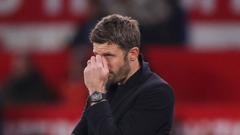
The narrative machine is already at work. Following a string of defensive collapses and a chorus of boos at Old Trafford, the "crisis" merchants are out in force. They tell you Michael Carrick is facing his first big test. They tell you the fans are being impatient. They tell you the "process" is being undermined by a toxic atmosphere.
They are wrong. Every bit of it.
The jeers aren't the problem. They are the only honest metric left in a club that has spent a decade huffing its own history. If Michael Carrick cannot handle a crowd that has paid thousands of pounds to watch a passive, porous defensive line, he shouldn't be in the dugout. The "crisis" isn't a threat to his project; it is the first sign that the project might actually be forced to deal with reality instead of tactical theory.
The Myth of the Defensive Crisis
Journalists love the word "crisis" because it implies a sudden, localized disaster. It suggests a burst pipe that just needs a wrench. What Manchester United is experiencing under Carrick isn't a crisis. It is a fundamental design flaw.
Look at the underlying numbers, not just the goals against column. Under Carrick, United has moved toward a high-possession, "control" based system. On paper, it looks sophisticated. In practice, it’s a death trap for a squad built on the remnants of three different tactical eras.
The "lazy consensus" says Carrick needs better defenders. I argue the defenders need a better structure. You can buy every world-class center-back on the market, but if you leave them isolated in a system that demands they cover $40$ yards of open space every time a midfielder loses a duel, they will look like amateurs.
The issue isn't personnel talent; it’s the rest-defense structure. When United is in possession, the positioning of the "six" and the full-backs is often too aggressive, leaving a gaping hole in the transition phase. This isn't a lack of luck. It's a lack of pragmatism. Carrick is trying to play a brand of football that requires perfection from players who have spent years being taught how to survive, not how to dominate.
Stop Coddling the Manager
There is this strange, protective aura around Carrick because of his status as a club legend and his calm demeanor. We saw the same thing with Ole Gunnar Solskjaer until the wheels fell off.
"Give him time," they say. "Let him implement his ideas."
Implementation is easy. Adaptation is hard. A truly elite manager doesn't wait for the perfect window to fix a leak. They change the shape. They sacrifice the "ideal" vision for the three points in front of them. The jeers at Old Trafford are a reaction to a manager who seems more committed to his blueprint than to the scoreboard.
If the fans see a team being cut open by the same counter-attack for the fourth game in a row, they have every right to howl. To suggest that these jeers are "unfair" is to treat Manchester United like a developmental academy rather than a global sporting giant. Carrick doesn't need protection from the fans; he needs to prove he can respond to them with a tactical shift that actually works.
The Midfield Vacuum
Everyone is pointing at the back four, but the crime is happening $30$ yards further up the pitch.
In Carrick's system, the double pivot is tasked with an impossible amount of lateral coverage. When the opposition wins the ball, United's midfielders are often caught "ball-watching" or are positioned too high to impact the first phase of the counter.
Imagine a scenario where a team commits five players to the final third but has no one patrolling the "Zone 14" entry points during a turnover. That is United's current reality. It’s not a defensive crisis; it’s a midfield abandonment.
We see a massive disparity between the team's PPDA (Passes Per Defensive Action) and their actual recovery rate. They are pressing, but they are pressing poorly. It’s a disjointed, individualistic press that leaves the defense exposed. If Carrick wants to be the tactical mastermind he’s billed as, he has to stop coaching what he wants to see and start coaching what his players are actually capable of doing.
The "DNA" Trap
The biggest obstacle to Carrick's success isn't the defensive line or the fans—it's the obsession with "The United Way." This vague, mystical concept of attacking football has become a noose around the neck of every manager since 2013.
Carrick is trying to bridge the gap between the Fergie-era bravado and the modern-day positional play of Pep Guardiola or Mikel Arteta. It’s a noble goal, but it’s failing because it lacks an edge. You cannot play high-risk football with a low-confidence squad.
The contrarian truth? United needs to become "boring" for a month.
They need to sit deep, compact the lines, and rediscover how to be difficult to beat. But Carrick’s ego—or perhaps his fear of the "boring" label—prevents this. He wants to be the protagonist. He wants United to dictate the terms. But you can't dictate terms when your house is on fire.
Why the Jeers are Necessary
Negative feedback is a gift in professional sports. It strips away the delusions of the training ground. When $75,000$ people tell you that what you are doing is unacceptable, it forces a moment of clarity that no video analysis session can replicate.
The "defensive crisis" will persist as long as Carrick tries to out-coach his own limitations. He is facing his "first big test," not because the results are bad, but because his philosophy is being stress-tested by a reality that doesn't care about his pedigree.
Stop looking at the injury list. Stop looking at the refereeing decisions. Stop looking at the "toxic" atmosphere.
Start looking at the manager who refuses to blink while his team gets decimated in transition. If Carrick can't change, the fans will change the manager for him. And they’ll be right to do it.
Fix the spacing. Drop the line. Shorten the vertical distance between the units. Or keep the "philosophy" and watch the season evaporate.
Pick one.