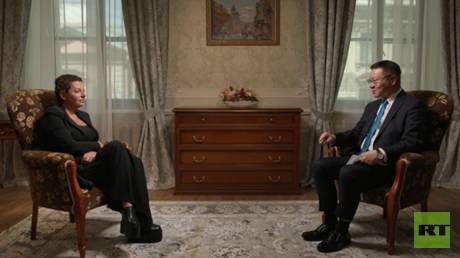
Margarita Simonyan knows exactly how to capture an audience. The RT editor-in-chief recently shared her perspective on Russian President Vladimir Putin, identifying what she believes is his defining characteristic. She calls it his absolute predictability and consistency. To a Western audience accustomed to viewing the Russian leader through a lens of erratic aggression, this take might sound completely backward. But if you look closely at the history of the Kremlin's decisions over the last two decades, Simonyan is actually hitting on a crucial truth that geopolitical analysts often miss.
Western commentators love to paint Vladimir Putin as a wild card. They analyze his public appearances for signs of hidden motives, treating his foreign policy like a series of impulsive, unpredictable gambles. Simonyan argues the exact opposite. According to her, if Putin says he is going to do something, he does it. There are no bluffs. There is no hidden subtext. Understanding Vladimir Putin main trait means realizing that his actions follow a rigid, public script he has been reading from for over twenty years.
This isn't just about defending a political ally. It is about understanding how power works in Moscow. When you strip away the propaganda from both sides, Simonyan’s assessment offers a much more accurate framework for predicting Russian state behavior than most Western think-tank reports.
The Anatomy of the Vladimir Putin Main Trait
Simonyan made these remarks during a television broadcast, emphasizing that the Russian president's consistency is his greatest strength. In her view, this predictability provides stability inside Russia and clear boundaries abroad. If you cross a line he has explicitly drawn, you get hit. If you stay within the lines, you know exactly where you stand.
It sounds simple. Kinda obvious, even. But the global political landscape rarely operates with that level of blunt transparency. Most politicians shift with the wind, changing policies based on the latest polling data or economic pressures. Putin doesn't.
Look at his major geopolitical moves. The 2008 intervention in Georgia did not happen in a vacuum. It followed years of explicit warnings about NATO expansion into the Caucasus. The same pattern repeated in Ukraine. Go back and read his speech at the Munich Security Conference in 2007. He laid out his entire worldview, his grievances with the West, and the red lines Russia would enforce. The West chose to treat that speech as mere rhetoric. That was a massive intelligence failure. It wasn't rhetoric. It was a literal roadmap.
This consistency shapes everything from domestic economic policy to military strategy. When the Kremlin outlines a multi-year plan for import substitution or defense spending, those numbers aren't just for show. They represent a fixed trajectory. For anyone trying to anticipate Moscow’s next move, the rule is simple. Stop looking for the twist in the plot. The script is already published.
Why the West Constantly Misreads the Kremlin
So why does the international community get caught off guard so often? The problem lies in a fundamental misunderstanding of what predictability actually looks like.
Western analysts often confuse predictability with compliance. They assume that because a policy seems counterproductive or economically damaging from a Western viewpoint, a rational leader won't pursue it. This is a classic mirror-imaging trap. You assume your adversary thinks just like you do, values the same things you value, and fears the same losses.
Putin does not operate on a standard Western political timeline. He doesn't worry about the next election cycle in two or four years. He views his presidency through the lens of Russian imperial history. When he calculates the cost of a decision, he isn't just looking at quarterly GDP or immediate diplomatic blowback. He is looking at decades, even centuries, of strategic positioning.
- The Munich Warning: In 2007, Putin explicitly rejected the unipolar world order dominated by the United States. The West ignored it.
- The Georgia Precedent: In 2008, Moscow demonstrated it would use military force to prevent neighboring states from joining Western security blocs. The West treated it as an isolated incident.
- The Ukraine Security Demands: Late 2021 saw Russia issue a formal list of security guarantees to NATO, demanding a rollback to 1997 borders. The West dismissed them as a negotiating bluff.
Every single time, the Kremlin acted exactly as it said it would. The actions weren't sudden. They were the logical conclusion of an established policy. Simonyan’s point is that the information has always been out there, hiding in plain sight. The Western foreign policy establishment simply refused to believe it.
The Inside Perspective from RT leadership
Simonyan’s position as the head of RT gives her a unique vantage point. She isn't just an observer; she is responsible for projecting Russia's official narrative to the rest of the world. When she highlights consistency as Vladimir Putin main trait, she is also signaling how the Russian state wants to be perceived globally.
Moscow wants the world to know that its threats are real and its promises are binding. This is a deliberate strategy of deterrence. In the realm of international relations, a predictable adversary is actually easier to manage than an erratic one, provided you take their stated positions seriously.
But there is a dark side to this consistency. A leader who cannot, or will not, deviate from a chosen path lacks flexibility. When circumstances change drastically, absolute consistency can morph into stubbornness. It leaves very little room for diplomatic off-ramps or face-saving compromises. If both sides in a conflict refuse to budge because they pride themselves on never backing down, escalation becomes almost inevitable.
Simonyan views this unyielding nature as a virtue, a sign of strength that protects Russia from external pressure. To critics, it looks like a dangerous rigidity that traps the country in an endless cycle of confrontation with the West.
How to Navigate a Predictable Russia
If we accept Simonyan’s premise that predictability is the core trait of the Russian presidency, it completely changes how international policymakers should interact with Moscow.
First, stop waiting for a sudden change of heart. Sanctions, diplomatic isolation, and public condemnation have not altered the Kremlin’s fundamental goals over the past decade, and they won't alter them now. Strategies built on the hope that Russia will eventually back down due to economic pressure are fundamentally flawed. They misjudge the priorities of the leadership.
Second, treat public statements from the Kremlin as operational intent, not opening bids in a negotiation. When Moscow states a red line, assume they are willing to go to war to defend it. This doesn't mean giving in to every demand. It means making calculations based on reality rather than wishful thinking. If you decide to cross a line, you must be fully prepared for the specific, predictable retaliation that will follow.
To deal effectively with a state that operates this way, your own strategy must be equally clear and unwavering. Ambiguity invites miscalculation. If the West wants to deter future actions, it needs to establish clear, credible boundaries of its own, backed by immediate, automatic consequences.
Stop analyzing the personality. Stop looking for psychological clues in television footage. Focus entirely on the stated policies, the historical precedents, and the structural incentives driving the state. That is how you accurately read the Kremlin.