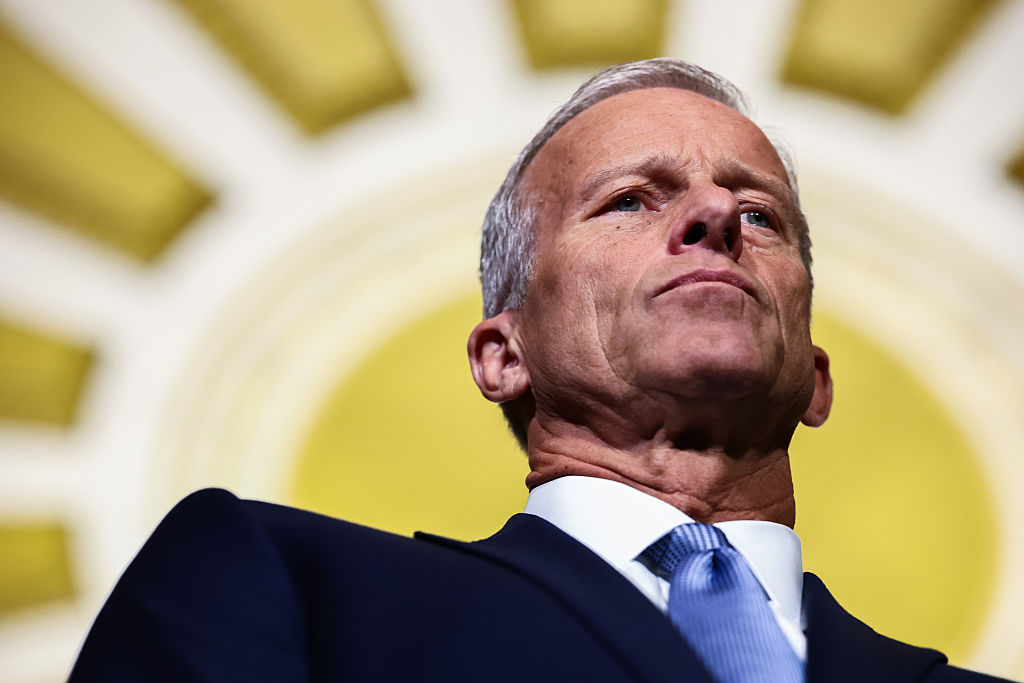
Senate Majority Leader John Thune is currently weathering a high-stakes standoff with Donald Trump over the SAVE America Act and demands to abolish the legislative filibuster. When the White House signaled that presidential patience was running out and demanded that the upper chamber cancel its August recess, Thune responded with a blunt procedural reality check. Show me how this ends. What is the picture of victory at the end?
This confrontation captures more than a routine clash between legislative and executive branches. It exposes the structural immunity that insulates modern Senate leadership from presidential coercion. While House members run every two years under the constant threat of primary challenges orchestrated from Mar-a-Lago, senators operate under six-year cycles and private-ballot leadership elections. Thune understands the arithmetic of the chamber he runs. The numbers do not change simply because a press secretary expresses frustration or a rally crowd starts chanting.
The Anatomy of a Legislative Dead End
To grasp why Thune refuses to bend, one must examine the absolute floor math of the United States Senate. Passing the SAVE America Act requires overcoming procedural hurdles that demand sixty votes. Republicans hold a functional majority of fifty-three seats. Simple subtraction reveals the fatal flaw in the administration's demand. Even if every single Republican member falls in line—an unlikely scenario given internal ideological splits—the caucus still falls seven votes short of the threshold.
President Trump has repeatedly insisted that Thune should simply trash the sixty-vote rule, terminating the filibuster to lower the barrier to a simple majority of fifty-one. Yet this demand ignores the institutional self-preservation instinct of the Senate Republican Conference. Veteran lawmakers across the ideological spectrum recognize a double-edged sword when they see one. Abolishing the filibuster to pass a restrictive voting bill today guarantees that a future Democratic majority can rewrite federal laws, court structures, and fiscal policy tomorrow with zero minority input.
Thune has pointed out this reality repeatedly, noting that the chamber has already voted on the core provisions multiple times. Dragging exhausted lawmakers through sticky August sessions in Washington will not conjure missing votes out of thin air. As veteran Texas Senator John Cornyn bluntly observed, the Senate can stay in session until the livestock return home, and the vote count will remain stubbornly identical.
Institutional Insulation and the Six-Year Buffer
The friction between Thune and the executive branch highlights a structural divergence in how power is exercised across the Capitol. House Speaker systems are vulnerable to immediate mob-mentality politics because open-floor votes leave individual representatives exposed to targeted retribution. The Senate, by design, functions as a slower, more insulated deliberative body.
Thune secured his leadership post through a private-ballot election among his peers. This mechanics-driven secrecy protects senators from immediate retaliation during internal votes, allowing them to support a leader who pushes back against executive overreach. Furthermore, the staggered nature of Senate terms means the vast majority of members do not face the immediate electoral guillotine in any given cycle.
This insulation creates a cultural boundary that executive pressure campaigns struggle to penetrate. When White House briefers warn that the president's patience is exhausted, Senate leadership treats the threat as background noise. Thune's counter-directive to the administration was telling: if the executive branch believes specific senators are persuadable, the White House should pick up the phone and secure the commitments themselves rather than demanding that leadership perform legislative alchemy.
The Midterm Trap
Beyond floor math and institutional protection lies a pragmatic political calculation regarding the upcoming midterm elections. Forcing vulnerable Republican incumbents to spend precious summer weeks in Washington voting repeatedly on doomed legislation is viewed by many party strategists as political malpractice.
Senators defending seats in competitive states need to be back home connecting with constituents, addressing local concerns, and navigating heavy economic headwinds. Keeping them chained to their desks for optics that appeal strictly to the party base risks depressing broader voter turnout. Thune's resistance is rooted in the hard-earned wisdom of a legislative veteran who knows that empty procedural theater rarely translates into electoral momentum.
The standoff underscores a shifting balance within the conservative coalition. While the base demands total compliance, the institutional machinery of the Senate still obeys its own internal gravity. Thune is betting that his members prefer functional realism over impossible theatrical demands.
The calendar is fixed, the math is unyielding, and the August recess looms regardless of executive edicts. By demanding to see the end of the road before taking another step, Thune has established a boundary that raw executive pressure cannot easily cross.