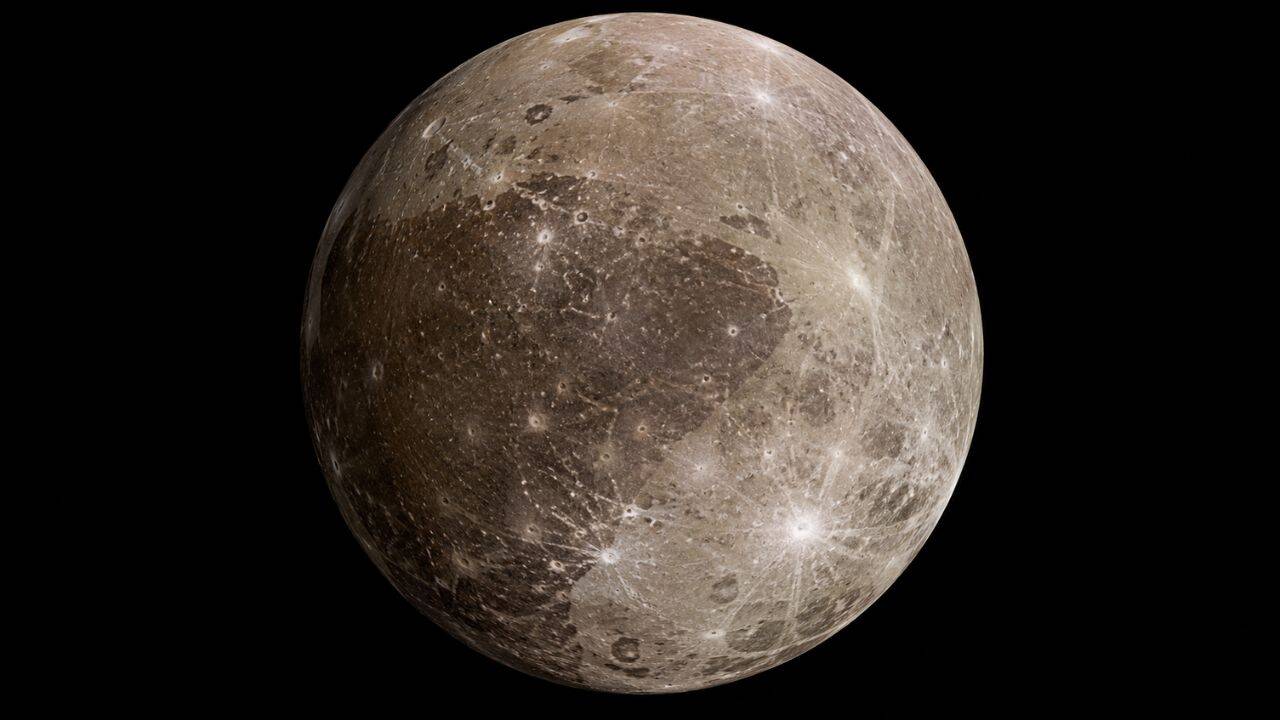
Ganymede defies standard planetary classification. As the largest moon in the Solar System, with a radius of 2,634 kilometers, it exceeds the physical dimensions of Mercury and dwarf planets such as Pluto. Size alone, however, provides a superficial metric. The structural composition, gravitational interactions with Jupiter, and internal thermal engine of Ganymede present a complex system of planetary mechanics. Beneath an outer crust of silicate rock and water ice lies a subsurface ocean containing more liquid water than Earth. Deconstructing this body requires examining the physical properties, tidal heating models, and magnetospheric anomalies that define its existence.
The Structural Anatomy of a Jovian Moon
Planetary differentiation dictates the internal profile of Ganymede. The body separates into three distinct layers: a molten iron-nickel core, a silicate mantle, and an outer shell composed primarily of water ice.
The core generates an intrinsic magnetic field, making Ganymede unique among the moons in the Solar System. This magnetic dynamo operates through convection within the liquid iron core, sustained by residual accretion heat and primordial differentiation energy. Surrounding this metallic center is a rocky mantle, subject to high-pressure phase changes that alter mineral density with depth.
The outermost shell consists of a lithosphere of rigid ice overlying a ductile asthenosphere. The structural integrity of this icy shell is governed by temperature gradients and pressure-induced phase boundaries. Water ice does not exist in a single crystalline form under planetary pressures; it transitions through various high-pressure polymorphs, creating physical barriers that influence internal heat transfer.
The Subsurface Hydrological Architecture
Liquid water on Ganymede does not form surface oceans akin to Earth. Instead, a global liquid layer is sandwiched between layers of high-pressure ice at depth and a rigid surface crust above.
The depth of this subsurface ocean is estimated to extend between 100 and 800 kilometers below the surface. The pressure regime at the base of the ocean prevents normal ice formation, forcing water into dense crystalline phases like Ice V, Ice VI, and Ice VII. These heavy ice polymorphs sink toward the rocky mantle, while liquid water floats or remains trapped beneath the superficial crust.
The thermal maintenance of this ocean challenges standard cooling models. Without an active internal heat source, conductive cooling would freeze a water layer of this magnitude over geological timescales. The persistence of the liquid phase relies on tidal dissipation driven by orbital resonances.
Orbital Resonance and Tidal Dissipation Engines
The energy maintaining Ganymede's internal ocean originates from gravitational interactions with Jupiter and its neighboring Galilean satellites, Io and Europa. These bodies are locked in a Laplace resonance. For every single orbit that Ganymede completes around Jupiter, Europa completes two, and Io completes four.
This orbital synchronization forces eccentricities in the orbits of the moons. As Ganymede moves along its slightly elliptical path, the gravitational pull exerted by Jupiter fluctuates. The changing gravitational gradient deforms the body cyclically, creating internal friction. This process, known as tidal heating, converts mechanical energy into thermal energy within the silicate mantle and the icy shell.
The efficiency of tidal dissipation dictates the thermal budget of the interior. If the resonance stabilizes, the heat generated balances the conductive heat loss through the crust, stabilizing the subsurface ocean against freezing. Mathematical modeling of this resonance shows that small variations in eccentricity yield massive shifts in thermal output, explaining why bodies in similar orbital configurations display vastly different internal states.
Magnetospheric Coupling and Plasma Environments
Ganymede orbits within the intense magnetosphere of Jupiter, a plasma environment dominated by energetic charged particles and strong magnetic fields. The interaction between the Jovian magnetic field and Ganymede's intrinsic field creates a mini-magnetosphere embedded within a larger planetary magnetosphere.
The intrinsic field shields parts of the moon's surface from direct bombardment by Jovian plasma, forming distinct plasma boundaries, bow shocks, and magnetopause currents. However, plasma leakage occurs at the polar regions, where open magnetic field lines connect the moon to the upper atmosphere of Jupiter.
This interaction produces observable auroral ovals. Ultraviolet emissions captured by space telescopes reveal dynamic shifts in the auroral belts, driven by changes in the ambient Jovian plasma sheet. Tracking these auroral shifts provides an indirect diagnostic tool for measuring the electrical conductivity of the subsurface ocean. Saline water acts as an electrical conductor; when the Jovian magnetic field sweeps past Ganymede, it induces electrical currents within the subsurface ocean, generating a secondary magnetic field that modulates the primary interaction.
Surface Morphology as an Inverse Function of Internal Stress
The surface of Ganymede is split into two primary geological terrains: dark regions heavily scarred by impact craters, and bright regions characterized by complex systems of parallel grooves and ridges.
The dark terrain represents the oldest surface units, dating back up to four billion years. The high density of impact craters indicates a stable, inactive crust that preserves the bombardment history of the early Solar System.
Conversely, the bright terrain exhibits tectonic deformation. The grooves and troughs are graben structures formed by extensional faulting of the icy crust. This tectonic activity implies that Ganymede underwent periods of global expansion or localized cryovolcanism. Thermal expansion, driven by phase changes in the interior ice or localized melting events, fractured the brittle lithosphere, allowing ductile ice to well up and form new surface expressions.
The absence of extensive impact cratering in the bright terrain points to resurfacing mechanisms that erased older topological features. Unlike rocky planets where plate tectonics recycle the crust, Ganymede relies on ice tectonics and cryomagma intrusion to relieve internal stresses.
Comparative Planetary Mechanics
Contrasting Ganymede with neighboring Europa and Callisto clarifies the thresholds required for subsurface ocean stability.
Europa, located closer to Jupiter, experiences higher tidal heating rates. Its ocean is more volatile, with frequent exchange mechanisms breaching the ice shell. Callisto, situated further out in the Jovian system, experiences minimal tidal heating due to its lack of participation in a tight orbital resonance. Consequently, Callisto's interior is partially differentiated, and its subsurface ocean is either heavily frozen or heavily reliant on anti-freeze compounds like ammonia to remain liquid.
Ganymede occupies the median threshold. It possesses enough mass and radiogenic material for initial differentiation, and enough orbital resonance coupling to sustain a liquid layer over billions of years without completely destabilizing its crust.
Strategic Assessment for Future Exploration
Future analysis of icy moons requires targeted in-situ measurements rather than remote sensing alone. Orbital missions must prioritize gravity field mapping and magnetic induction sounding to constrain the thickness of the ice shell and the salinity profile of the subsurface ocean.
The primary technical constraint in exploring Ganymede is overcoming the radiation belts of Jupiter. Spacecraft operating in this environment suffer rapid degradation of solar panels, electronics, and optical sensors due to high-energy electron and proton fluxes. Trajectory design must utilize gravity assists from Callisto to minimize radiation exposure before inserting into a stable orbit around Ganymede.
Optimizing mission architecture demands a focus on high-inclination orbital phases to measure the induced magnetic fields directly above the polar regions. This operational strategy yields definitive verification of ocean depth and conductivity, bypassing the ambiguities inherent in surface observations.