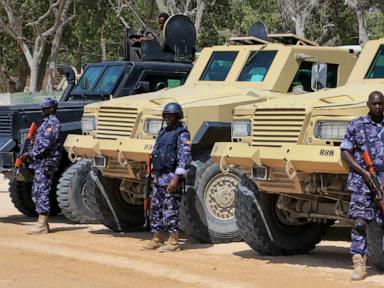
The drawdown of Ugandan military personnel from Somalia marks the collision between finite international peacekeeping mandates and the incomplete maturation of indigenous state security apparatuses. Rather than representing a routine rotation or a clear indicator of stabilized governance, the reduction of Uganda People's Defence Forces (UPDF) units under the African Union Transition Mission in Somalia (ATMIS) exposes a persistent structural deficit in counterinsurgency economics. When an anchor troop-contributing country initiates a phased withdrawal before host-nation forces achieve autonomous operational capacity, the resulting security vacuum alters the territorial control equilibrium in favor of entrenched insurgent networks like al-Shabaab.
To understand the operational consequences of Uganda's withdrawal, analysts must discard surface-level diplomatic narratives about regional ownership and examine the underlying mechanics of force generation, logistical sustainment, and asymmetric warfare. The transition from the African Union Mission in Somalia (AMISOM) to ATMIS, and subsequently toward smaller follow-on stabilization frameworks, operates on an externally imposed timeline dictated by donor fatigue rather than battlefield metrics. For an alternative look, consider: this related article.
The Architecture of Externalized Security
Since deploying the first contingents to Mogadishu in 2007, Uganda has functioned as the operational backbone of the African Union's military intervention in Somalia. In counterinsurgency theory, an anchor force provides three non-negotiable capabilities that host-nation militias initially lack: unified command and control, heavy indirect fire support, and sustained expeditionary logistics.
For over fifteen years, the security architecture of south-central Somalia relied on a division of labor where Ugandan and allied regional forces held major population centers, secured critical supply corridors, and absorbed the highest-intensity kinetic shocks from al-Shabaab. This arrangement produced a strategic paradox. By insulating the Federal Government of Somalia (FGS) from existential collapse in Mogadishu, the presence of UPDF battle groups simultaneously reduced the immediate survival pressure required to force rapid institutional reform within the Somali National Army (SNA). Similar analysis on this matter has been provided by Associated Press.
This dynamic illustrates the Principal-Agent Problem in Security Force Assistance:
- Divergent Incentives: International donors seek a defined exit date and reduced financial liability. Troop-contributing countries seek predictable reimbursement, diplomatic standing, and regional border security. The host government seeks regime survival and political leverage over federal member states.
- Asymmetric Information: External sponsors rely on formal unit rosters and graduation metrics from basic training pipelines to measure SNA readiness, missing critical informal variables such as clan loyalties, ammunition diversion, and inconsistent payroll distribution.
- Moral Hazard: As long as UPDF units manned forward operating bases (FOBs) in the Lower Shabelle region, Somali political elites could defer difficult negotiations over force integration and federal resource sharing.
The Mechanics of Forward Operating Base Handovers
The physical execution of a troop drawdown is the point of maximum tactical vulnerability in any counterinsurgency campaign. When Ugandan forces vacate a Forward Operating Base, they do not merely transfer physical real estate; they remove a complex ecosystem of intelligence, surveillance, and reconnaissance (ISR) assets, medical evacuation (MEDEVAC) capabilities, and armored quick-reaction forces (QRF).
A standard handover sequence requires the departing UPDF battalion to conduct joint patrols with the incoming SNA unit, transfer static defensive fortifications, and recalibrate artillery support sectors. In practice, three friction points routinely degrade this transfer:
- The Logistics Tail Collapse: UPDF units operate within an established African Union supply chain backed by United Nations Support Office in Somalia (UNSOS) logistical packages. When an SNA unit assumes control of a remote base, its sustainment often reverts to fragmented national supply lines. Without guaranteed deliveries of fuel, spare parts, potable water, and rations, static defensive positions rapidly become untenable.
- Loss of Enablers: Ugandan forces rely heavily on armored personnel carriers, mine-resistant ambush-protected vehicles, and coordinated air support to survive improvised explosive device (IED) ambushes along main supply routes. The SNA lacks equivalent organic armor and airlift capacity, forcing newly deployed Somali garrisons into static, defensive postures that cede freedom of movement to insurgents.
- The Intelligence Reset: Human intelligence networks built by Ugandan commanders over multi-year deployments are tied to specific officers and translators. When those units depart, local informants frequently sever contact due to fear of insurgent retaliation, leaving the incoming SNA garrison blind to imminent vehicle-borne IED attacks.
The Cost Function of Asymmetric Attrition
Al-Shabaab operates as a shadow governance structure and a resilient guerrilla army whose strategic doctrine is built around temporal endurance. The group does not need to defeat Ugandan or Somali forces in conventional set-piece battles to achieve its objectives; it only needs to outlast the political will of the coalition's financial backers.
The economic asymmetry between the counterinsurgent coalition and al-Shabaab dictates the pace of the conflict. Maintaining a single mechanized peacekeeping battalion in Somalia requires tens of millions of dollars annually in stipends, fuel, equipment depreciation, and airlift support, funded primarily by the European Union, the United States, and the United Nations. Conversely, al-Shabaab funds its operations through an internal taxation and extortion apparatus spanning ports, agricultural transit routes, and urban businesses across southern Somalia.
This creates a structural imbalance in the cost function of war:
- High Fixed Costs for Peacekeepers: Every additional month of deployment incurs massive overhead for the international coalition, regardless of whether offensive operations occur. Donor nations eventually cap funding, forcing troop reductions through budgetary attrition.
- Low Marginal Costs for Insurgents: Al-Shabaab utilizes decentralized cell structures, locally manufactured explosives using precursor chemicals or salvaged ordnance, and tactical dispersion. When UPDF pressure increases in one sector, insurgent cadres melt into the rural population, reducing their operational expenditure until the counterinsurgent force thins out.
Uganda's withdrawal directly validates al-Shabaab's strategy of strategic patience. By waiting out the international mandate, the insurgency avoids decisive kinetic defeat while conserving combat power for the exact window when battle-hardened UPDF units are replaced by less experienced SNA battalions.
The Clannish Fault Lines of Force Generation
A persistent flaw in external assessments of Somalia's security transition is treating the Somali National Army as a monolithic, Weberian state institution. In reality, the SNA remains heavily fragmented along sub-clan lines, where unit cohesion and officer loyalty are frequently mediated by kinship networks rather than formal chains of command.
Ugandan troops functioned as an essential neutral arbiter precisely because they stood outside Somalia's internal clan politics. A UPDF commander stationed in Marka or Barawe had no stake in local land disputes or clan power balances, allowing the force to hold territory without triggering immediate local insurgencies driven by clan rivalry.
When Ugandan units withdraw and transfer authority to SNA brigades, the neutrality buffer vanishes. If the incoming SNA unit is predominantly drawn from a rival clan to the local population in the Lower Shabelle or Jubaland regions, local elders may view the new garrison not as a national liberator, but as an occupying militia representing a competing faction in Mogadishu. Al-Shabaab systematically exploits these grievances, offering local clans dispute resolution, protection from predatory checkpoints, and ideological alignment in exchange for passive support or active recruitment against the incoming SNA forces.
Operational Vulnerabilities in the Post-Drawdown Corridor
The geographic focus of Uganda's deployment—Sector 1, encompassing Mogadishu and the Lower Shabelle region—is the economic and political center of gravity in Somalia. The Lower Shabelle contains the country's most productive agricultural land and controls the primary arterial roads connecting the capital to the southern ports of Barawe and Kismayo.
Reducing UPDF troop density in Sector 1 introduces immediate operational risks across three distinct zones:
- Main Supply Routes (MSRs): Al-Shabaab's primary tactical method for isolating government-held towns is the interdiction of MSRs using command-detonated IEDs and complex ambushes. Without continuous Ugandan route-clearance patrols, towns nominally under SNA control risk becoming isolated islands accessible only by expensive rotary-wing airlift.
- Peri-Urban Buffer Zones: The relative security of Mogadishu depends on maintaining a deep defensive perimeter in towns like Afgooye, Balcad, and Marka. Thinning out UPDF garrisons in these outer rings allows al-Shabaab mortar teams and assassination squads to infiltrate closer to the capital's administrative core.
- Tactical Reserve Capacity: Historically, when SNA offensive operations stalled or encountered fierce counterattacks, UPDF armored units served as the operational backstop to stabilize the front line. With fewer Ugandan troops in theater, the margin for tactical error during SNA-led operations shrinks to zero; a single failed assault can cascade into a disorderly retreat and the loss of stockpiled weaponry to insurgents.
Limitations of the Transition Strategy
The prevailing policy framework assumes that phased troop withdrawals create a forcing function that compels the Federal Government of Somalia to accelerate security sector reform. While theoretically sound in classic state-building literature, this strategy carries severe operational limitations in the Somali context:
- Fiscal Insolvency: The FGS lacks the domestic tax base required to independently pay, equip, and sustain a standing army of thirty thousand troops. Even if political will is maximized, the Somali state cannot absorb the recurrent costs previously subsidized by international peacekeeping budgets without continuous external budgetary support.
- Training Pipeline Bottlenecks: Generating infantry battalions through basic training programs in Uganda, Turkey, or Eritrea does not produce an effective military. Combat effectiveness requires institutional leadership, non-commissioned officer corps development, and maintenance ecosystems that take decades, not budget cycles, to mature.
- Divergent Regional Interests: Neighboring states—including Uganda, Kenya, and Ethiopia—possess distinct national security priorities in Somalia. Uncoordinated drawdowns or unilateral bilateral security arrangements risk fragmenting the unified command structure that prevented Somalia from relapsing into warlordism after 2007.
Strategic Imperatives for Stabilization
To prevent the withdrawal of Ugandan forces from triggering a systemic collapse of territorial control in south-central Somalia, international donors and the Federal Government of Somalia must abandon calendar-based drawdown schedules in favor of capability-verified transition gates.
First, logistical sustainment must be decoupled from troop numbers. Rather than simply reducing the headcount of UPDF infantry, international partners must retain specialized Ugandan engineering, MEDEVAC, intelligence, and armored QRF units in a dedicated support role until the SNA demonstrates verifiable proficiency in sustaining remote bases for ninety consecutive days without external resupply.
Second, force deployment must align with local clan dynamics. The FGS must halt the deployment of homogeneous SNA units into regions dominated by rival clans, instead integrating locally recruited, vetted stabilization forces into the formal command structure before UPDF units vacate strategic towns.
Finally, donor funding mechanisms must shift from subsidizing troop stipends to enforcing accountability metrics. Financial disbursements to the Somali security sector should be directly tied to biometric payroll verification, ammunition tracking audits, and the uninterrupted maintenance of main supply routes. Without structural reform to how forces are sustained and governed on the ground, reducing Uganda's footprint will not transfer security to the Somali state—it will merely transfer territory back to the insurgency.