The intersection of modern lunar exploration infrastructure and historical wireless energy concepts frequently produces a profound misunderstanding of engineering realities. Pop-science narratives often conflate China’s advancements in space-based wireless power transmission (WPT) and localized lunar laser networks with Nikola Tesla’s early 20th-century vision of worldwide "free" energy. A cold analysis of the underlying physics and orbital economics reveals that these systems share no conceptual, structural, or thermodynamic DNA with Tesla’s planetary resonance theories. Instead, modern lunar power beaming represents a highly targeted, capital-intensive infrastructure play designed to solve specific thermodynamic constraints in the extreme environments of the lunar poles.
The Physics of Path Loss: Terrestrial Resonance vs. Directed Photons
To understand why modern space-based WPT architectures diverge from historical concepts, one must isolate the mechanism of transmission. Tesla’s Wardenclyffe Tower project was predicated on terrestrial conduction and global resonance. His objective was to inject high-frequency electrical currents into the Earth’s crust and ionosphere, treating the globe as a giant spherical capacitor. The theoretical foundation assumed that the Earth could be made to resonate electrically, allowing users anywhere to draw power by sticking a tuned receiver into the ground.
This model failed due to fundamental electromagnetic realities:
- Conduction Losses: The Earth’s crust possesses high electrical resistance over long distances, causing rapid attenuation of low-frequency currents through ohmic heating.
- Ionospheric Dispersion: The upper atmosphere does not act as a lossless, perfectly reflective boundary layer for power-scale currents; it scatters and dissipates energy.
- Omnidirectional Diffusion: Broadly radiating energy into a spherical medium obeys the inverse-square law, diluting the energy density exponentially as distance increases from the source.
Conversely, modern systems developed under initiatives like China's Zhuri (Sun Chasing) project and global lunar development frameworks rely on directed, high-frequency electromagnetic beams—specifically microwaves and lasers. These systems do not attempt to charge the environment; they utilize the vacuum of space to transport photons along a strict line of sight from a defined emitter to a specific aperture.
The choice of frequency dictates the physical footprint of the architecture. The divergence of an electromagnetic beam is governed by the diffraction limit, expressed by the relationship:
$$D_r \approx \frac{2.44 \cdot \lambda \cdot L}{D_t}$$
Where $D_r$ is the receiver diameter, $\lambda$ is the wavelength, $L$ is the transmission distance, and $D_t$ is the transmitter diameter.
For terrestrial-to-space applications, microwave systems (typically operating at $2.45\text{ GHz}$ or $5.8\text{ GHz}$) require apertures measuring kilometers in diameter to maintain beam coherence over geostationary distances. On the lunar surface, where rugged topography dominates the polar regions, the localized infrastructure deployment shifts toward laser power transmission stations (LPTS). Operating in the near-infrared spectrum ($\approx 808\text{ nm}$ to $1070\text{ nm}$), lasers drastically reduce $\lambda$, allowing highly concentrated energy delivery over tens of kilometers using optical components measured in centimeters rather than kilometers.
The Structural Architecture of Lunar Laser Power Transmission
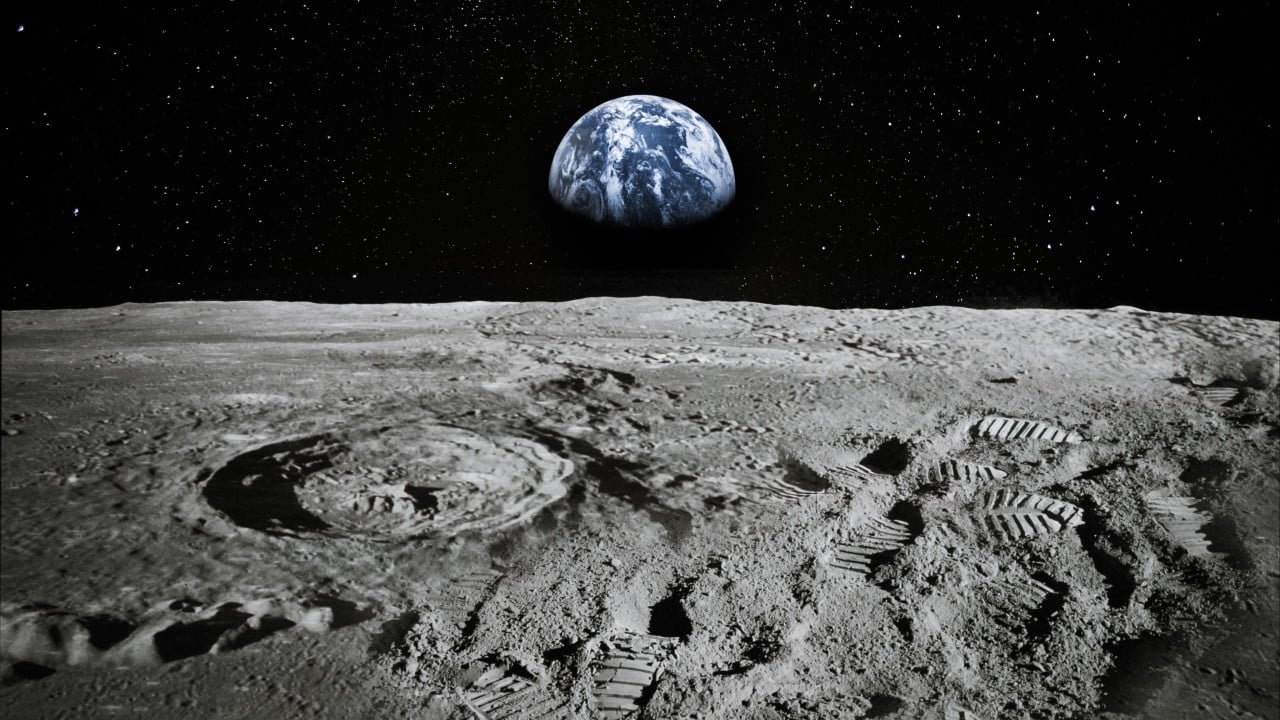
The deployment of laser power networks in the lunar polar regions—specifically around the Shackleton Crater—is driven by a stark environmental reality: Permanently Shadowed Regions (PSRs). These craters contain volatile water ice critical for deep-space sustenance and propellant production, yet they receive zero sunlight. Conversely, the elevated rims of these craters experience near-continuous illumination.
Rather than laying thousands of metric tons of physical copper cabling across treacherous, ultra-cold topography, space agencies are modeling optical power grids. This architecture operates across a strict coverage-connectivity-cost trade-off framework.
The Emitter Node (Laser Power Transmission Station)
Situated on illuminated crater rims, these stations utilize high-efficiency photovoltaic arrays to capture continuous solar energy. This direct current (DC) is fed into solid-state or fiber laser diodes, converting electrical energy into a highly collimated monochromatic light beam. These nodes require advanced gimbals and active optoelectronic feedback loops to track dynamic targets moving through the shadows below.
The Propagation Medium (The Lunar Vacuum)
Unlike terrestrial laser systems that suffer from thermal blooming, atmospheric turbulence, and aerosol scattering, the lunar environment provides a near-perfect vacuum. This eliminates beam degradation caused by index-of-refraction fluctuations. However, it introduces a separate operational variable: extreme topographical obstructions. Validations using Lunar Orbiter Laser Altimeter (LOLA) data demonstrate that the primary constraint is not atmospheric path loss, but line-of-sight availability across rugged crater terrains.
The Receiver Node (Laser Rectenna)
The target assets—such as lunar rovers, autonomous ice drills, and automated habitats operating inside the PSRs—are equipped with specialized photovoltaic receivers tuned specifically to the laser’s precise wavelength. These monochromatic cells achieve significantly higher theoretical efficiencies ($\approx 50%$ to $60%$) than standard multi-junction solar cells exposed to the broad solar spectrum, directly converting the incoming laser photons back into usable DC power.
The Efficiency Bottleneck and the True Cost Function
The primary argument against any narrative of "free energy" in modern WPT systems is the severe efficiency penalty paid at every stage of the energy conversion chain. Wireless power is not a generation source; it is a highly inefficient transport mechanism.
To quantify the economic and physical reality of these systems, one must analyze the end-to-end DC-to-DC efficiency chain ($\eta_{\text{total}}$), which is defined as:
$$\eta_{\text{total}} = \eta_{\text{gen}} \cdot \eta_{\text{conv}} \cdot \eta_{\text{trans}} \cdot \eta_{\text{coll}} \cdot \eta_{\text{rect}}$$
- $\eta_{\text{gen}}$ (Solar Capture Efficiency): The efficiency of the primary photovoltaic arrays capturing raw sunlight on the crater rim ($\approx 30%$).
- $\eta_{\text{conv}}$ (DC-to-Laser Conversion): The electrical-to-optical efficiency of the laser diodes ($\approx 40%$ to $50%$).
- $\eta_{\text{trans}}$ (Transmission/Pointing Efficiency): Losses due to beam jitter, alignment errors, and peripheral scattering ($\approx 85% balance$).
- $\eta_{\text{coll}}$ (Beam Collection): The percentage of the beam spot size successfully captured by the physical footprint of the receiver aperture.
- $\eta_{\text{rect}}$ (Optical-to-DC Rectification): The efficiency of the receiver cell converting monochromatic light back to electricity ($\approx 50%$).
Empirical baselines from ground-based validation systems highlight the steepness of this slope. In tests conducted by Xidian University for dynamic, one-to-many wireless power systems, researchers achieved a direct current-to-direct current transmission efficiency of $20.8%$ over a modest distance of 100 meters. While this represented a measurable step up from the team's $2022$ baseline of $15.05%$, it underscores the systemic energy destruction inherent to wireless links.
When scaled to lunar operational distances, every watt of usable power delivered inside a permanently shadowed crater requires approximately five watts of generation capacity on the ridge. This structural overhead introduces a massive capital expenditure (CapEx) barrier, encompassing the launch mass of large solar fields, heavy thermal management systems required to dissipate waste heat from the laser diodes, and redundant optical tracking systems.
Strategic Implications for Cis-Lunar Infrastructure
The deployment of lunar laser power networks will fundamentally dictate the geopolitics and resource economics of the lunar surface between $2030$ and $2050$. Rather than validating utopian dreams of boundless, infrastructure-free electricity, these technical developments point toward a highly competitive monopolization of lunar logistics hubs.
The optimization of these networks creates a natural geographic advantage. Organizations that successfully place high-altitude laser power beaming nodes on key topographical features—such as the Connecting Ridge near Shackleton Crater—will effectively control the operational cadence of all resource extraction activities within the adjacent shadows. By controlling the power beam, an operator dictates which rovers survive the lunar night and which extraction operations can run continuously.
Furthermore, the technology pipeline established for lunar polar networks serves as the direct scaling mechanism for larger, orbital space-based solar power (SBSP) architectures. The engineering solutions developed to solve real-time pointing precision for moving targets on the moon are the identical frameworks required to beam gigawatt-scale microwave or laser energy from geostationary orbits down to terrestrial rectennas.
The immediate tactical priority for space agencies and private defense contractors is the refinement of automated optoelectronic alignment mechanisms. Because a laser beam carrying tens of kilowatts of energy can cause catastrophic thermal damage if misaligned by even a fraction of a degree, the development of failsafe, closed-loop interlocks is as critical as the core conversion efficiency itself. The future of cis-lunar industrialization belongs not to the pursuit of free energy, but to the precise, ruthlessly optimized management of localized photonic distribution networks.
For a deeper look into the physical deployment of these systems, the video Long-range wireless power transfer using laser technology demonstrates real-world testing of continuous laser power beaming under turbulent conditions, mirroring the alignment challenges faced by space-based architectures.