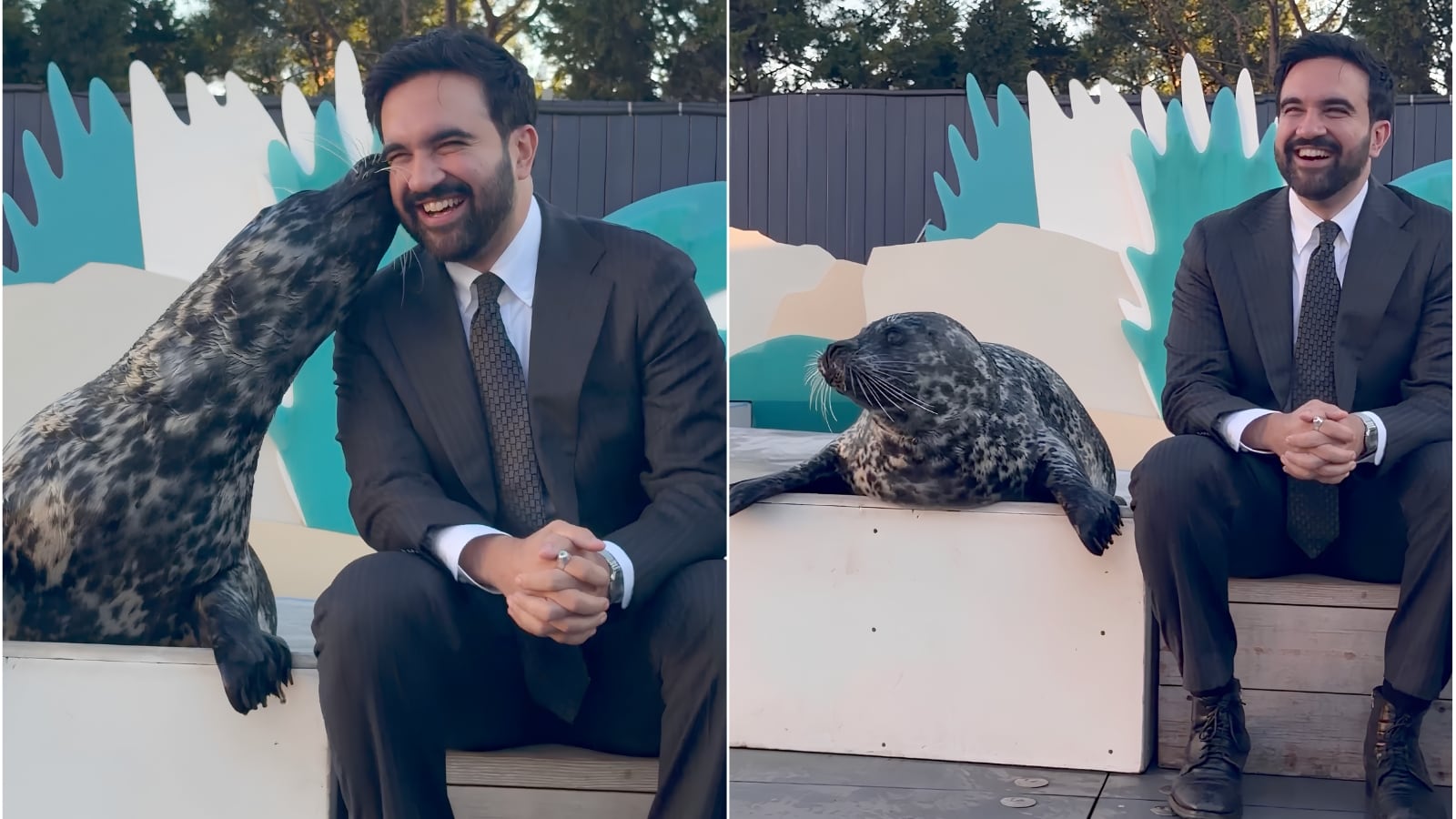
A single photograph of a sitting New York City mayor pressed cheek-to-whisker against a pinniped at the Coney Island facility operates as a calculated media asset rather than a spontaneous human-interest moment. Local press coverage typically treats municipal zoo and aquarium appearances as lightweight filler, missing the institutional machinery, animal conditioning protocols, and political communication strategies required to produce that specific visual frame. Analyzing an event where Mayor Zohran Mamdani interacts with seals at the New York Aquarium requires separating emotional press framing from the operational realities of both City Hall press operations and the Wildlife Conservation Society.
Standard municipal reporting relies on superficial chronology: an elected official arrives, tours an exhibit, interacts with an animal, and generates a viral image. That framing obscures three distinct systems operating simultaneously. First, the political communications apparatus uses low-friction, non-partisan environments to soften ideological edges and capture earned media across demographics that ignore policy briefings. Second, marine mammal husbandry teams deploy operant conditioning to make an unpredictable wild-descended apex predator execute a precise physical behavior on cue. Third, cultural institutions trade controlled access to flagship species for budgetary visibility, capital funding support, and public attendance spikes.
The Architecture of Low-Friction Political Optics
In municipal governance, public appearances fall along a spectrum of reputational risk. Town halls, transit disruptions, and budget hearings carry high variance; an unscripted confrontation can dominate a news cycle for days. Cultural and conservation institutions represent the opposite extreme: controlled-access environments with predictable visual outputs.
When a mayor visits the New York Aquarium in Coney Island, the advance team engineers the environment to eliminate variables before the press pool enters the perimeter. The objective is visual clarity. Policy achievements—such as zoning adjustments, municipal bond allocations, or transit maintenance schedules—lack immediate visual shorthand. A photograph of a mayor standing beside a harbor seal or California sea lion solves the visual deficit by pairing the executive with an universally recognizable, non-controversial subject.
The specific gesture—a seal pressing its face against the mayor's cheek—functions as an affective anchor in political communication. Behavioral political science demonstrates that voters process visual cues of warmth and approachability faster than textual policy platforms. By placing the executive in a posture of physical vulnerability and affection with an animal, the image bypasses partisan filtering. Viewers do not evaluate the photograph through the lens of municipal tax policy or housing debates; they register an immediate, non-verbal signal of relatability.
This dynamic relies on asymmetric media distribution. Hard policy announcements rarely travel beyond local political desks and civic newsletters. An image of a pinniped kissing a mayor crosses into lifestyle feeds, morning broadcast segments, and social media aggregators. The return on time invested for the press office is exceptionally high: a 45-minute site visit yields multi-platform impressions without requiring the executive to answer adversarial questions on municipal operations.
Operant Conditioning Behind the "Spontaneous" Gesture
Media narratives frequently describe animal interactions during political visits as moments of organic affection, implying the animal recognized or favored the visitor. In professional marine mammal management, that interpretation is biologically inaccurate. Pinnipeds—specifically harbor seals (Phoca vitulina), grey seals (Halichoerus grypus), and California sea lions (Zalophus californianus) housed at facilities accredited by the Association of Zoos and Aquariums (AZA)—do not perform close-contact facial touches with unfamiliar humans out of spontaneous emotion.
The behavior is the output of structured operant conditioning using positive reinforcement. Marine mammal trainers build complex behaviors through successive approximations, known as shaping, paired with a bridging stimulus (typically a whistle) and a primary reinforcer (fish, usually herring or capelin).
To achieve a safe cheek-to-cheek touch with a non-trainer, the animal undergoes specific desensitization and targeting protocols:
- Stationing: The animal learns to hold its body at a fixed geographic point, either on a haul-out deck or at the edge of a pool, ignoring ambient noise from cameras, microphones, and unfamiliar personnel.
- Tactile Targeting: Trainers teach the animal to touch its nose or mystacial vibrissae (whiskers) to a specific target—initially a buoy or a trainer's hand, and eventually a designated point on a human face.
- Duration and Impulse Control: The animal is reinforced for maintaining contact for a set duration (two to five seconds) without opening its mouth, lunging, or reacting to sudden movements from the human participant.
- Generalization: The behavior is practiced across multiple trainers and facility staff so the animal responds reliably to the trainer's hand cue even when the target person is a stranger.
During a mayoral visit, the political principal is positioned precisely according to the trainer's spatial instructions. The trainer stands just outside the camera frame, delivering the visual discriminative stimulus (hand signal) that prompts the seal to extend its neck and press its muzzle against the mayor's cheek. When the whistle blows, the seal breaks contact and returns to the trainer for its fish reward. What appears in the published photograph as an unscripted bond is actually a tightly choreographed behavioral chain executed under strict safety thresholds.
Institutional Incentives and Municipal Capital Flows
The Wildlife Conservation Society (WCS), which operates the New York Aquarium alongside the Bronx Zoo, Central Park Zoo, Queens Zoo, and Prospect Park Zoo, does not host executive visits purely for novelty. Cultural institutions operating on city-owned land depend on a hybrid financial model combining earned revenue (ticketing, memberships, concessions), private philanthropy, and direct municipal support.
New York City provides critical capital funding for infrastructure upgrades, storm-surge resilience, and exhibit construction, alongside annual expense support for energy and operational baseline costs. Following the severe structural damage inflicted on the Coney Island facility by Hurricane Sandy in 2012, the aquarium's multi-year reconstruction and expansion—including the Ocean Wonders: Sharks! exhibit and upgraded marine mammal habitats—required sustained coordination between WCS leadership, the Department of Cultural Affairs (DCLA), and City Hall.
Hosting the mayor generates three tangible institutional returns:
- Capital Priority: Direct physical engagement with the facility reinforces its status as a civic asset during capital budget negotiations, where cultural institutions compete against libraries, parks, and infrastructure agencies for discretionary municipal dollars.
- Geographic Equity Signaling: The New York Aquarium is the only major cultural institution of its scale located in southern Brooklyn. A high-profile executive visit signals administrative attention to outer-borough economic engines, particularly Coney Island's seasonal tourism corridor.
- Earned Media Valuation: Every news broadcast and digital article naming the New York Aquarium functions as zero-cost advertising, driving family ticket sales during shoulder seasons when attendance naturally dips.
Risk Management and Biosecurity Constraints
Allowing an elected official into direct physical contact with a marine mammal introduces operational hazards that facility directors must mitigate through rigid protocols. Pinnipeds possess substantial bite force and rapid cranial reflexes; even conditioned animals can startle if exposed to camera flashes, sudden vocalizations, or abrupt hand movements from an unbriefed visitor.
Furthermore, zoonotic disease transmission operates in both directions. Marine mammals are susceptible to human respiratory pathogens, including influenza strains, while humans can contract bacterial infections—such as Mycoplasma species (commonly known as "seal finger")—through contact with pinniped oral or nasal secretions.
To manage these variables, aquarium veterinary and husbandry teams enforce strict containment rules during VIP visits:
- Pre-Visit Briefing: The mayor and accompanying staff receive explicit instructions on posture, hand placement, and prohibited movements before entering the animal's line of sight.
- Perimeter Control: Only a minimal pool of credentialed photographers and handlers is permitted inside the exhibit zone; external press remains behind physical barriers to prevent acoustic spikes.
- Hygiene Protocols: Immediate hand sanitization and mucosal avoidance rules apply before and after contact to protect both the animal's immune baseline and the official's health.
- Animal Selection: Trainers select individual animals with the longest tenure in public-facing ambassador programs and the highest tolerance for environmental novelty, bypassing younger or more reactive individuals in the colony.
Deconstructing the Media Distortion Loop
The gap between what happens inside the exhibit and what appears in local headlines illustrates a structural flaw in contemporary municipal journalism. Newsrooms operating under compressed production cycles prioritize immediate visual hooks over institutional context. When a press release or wire photo arrives showing the mayor with a seal, the editorial workflow defaults to a predictable formula: descriptive headline, brief summary of the photo opportunity, and minimal inquiry into the underlying policy or operational context.
This coverage pattern creates an analytical blind spot for readers. By framing the event solely around the novelty of the animal interaction, reporters omit the substantive questions that justify executive presence at a major civic institution:
- What is the current status of city capital allocations for coastal cultural facilities?
- How are outer-borough tourism metrics performing relative to pre-pandemic baselines?
- What conservation or marine monitoring initiatives is the Wildlife Conservation Society running in the New York Bight—such as acoustic buoy tracking of North Atlantic right whales or local harbor seal population surveys—that intersect with municipal waterfront policy?
When coverage stops at the photograph, the public receives entertainment rather than civic intelligence. Both City Hall and the host institution achieve their communications objectives precisely because the media declines to look past the surface frame.
Tactical Framework for Evaluating Executive Photo Ops
Analysts, journalists, and civic observers assessing future municipal site visits should apply a four-step diagnostic filter rather than accepting the press framing at face value:
- Identify the Calendar Trigger: Map the visit against the municipal budget cycle, upcoming legislative votes, or seasonal tourism windows. Executive appearances rarely occur in a vacuum; they typically precede capital budget announcements, cultural funding renewals, or regional economic initiatives.
- Audit the Access Tier: Distinguish between standard public viewing areas and behind-the-scenes ambassador zones. When an institution grants direct tactile access to flagship animals, it signals a high-priority institutional relationship and significant advance coordination between executive staff and facility leadership.
- Separate Behavioral Mechanics from Narrative: Recognize that close-proximity wildlife interactions are engineered through professional animal training and strict veterinary controls. Treat claims of "spontaneous" animal behavior as press-release rhetoric rather than biological fact.
- Track Subsequent Resource Flows: Monitor City Council and Office of Management and Budget (OMB) disclosures over the two quarters following the appearance to verify whether the visual goodwill translates into capital appropriations, zoning approvals, or regulatory support for the host organization.