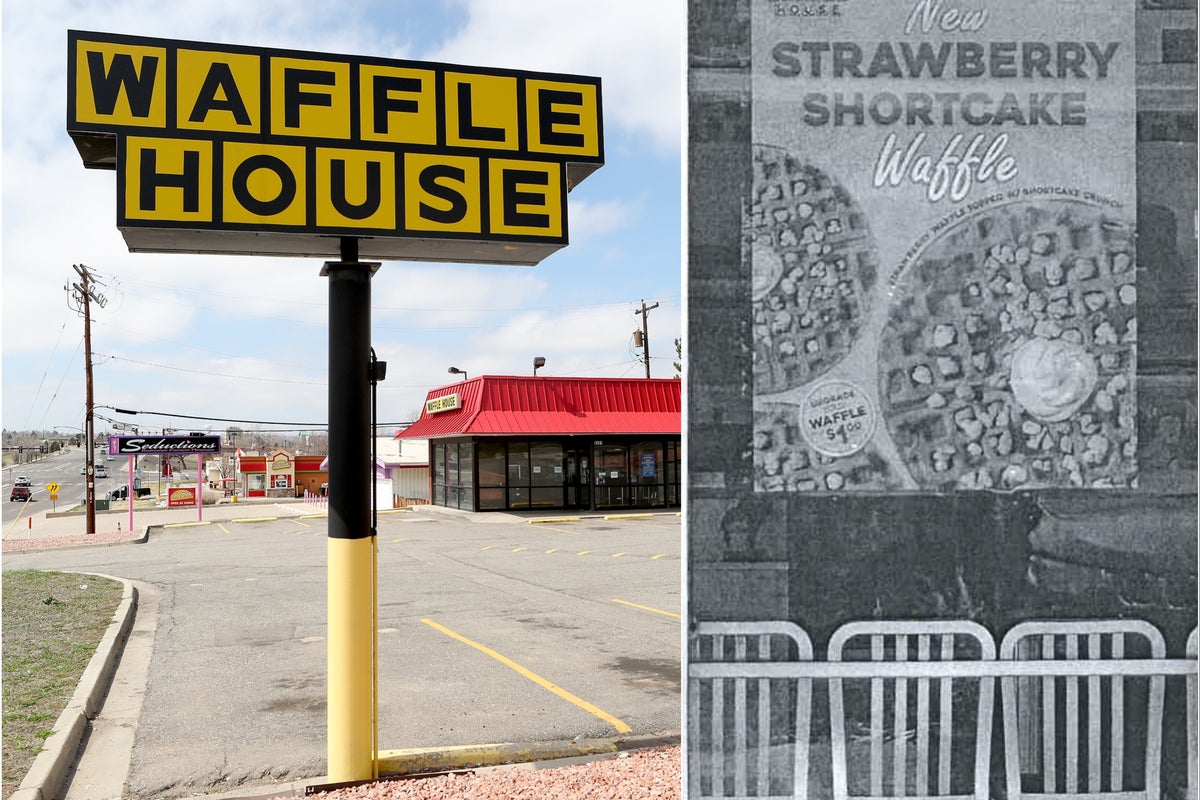
Commercial property owners operate under a continuous legal obligation known as the duty of care. When a business invites the public onto its property to generate revenue, it enters a tacit risk management contract. A breakdown in this contract occurs when architectural design, marketing execution, and pedestrian biomechanics intersect negatively. The litigation involving an 84-year-old plaintiff, a Waffle House advertisement, and a non-standard curb height offers a stark case study in how visual marketing strategies can directly compromise physical infrastructure safety.
To evaluate the validity of such a claim, analysts must look past the sensationalized headlines and deconstruct the event into three distinct, measurable variables: sensory capture efficiency, architectural compliance, and human gait mechanics.
The Tri-Causal Framework of Premise Liability
The incident cannot be understood as a isolated failure of either the pedestrian or the property owner. Instead, it represents a systemic failure across three distinct operational layers.
[Sensory Capture] + [Architectural Deviation] + [Biomechanical Vulnerability] = Incident Event
1. Sensory Capture and Cognitive Load
Commercial signage is explicitly engineered to hijack human attention. In marketing terms, this is success; in safety engineering, it is a forced cognitive distraction. The human brain possesses a finite capacity for working memory and situational awareness. When an advertisement achieves high sensory capture efficiency, it induces "inattentional blindness."
The pedestrian allocates visual processing power away from ground-level navigation to decode the marketing message. Property owners who place high-impact visual stimuli directly adjacent to navigational hazards create a high-risk zone where cognitive distraction is almost guaranteed.
2. Architectural Deviation and Micro-Topography
The plaintiff cited an "abnormally high" curb. In civil engineering, standard curb heights typically range between 4 to 6 inches. This consistency allows humans to develop a subconscious locomotive expectation. When a curb deviates from municipal building codes or regional standards—even by a fraction of an inch—it violates the pedestrian's predictive motor planning.
- Standard Curb Gradient: Predictable, uniform height allowing for passive clearing by the foot.
- Non-Standard Variation: Forces an active, conscious adjustment that a distracted pedestrian cannot calculate in real-time.
3. Biomechanical Vulnerability of Aging Demographics
Human gait mechanics undergo significant changes with age. Empirical data in gerontology shows that older adults exhibit reduced toe clearance, slower compensatory stepping reactions, and a greater reliance on continuous visual feedback of the terrain.
An 84-year-old pedestrian requires more processing time to negotiate changes in elevation. When visual feedback is interrupted by a corporate advertisement, the margin for error drops to near zero. A younger pedestrian might recover from a trip via rapid muscle activation; an older individual faces a much higher probability of a full fall event.
Quantifying the Liability Risk Matrix
Property owners frequently misjudge the financial risks associated with perimeter marketing. The chart below establishes how visual stimulation interacts with structural hazards to determine liability exposure.
| Visual Stimulus Intensity | Structural Conformity | Risk Level | Primary Liability Vector |
|---|---|---|---|
| Low (Standard Signage) | High (Code Compliant) | Negligible | Comparative negligence of pedestrian |
| High (Aggressive Ad Placement) | High (Code Compliant) | Moderate | Contributory negligence via distraction |
| Low (Standard Signage) | Low (Defective Curb) | High | Strict premises liability for hazard |
| High (Aggressive Ad Placement) | Low (Defective Curb) | Critical | Joint marketing and structural negligence |
This matrix illustrates that the Waffle House case sits in the Critical Risk quadrant. The business actively pulled the pedestrian's eyes upward while failing to maintain a predictable walking surface downward.
Operational Remediation Strategies
To mitigate litigation risks without neutralizing marketing efficacy, commercial enterprises must adopt a structured approach to site design.
Spatial Separation Zones
Marketing teams and facilities engineering teams must collaborate. High-impact visual advertisements should never be placed within a 10-foot radius of a primary elevation change, such as steps, ramps, or curbs. Signage must be positioned either far ahead of the hazard—allowing the customer to process the information and re-engage with their surroundings—or well past it.
High-Contrast Visual Cueing
If structural variations in curbs cannot be immediately re-engineered to code, property owners must deploy physical alerts. Applying high-visibility, slip-resistant yellow safety paint to the edge of the curb alters the pedestrian's peripheral vision. This ensures that even if the primary gaze is captured by an advertisement, the peripheral vision detects the elevation change.
Comprehensive Site Audits
Businesses must move away from reactive maintenance and adopt predictive risk modeling. This involves mapping out the exact foot-traffic pathways of the most vulnerable customer segments and auditing those paths for visual distractions and micro-topographical hazards simultaneously.
The ultimate resolution of cases like the Waffle House lawsuit relies on proving whether the business created an "unreasonable hazard." When a company pairs distracting stimuli with non-standard infrastructure, they systematically build the exact environment required for a liability claim. Corporate strategy must pivot to treat pedestrian safety not as a legal afterthought, but as a core component of structural design.


