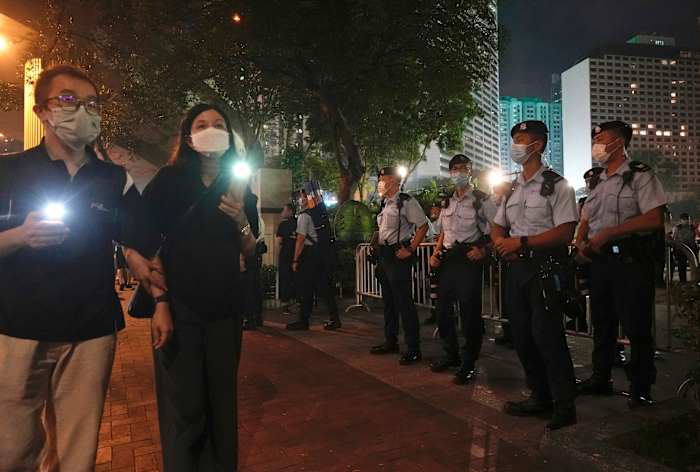
Prosecutorial strategy in national security cases requires a structural shift in how courts evaluate historical assembly, political speech, and organizational intent. When a judiciary evaluates the sentencing phase of organizers linked to the defunct Hong Kong Alliance in Support of Patriotic Democratic Movements of China, the proceedings reveal a calculated transformation of public memory into a liability under the National Security Law. This systemic overhaul strips away the traditional separation between advocacy and subversion, replacing historical evaluation with a strict statutory hierarchy of culpability.
The legal mechanism rests on the operational framework of the National Security Law enacted in 2020. Article 22 classifies subversion into principal offenders, active participants, and minor participants, establishing mandatory sentencing floors that restrict judicial discretion. For legal analysts examining the sentencing arguments presented against former leaders of the vigil organization, the core tension lies not in the dispute of past actions, but in the statutory reinterpretation of those actions. Organizing an annual commemoration is no longer framed as an exercise in freedom of expression or political assembly; it is formally recategorized as an ongoing operational effort to subvert state power through collective mobilization.
To understand the trajectory of these hearings, one must analyze the prosecution's method of establishing intent. State attorneys utilize a three-part evidentiary standard that maps organizational output to systemic disruption. First, the structural continuity of the alliance over three decades is presented as an institutionalized campaign rather than isolated annual events. Second, public declarations, manifesto statements, and digital archives are parsed to demonstrate an alignment with foreign political bodies or ideological objectives that conflict with the sovereign framework. Third, financial and logistical networks are audited to trace the velocity and source of capital used to sustain the organizational apparatus.
This approach creates a severe structural penalty for institutional persistence. Under standard criminal statutes, duration of operation might mitigate severity through established community ties or historical precedent. Under the statutory framework governing national security litigation, however, duration compounds liability. Each successive year of organizing a prohibited or unapproved mass gathering functions as a discrete metric of escalation. The prosecution argues that continuous operation despite shifting legal parameters signals intent to challenge statutory authority directly, thereby moving the defendants past the threshold of active participants into the category of principal offenders.
Defense strategies face a severe constraint matrix within this environment. Traditional legal defenses that rely on constitutional protections for free speech or historical precedent find little traction because the statutory architecture of the National Security Law supersedes prior common law interpretations of political rights. Counsel is forced to pivot from contesting the underlying acts to parsing the precise statutory definitions of leadership tiers. By arguing that individual defendants played administrative rather than strategic roles, defense teams attempt to lower the classification from principal offender to active participant, unlocking lower mandatory sentencing minimums.
The mechanics of this classification hinge on the definition of organizational hierarchy. The prosecution defines leadership through functional impact, measuring the visibility of public figures, their role in drafting institutional rhetoric, and their capacity to direct subordinate labor. The defense counters by decoupling public visibility from internal governance, asserting that prominent figures often serve as figureheads while operational control remains decentralized or handled by external actors who may not be present in the courtroom. This evidentiary battle determines which statutory sentencing tier applies, dictating whether a defendant faces a baseline of ten years to life imprisonment or a reduced term scaled by active participation limits.
Beyond the immediate courtroom dynamics, these sentencing hearings establish a procedural precedent for future political litigation in the jurisdiction. The normalization of restricted public galleries, streamlined evidentiary hurdles, and the application of designated judges create a distinct judicial subsystem. This subsystem operates with a high degree of predictability regarding outcomes, shifting the primary variable from the verdict itself to the marginal calibration of the sentence length. The strategic utility for the state lies in demonstrating the absolute cost of institutional memory, ensuring that alternative historical narratives regarding state formation and political legitimacy are systematically priced out of the public sphere.
The long-term operational outcome of this jurisprudence is the complete elimination of autonomous civil society infrastructure. When historic political organizations are dismantled not merely through dissolution orders, but through the penalization of their historical archives and leadership structures, the deterrent signal extends far beyond the defendants in the dock. Future organizers must calculate the risk profile of collective action against a legal precedent where administrative participation in historical commemorations carries the legal weight of state subversion. Consequently, political dissent is forced to evolve from institutionalized, visible mass movements into atomized, low-visibility expressions that resist easy categorization by prosecuting authorities.
The final phase of these proceedings requires a rigorous assessment of how appellate mechanisms will interact with the established sentencing baselines. Because the National Security Law vests primary interpretive power outside standard judicial review channels, appeals based on proportionality or historical context face structural deadlocks. The appellate courts must evaluate whether the original sentencing judge correctly applied the statutory tiers of culpability rather than whether the statute itself infringes upon international human rights frameworks. Practitioners observing the appellate horizon must anticipate that relief will not come from structural judicial nullification of the statutory floors, but from precise procedural challenges concerning evidentiary overreach in the classification of leadership roles. The sentencing hearings thus mark the final consolidation of a legal environment where historical continuity is systematically dismantled by statutory design.