Chasing referral traffic from legacy social networks is a dead end. If you're still building a media strategy around algorithmic handouts from Facebook or X, you're playing a game that ended three years ago.
Nic Newman, Senior Research Associate at the Reuters Institute for the Study of Journalism, has spent years tracking the structural shifts in digital news. Through the annual Digital News Report and the Journalism, Media, and Technology Trends and Predictions reports, Newman has consistently highlighted a stark reality. Publishers aren't dying, even if the old ad-funded traffic model is collapsing. Instead, growth has concentrated into specific, high-intent pockets where audiences actually care about the brand they're reading or watching.
I've watched countless newsrooms burn millions trying to outrun search engine updates while ignoring the exact channels Newman's research points toward. They treat direct audience relationships like a side project. That's backwards.
Why Nic Newman Says Publisher Growth Comes From Direct Habits
The core finding across Nic Newman's work at the Reuters Institute is simple. Traffic volume no longer equals business health.
For over a decade, media companies optimized for scale. Cheap clicks, programmatic display ads, and viral social headlines drove the entire industry. When referral traffic from major social platforms dropped sharply across global markets, organizations built on scale saw their revenue evaporate overnight.
Yet publishers focusing on direct habits are expanding. According to Reuters Institute findings, media executives increasingly prioritize direct website and app traffic, email newsletters, and podcasts over third-party social feeds. Why? Because a reader who types your URL into a browser or opens your newsletter every morning converts to a paying subscriber at exponentially higher rates than someone clicking a random link on a social feed.
Stop measuring success by unique monthly visitors. Start measuring it by how many people would notice if you disappeared tomorrow.
The Subscription Ceiling and Bundling Reality
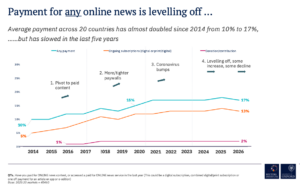
Subscriptions remain the primary revenue focus for a large majority of news leaders surveyed by the Reuters Institute. Still, Newman's research flags a major friction point that many executives ignore.
Subscription fatigue is real. Most households will only pay for one or two standalone news products. If your entire growth model relies on convincing an average reader to add a fourth or fifth monthly news bill to their credit card, you're going to hit a wall fast.
The publishers breaking through this ceiling aren't just selling raw news anymore. They're bundling. Look at how The New York Times transformed its business around games, cooking, sports via The Athletic, and product reviews via Wirecutter. Smaller and regional outlets are copying this playbook on a realistic scale by combining local journalism with community events, niche lifestyle verticals, or specialized B2B intelligence.
If you're running a niche publication, ask yourself what daily utility you offer beyond breaking news. News is a commodity. Utility is a habit.
Video and Audio Are No Longer Optional Side Projects
Text-only publishing is shrinking as a primary consumption mode for younger audiences. Nic Newman's reports repeatedly emphasize how rapidly news consumption is shifting toward video platforms like YouTube and TikTok, alongside long-form audio.
Many traditional editors hate this shift. They view short-form video as shallow and beneath serious journalism. That attitude is pure arrogance, and it's costing them an entire generation of readers.
YouTube has quietly become one of the most important discovery and monetization engines for news organizations and independent journalists alike. Unlike legacy text platforms, YouTube rewards watch time, deeper explanation, and personality-driven reporting. Publishers that invest in dedicated video teams—rather than just slapping text captions over B-roll—are finding new audiences that never visit a traditional homepage.
Podcasts occupy a similar high-trust space. Even as the broader podcast advertising market experienced corrections, high-intent news and analysis podcasts continue to deliver unmatched listener loyalty. A twenty-minute daily audio briefing builds a parasocial bond with the host that a ten-paragraph text article rarely matches.
Personality Over Institutional Voice
Here's something Newman's research makes painfully clear. Audiences increasingly follow individuals rather than faceless institutions.
In markets around the world, independent creators, newsletter writers, and video commentators are capturing attention that used to belong exclusively to legacy mastheads. People trust human voices they recognize. When a publisher forces every journalist to write in a sterile, institutional tone, they strip away the exact human element that drives modern engagement.
Smart publishers are leaning into journalist-led newsletters and host-driven video formats. Yes, it creates retention risk if a star writer leaves for Substack or launches an independent channel. You mitigate that risk by paying your talent properly and giving them internal distribution support they couldn't build alone, not by suppressing their voice.
How AI Search Is Reshaping Publisher Discovery
You can't talk about publisher growth right now without addressing generative AI. Nic Newman's recent trend reports dedicate massive attention to how AI-powered search interfaces and chatbots threaten traditional SEO traffic.
When a search engine answers a user's basic factual question directly at the top of the page, nobody clicks through to your site. That means commoditized content—basic explainers, rewritten press releases, simple weather or stock updates—has zero long-term value. It's dead weight on your CMS.
Where does that leave growth-minded publishers? It pushes them toward things an AI model can't replicate on its own:
- Original investigative reporting that uncovers new facts rather than summarizing existing ones.
- On-the-ground local coverage where a reporter physically attends town halls, courtrooms, and community events.
- Sharp, human-led analysis with a distinct point of view that readers actively seek out.
- Live events and peer communities that require real-world human connection.
Publishers licensing their archives to AI companies are securing short-term cash injections, which helps the balance sheet today. Licensing deals aren't a substitute for an audience strategy. If you trade away your entire content library without building a direct relationship with your readers, you're just feeding the machine that plans to replace you.
B2B and Niche Verticals Outperform General News
One of the clearest bright spots in the Reuters Institute data sits outside consumer mass media. Business-to-business publishing, specialized trade journalism, and high-value niche verticals are thriving while general consumer news struggles.
Why does B2B work so well? Because the buyer isn't paying out of their personal entertainment budget. They're expensing it to a corporate budget because missing critical industry intelligence costs them money.
Whether it's energy transition policy, healthcare regulation, financial technology, or supply chain logistics, professionals happily pay hundreds or thousands of dollars a year for accurate, timely reporting that helps them do their jobs. Consumer publications trying to survive on a ten-dollar monthly subscription need massive volume to pay a single reporter's salary. A B2B outlet charging two thousand dollars per seat needs a fraction of that audience to stay wildly profitable.
Even consumer publishers are adopting B2B mechanics by launching paid industry briefings, data dashboards, and executive summits alongside their free public journalism.
Practical Shifts You Need to Make Right Now
Knowing what Nic Newman's research shows is useless if your editorial workflow stays stuck in 2016. Most media teams know they need better direct retention, yet they still spend eighty percent of their energy chasing cheap search and social clicks.
If you want to align your publication with where actual growth is happening, start cutting dead weight immediately:
- Audit and kill commodity content. Look at your analytics over the last six months. Identify the low-effort, rewritten news aggregation posts that bring zero newsletter signups and zero subscription conversions, and stop assigning them. Reallocate those reporting hours to original features or local scoops.
- Make newsletter conversion your primary homepage metric. Stop cluttering your articles with ten different programmatic ad units that ruin the reading experience. Put a clean, high-value newsletter signup box front and center, and promote it aggressively across every video and audio asset you produce.
- Invest in one flagship video or audio format. Don't try to be everywhere at once. Pick either YouTube or a daily/weekly podcast, assign a dedicated producer who understands the medium, and commit to publishing consistently for at least twelve months before judging the return.
- Build a non-news retention hook. Introduce a weekly interactive element, a curated resource directory, a niche vertical newsletter, or a local event series that gives your audience a reason to engage even on slow news days.
The media companies winning today aren't waiting for algorithms to rescue them. They're building smaller, fiercely loyal audiences that show up directly, trust the voices behind the work, and pay for value they can't get from a search summary.