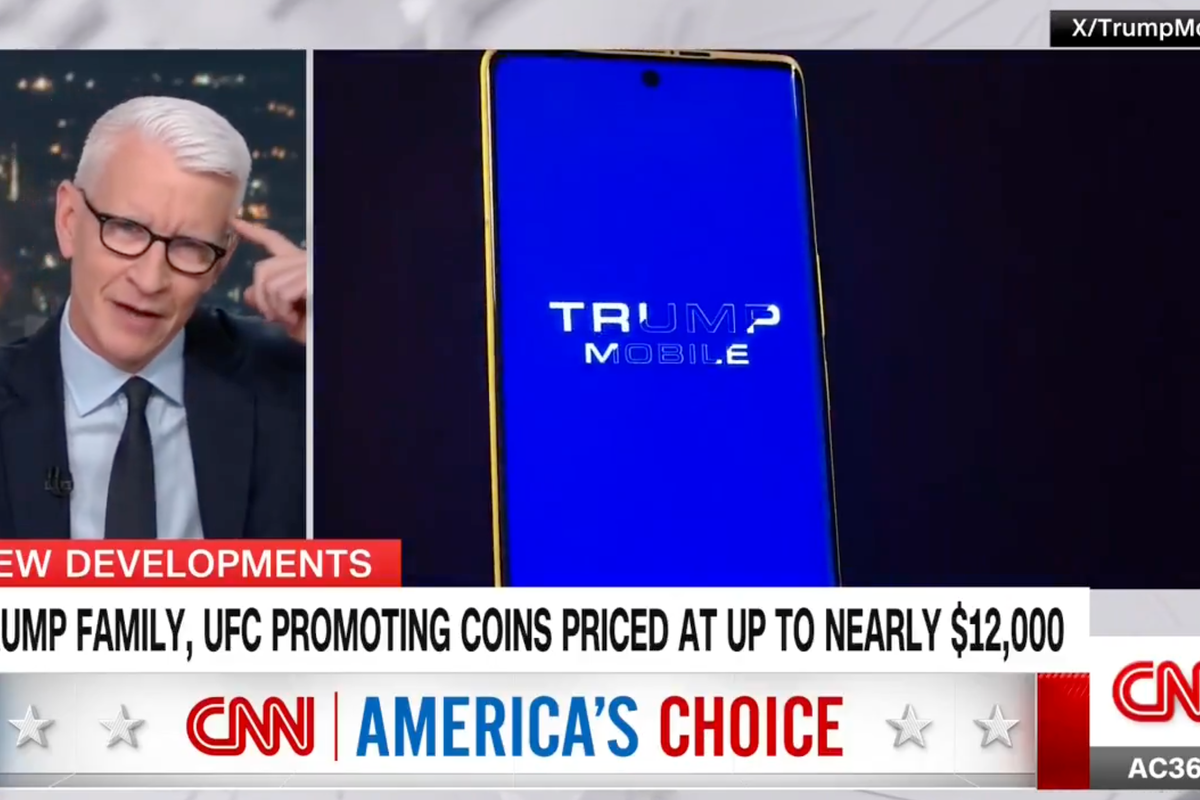
CNN anchors are laughing on live television again. They are giggling at a $500 gold-plated smartphone. They are scoffing at $100 Bibles, $12,000 commemorative coins, and gold high-top sneakers. "Where does he find the time?" they gasp, clutching their metaphorical pearls while reading from a teleprompter.
It is a comforting routine for the media elite. It allows them to feel intellectually superior while framing Donald Trump’s sprawling product catalog as a desperate, chaotic side hustle. You might also find this similar article useful: Why Your Wallet is Screaming What the Headline Inflation Numbers Keep Hiding.
They are entirely missing the point.
The collective elite mockery of political merchandise is not a critique of bad product design. It is a fundamental misunderstanding of modern brand licensing, attention monetization, and direct-to-consumer loyalty architecture. While legacy media analysts ask how a political figure finds the hours in the day to design an 11-stripe American flag phone, the actual mechanism of contemporary commerce is staring them right in the face. As extensively documented in recent reports by CNBC, the results are worth noting.
He does not find the time. He does not need to. He licensed his name.
The Illusion of the Working CEO
Legacy media remains trapped in an industrial-era mindset. They operate under the assumption that to sell a product, an executive must sit in a boardroom, review blue prints, manage supply chains, and oversee quality control.
That is not how modern enterprise works.
In the 21st century, attention is the ultimate commodity. Manufacturing is commoditized; distribution is plug-and-play. The hardest asset to acquire is a captive, highly motivated audience willing to convert attention into capital. Once you have that, the traditional product pipeline becomes completely irrelevant.
Consider how licensing actually functions in the corporate world:
- The IP Owner: Supplies the brand equity, the logo, and the immediate customer acquisition channel.
- The Licensee: Handles the manufacturing, supply chain logistics, customer service, and regulatory compliance.
- The Deal: The IP owner takes a massive upfront fee or a heavy percentage of gross sales, risking zero capital of their own.
When a media personality asks where a public figure finds the time to launch a phone or a sneaker line, they reveal their own financial illiteracy. The operational burden on the brand owner is essentially zero hours. The licensee does the heavy lifting. The brand owner simply signs the contract and records a 30-second promotional clip.
I have seen legacy consumer packaged goods corporations spend tens of millions of dollars over three years trying to build brand trust for a new product, only to watch it get absolutely crushed by a single influencer who white-labeled a generic formula and promoted it on TikTok. The product quality did not win the day. The distribution did.
The Tech Elite Misdirection
Tech commentators are currently having a field day tearing apart the technical specs of the "T1" gold smartphone. They point out that it resembles a rebranded, lower-end Taiwanese model. They scoff at the software optimization. They note the inaccuracies in the flag design printed on the chassis.
They think they are winning an argument. In reality, they are playing the wrong game.
No one buys a $500 branded political smartphone because they want to compete with the processing power of a flagship Apple or Samsung device. Buying this product is not a technology purchase; it is a financial pledge of allegiance. It is a physical manifestation of tribal identity.
The True Utility of Political Merch
| Attribute | What the Media Throws Up Over | The Economic Reality |
|---|---|---|
| Product Specs | Low-end hardware, incorrect flag design, outdated chips. | Irrelevant. The phone is a badge of membership, not a tool for high-end mobile gaming. |
| Price Point | Overpriced at $500 for the tech provided. | Correctly priced for an explicit luxury/identity markup where margin is maximized. |
| Supply Chain | White-labeled foreign manufacturing. | Standard practice for 90% of global consumer tech brands, standardizing high profit margins. |
To judge an identity product by its technical utility is a failure of basic consumer psychology. When luxury fashion brands sell a plain white cotton t-shirt with a screen-printed logo for $450, fashion critics do not analyze the thread count to prove the consumer is being cheated. They understand that the consumer is buying the brand equity and the social signaling mechanism.
Political merchandise operates on the exact same economic wavelength, but with an even more potent emotional driver: ideological alignment.
The Myth of the Damaged Brand
The most common "lazy consensus" among political pundits is that selling cheap or eccentric merchandise degrades the dignity of a public figure's brand. They argue that it alienates moderate supporters and makes the individual look small-time.
This logic is completely backwards.
In a highly polarized attention economy, trying to maintain a pristine, universally acceptable brand is financial and political suicide. Universal appeal leads to total dilution. The goal is no longer to avoid alienation; the goal is to maximize intensity among your core demographic.
High-priced commemorative items and branded Bibles do something that standard political fundraising can never achieve: they eliminate the friction of altruism.
When a campaign asks for a $100 donation, the donor receives psychological satisfaction but nothing tangible. When a brand sells a $100 book or a $500 piece of technology, the consumer receives a physical artifact that sits on their coffee table or in their pocket. It acts as a permanent, physical anchor for their loyalty. It is a self-funding loyalty program that generates massive revenue streams while solidifying a base of hyper-consumers.
Dismantling the Premium Fallacy
Let us address the "People Also Ask" consensus regarding this phenomenon: Doesn't selling low-quality merchandise hurt long-term credibility?
The short answer is no, because credibility is no longer defined by traditional gatekeepers or objective standards of premium manufacturing.
We live in a decentralized media ecosystem where credibility is defined by authenticity and anti-establishment signaling. To the target consumer, the fact that mainstream media networks and tech journalists are actively mocking a product does not discredit the item. It validates it. The mockery itself becomes proof that the product is an authentic counter-cultural statement.
Imagine a scenario where a political figure launched a highly polished, Silicon Valley-approved, beautifully minimalist smartphone designed by former Apple engineers. It would be praised by tech blogs, but it would completely fail as a political symbol. It would look like the product of the very establishment its base distrusts. A slightly unpolished, aggressively branded, overtly symbolic device fits the narrative perfectly.
The downside to this contrarian model is obvious: it creates a hard ceiling on your customer base. You will never convert the skeptic. You will never sign up the moderate. But in the modern economy, a hyper-monetized, deeply devoted 35% of a market is infinitely more valuable and resilient than a lukewarm, easily distracted 70%.
Stop analyzing the spec sheets. Stop counting the stripes on the flag. Stop wondering how an international public figure manages a supply chain in between court dates and rally schedules. They do not. They have mastered the rules of the attention economy while the media is still trying to grade them on the rules of 1990s retail corporate governance.
The laugh is on the people doing the laughing.