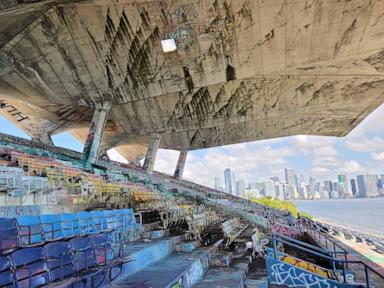
You can see the sweeping, folded concrete roof from across Biscayne Bay. It looks like a modernist wave frozen in mid-air, casting cool shadows over rows of empty, graffiti-splattered seats.
For over thirty years, the Miami Marine Stadium on Virginia Key has sat quiet. Hurricane Andrew forced its closure in 1992, and it quickly became an unauthorized urban canvas for graffiti artists and a haunting backdrop for curious kayakers. But the long neglect might finally be ending. Miami voters and city officials are weighing a crucial partnership with private operators to bring the venue back to life. It is a polarizing battle between historic preservation and neighborhood anxiety over noise and traffic.
A Concrete Masterpiece Born From Immigration
To understand why people care so deeply about a rotting hulk of concrete, you have to look back at how it started. In the early 1960s, a 28-year-old architect named Hilario Candela arrived in South Florida as a refugee from the Cuban Revolution. Tasked with designing a home for powerboat racing on Virginia Key, Candela didn't just pour a standard grandstand. He engineered a Brutalist marvel featuring a massive cantilevered roof spanning nearly 326 feet without intermediate supports.
When it opened in December 1963, it was the only stadium in America purpose-built for motorboat racing. It cost $2 million at the time, equivalent to roughly $21 million today. Sadly, tragedy struck on opening day when a driver named James Tapp crashed and died during a race. Despite the grim start, the venue quickly evolved into a cultural heartbeat for the city.
When Jimmy Buffett and Elvis Ruled the Bay
Before the arena became a ghost town, it was the place to be seen in Miami. Picture this: a massive floating stage anchored right in front of the grandstands. Fans didn't just sit in the 6,500 concrete seats; hundreds of them floated right up on boats, canoes, and yachts, dropping anchor in the basin to tailgate on the water.
Elvis Presley filmed scenes for his 1967 movie Clambake right here, racing speedboats across the bay. President Richard Nixon and Sammy Davis Jr. shared a stage during a 1972 campaign rally. Gloria Estefan packed the venue. And then there was Jimmy Buffett.
The late Margaritaville icon played an legendary show here in August 1985, an event captured in his Live by the Bay video. Don Johnson of Miami Vice fame introduced him. At the end of the night, Buffett famously leaped off the floating stage into the warm water, swimming out to his cheering fans. Decades later, shortly before his passing, Buffett wrote a letter pleading with city officials to save what he called a "little cathedral of musical fun".
The Endless Fight to Save Virginia Key
After Hurricane Andrew battered the structure in 1992, inspectors condemned it. City leaders eyed the valuable waterfront land for demolition more than once. Preservationists panicked. Groups like the Dade Heritage Trust and local activists fought back, earning the stadium a spot on the National Register of Historic Places in 2018.
Small wins followed. Crews repaired damaged underwater support pilings, spending millions just to stop the erosion. The annual Miami International Boat Show used the surrounding asphalt parking lots for temporary displays, proving the area could still handle crowds. But a permanent fix required massive capital.
Now, the city is looking at partnering with private hospitality groups to handle day-to-day operations while keeping public ownership intact. Proponents argue the site could rival Colorado's Red Rocks Amphitheatre for sheer acoustic and visual drama. Imagine watching a sunset concert against the glowing downtown Miami skyline with the bay breeze hitting your face.
Why Not Everyone Is Cheering
Local residents aren't entirely sold on the romantic vision. Neighborhood groups, including the Brickell Homeowners Association, raise valid concerns about what a resurrected entertainment mega-venue means for daily life. Virginia Key is a fragile ecological sanctuary. Pumping thousands of concertgoers onto the causeway threatens gridlock traffic and noise pollution that would echo right across the water into residential balconies.
Critics argue the city should focus on quiet green spaces and low-impact parks rather than commercializing the waterfront for high-ticket concerts. Cynicism runs deep because past municipal promises to restore the stadium have stalled out repeatedly due to shifting political tides and ballooning cost estimates.
Reviving a decaying Brutalist icon isn't cheap or easy. If you care about midcentury architecture, maritime history, or catching live music under a Florida moon, keep an eye on how Miami handles this vote. The fate of the marine stadium decides whether a legendary piece of the city's soul gets a second act or crumbles completely into the bay. Stop by Virginia Key next time you're in town, look across the water at the graffiti-covered concrete ribs, and decide for yourself what it's worth.