The automation of the Russo-Ukrainian air war has reached a structural tipping point where tactical engagements are no longer bounded by geographic frontlines. The intersection of long-range one-way attack (OWA) unmanned aerial systems (UAS), dense electronic warfare (EW) environments, and mid-air interception tactics has created an operational spillover effect into mainland Europe. As both combatants scale asymmetric strike capabilities, the structural dynamics of this conflict are reformatting European airspace security through two distinct mechanisms: the physical extension of deep-strike vectors and the electromagnetic hijacking of guidance architectures via spoofing and signal redirection.
To understand how localized drone operations escalate into transcontinental security threats, the conflict must be analyzed not through political intent, but through structural frameworks governing electromagnetic attrition, supply-chain localization, and kinetic interception math. For another look, read: this related article.
The Tri-Centric Architecture of Asymmetric Air Supremacy
The current phase of the aerial campaign operates across three distinct technological vectors. Each vector possesses unique cost functions, operational ranges, and failure modes that dictate how stray or manipulated hardware enters sovereign European airspace.
                          [ Asymmetric Air Supremacy ]
                                        │
         ┌──────────────────────────────┼──────────────────────────────┐
         ▼                              ▼                              ▼
[ Tactical FPV Layer ]        [ Strategic OWA Layer ]        [ Interception & EW Layer ]
  - Range: <15 km                - Range: 500-2,000 km          - GPS/GNSS Spoofing
  - Cost: $400-$1,000            - Cost: $20,000-$50,000        - Signal Hijacking (C2)
  - Attrition Rate: ~90%         - Threat to Europe: Deflection - Kinetic Air Defense Gaps
1. The Short-Range Tactical FPV Layer
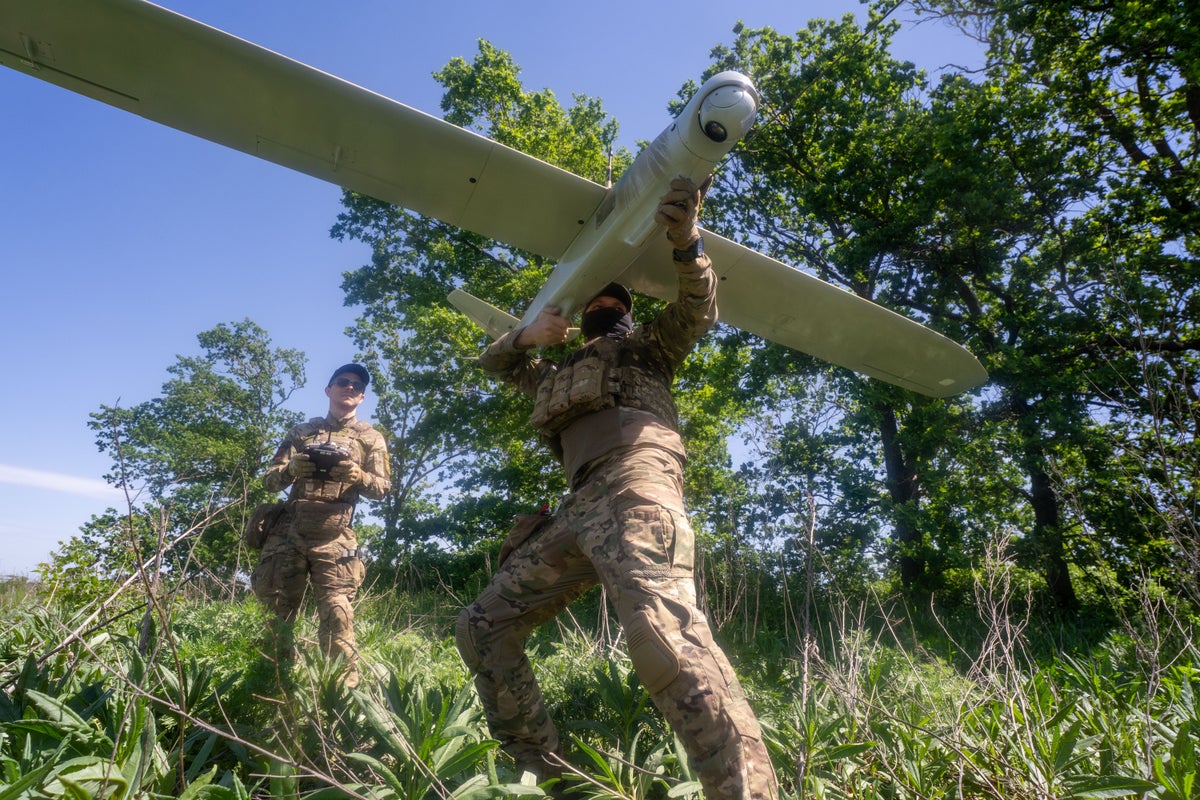
First-Person View (FPV) loitering munitions operate within a restricted operational radius of less than 15 kilometers. Characterized by unit costs ranging from $400 to $1,000, these platforms rely on high-bandwidth, low-latency analog or digital radio frequency (RF) control links. While they account for the vast majority of battlefield hull losses, their limited battery life ensures that unmitigated or lost-link tactical platforms pose zero physical threat to neighboring European states. Further insight on this matter has been shared by CNET.
2. The Strategic Long-Range OWA Layer
Operating at ranges between 500 and 2,000 kilometers, this layer comprises platforms designed for deep structural attrition. Ukraine’s domestic production expansion has generated over 30 distinct types of long-range drones capable of striking deep into the Russian interior, specifically targeting oil refining capabilities and maritime logistics hubs.
The primary platforms driving this layer rely on internal combustion engines, low-radar-cross-section composite airframes, and combined GNSS/Inertial Navigation System (INS) guidance packages. When these systems are disrupted, their high fuel fractions allow them to fly hundreds of kilometers off-course, crossing directly into Poland, Romania, or the Baltic states.
3. The Interception and EW Hijacking Layer
The most critical vector driving European airspace exposure is mid-air interception and command-and-control (C2) manipulation. Rather than destroying incoming platforms via kinetic means, Russian electronic warfare units employ high-power, multi-band spoofing transmitters.
By overriding the primary encrypted military GNSS signals (such as GPS, GLONASS, or Galileo) with simulated coordinate data, EW operators alter the drone’s perceived position. This induces a false telemetry calculation, forcing the vehicle’s autopilot to steer toward unprogrammed vectors—frequently deflecting the strike profile outward toward European airspace.
The Cost Function of Electromagnetic Deflection
The economic asymmetry of kinetic air defense creates an unsustainable expenditure model for NATO and its partners on the eastern flank. Defending against low-cost, long-range OWA platforms using traditional surface-to-air missile (SAM) systems presents a fundamental mathematical vulnerability.
The operational economics are governed by the following cost ratio:
$$R_{\text{cost}} = \frac{C_{\text{effector}}}{C_{\text{target}}}$$
Where $C_{\text{effector}}$ is the cost of the intercepting missile and $C_{\text{target}}$ is the cost of the invading drone. When utilizing a Patriot PAC-3 interceptor ($C_{\text{effector}} \approx $4,000,000$) or an IRIS-T SLM ($C_{\text{effector}} \approx $450,000$) against an uncrewed system manufactured for $$20,000$, the economic efficiency index is highly unfavorable.
This mathematical reality has forced a rapid paradigm shift toward non-kinetic neutralization methods, specifically localized EW degradation and uncrewed interceptor systems. However, this shift introduces secondary systemic risks.
The Mechanism of the "Ghost Flight"
When an OWA drone enters an intense EW bubble, the following cascade occurs within the navigation software:
- Receiver Saturation: The spoofing transmitter floods the drone's antenna with a signal matching the carrier frequency ($L1$ or $L2$ bands) but at a significantly higher amplitude than the legitimate satellite constellation.
- Ephemeris Manipulation: The fake signal injects modified ephemeris data. The drone's flight controller calculates that it is hundreds of kilometers away from its true position.
- INS Drift Accumulation: If the drone detects the spoofing and switches exclusively to its onboard Inertial Navigation System, the absence of absolute coordinate updates causes positional drift. Over long distances, INS sensor drift accumulates exponentially, resulting in lateral deviation errors of up to 5% to 10% of the total distance flown.
The intersection of these three steps transforms a precision weapon into an unguided, long-range kinetic hazard. The platform continues to fly along its deflected vector until its fuel reserves are exhausted, explaining the recent debris discoveries and defensive scrambles inside NATO territory.
The Geopolitical Supply Chain Bottleneck
The escalation of the air war has triggered an industrial reaction from Moscow. As Western European nations transition from financial patrons to active industrial co-producers of Ukrainian long-range platforms, the Kremlin has reassessed its targeting philosophy. The defense industrial base supporting this drone war is no longer localized within Ukraine’s borders; it functions as a distributed European network.
| Variable | Ukrainian Domestic Assembly | European Joint Ventures |
|---|---|---|
| Primary Funding Mechanism | National Def. Budget / Crowdsourcing | Direct Allied Investment (€300M+ German/UK tranches) |
| Component Sourcing | Commercial Off-The-Shelf (COTS) | Mil-Spec Subsystems, Advanced Composites |
| Target Profile Vulnerability | High (Kinetic missile strikes on factories) | Low Kinetic / High Kinetic-Threat (Diplomatic escalation) |
| Electronic Counter-Measures | Rapid iterative software patches | Rigid qualification, highly secure links |
The Russian Ministry of Defense altered its strategic posture by publishing the exact corporate addresses of European defense enterprises engaged in joint drone manufacturing agreements with Kyiv. This step signals a structural transition: the Kremlin is reclassifying these European manufacturing facilities from neutral industrial zones into the "strategic rear" of the Ukrainian Armed Forces.
By explicitly naming facilities in the Czech Republic, Germany, and other NATO member states, Moscow has established a psychological deterrence framework. The strategic objective is to leverage European domestic political anxieties regarding direct kinetic contamination of NATO soil, thereby creating friction within the Western military assistance pipeline.
Airspace Decoupling and Defensive Limitations
European air defense architectures are fundamentally misaligned with the nature of the low-altitude, low-radar-cross-section threat profile. Traditional integrated air defense systems (IADS) optimized for high-altitude ballistic trajectories or fast-moving supersonic aircraft face specific operational limitations when confronted with low-speed, low-altitude uncrewed systems.
The first limitation is the radar horizon problem. Ground-based air defense radars operating in standard terrain environments face line-of-sight constraints due to the curvature of the Earth and local topography. A drone cruising at an altitude of 50 meters can evade detection until it is within approximately 25 to 30 kilometers of the radar array, leaving less than five minutes for threat identification, tracking, command routing, and kinetic engagement.
The second limitation involves target classification algorithms. To prevent radar screens from becoming cluttered with non-threatening tracks, military radar systems utilize velocity and size filters to discard returns from migratory birds or civilian weather phenomena. Low-speed composite drones frequently fall within these identical velocity parameters, meaning they are structurally filtered out by legacy systems until a visible penetration of airspace has already occurred.
This creates a severe operational bottleneck. To counter this, NATO forces have extended air policing missions, using platforms like the Eurofighter Typhoon or F-16 to physically intercept and visually identify slow-moving targets over Polish or Romanian airspace.
Yet, deploying a multi-million-dollar fourth- or fifth-generation fighter aircraft to shadow an uncrewed platform represents an unsustainable deployment of flight-hour resources and airframe fatigue capital.
The Proactive Interception Mandate
To mitigate the transcontinental spillover of the automated air war, the defensive posture of European borders must pivot from reactive kinetic defense to proactive electronic and autonomous containment. The following technical and tactical reconfigurations are required to secure border integrity:
- Establishment of Persistent Border EW Corridors: Deploying high-intensity, localized GNSS geofencing arrays along the eastern frontier. These systems must be capable of overriding corrupted navigation signals and forcing stray uncrewed platforms into controlled, low-altitude failsafe landings before they penetrate deep into civil aviation corridors.
- Transition to Low-Cost Kinetic Interceptors: Rapidly deploying specialized uncrewed interceptor platforms—such as the UK-partnered counter-drone systems designed to hunt OWA assets via automated optical tracking. This drives down the cost-to-kill ratio to an economically viable equilibrium.
- Decoupling Tracking Arrays from Strike Batteries: Distributing acoustic sensors, passive optical trackers, and low-altitude radar nodes along border perimeters. This ensures early detection of low-flying composite airframes without exposing high-value air defense batteries to specialized anti-radiation loitering munitions.
The strategic trajectory indicates that the boundary between electronic warfare manipulation and territorial sovereignty will continue to blur. As long as the structural cost asymmetry favors massed, long-range uncrewed strikes, the electromagnetic deflection of these weapons will remain an active threat to European airspace. Security will not be achieved through diplomatic deterrence, but through the deployment of autonomous, low-cost defensive infrastructure capable of neutralizing these platforms at the literal edge of the Euro-Atlantic theater.
The strategic evolution of uncrewed warfare requires a deep understanding of tactical shifts. To see how these operational dynamics are altering frontlines right now, watch this Field Report on Ukrainian Drone Momentum Shift, which provides a detailed look at the technological edge driving the moving frontlines.