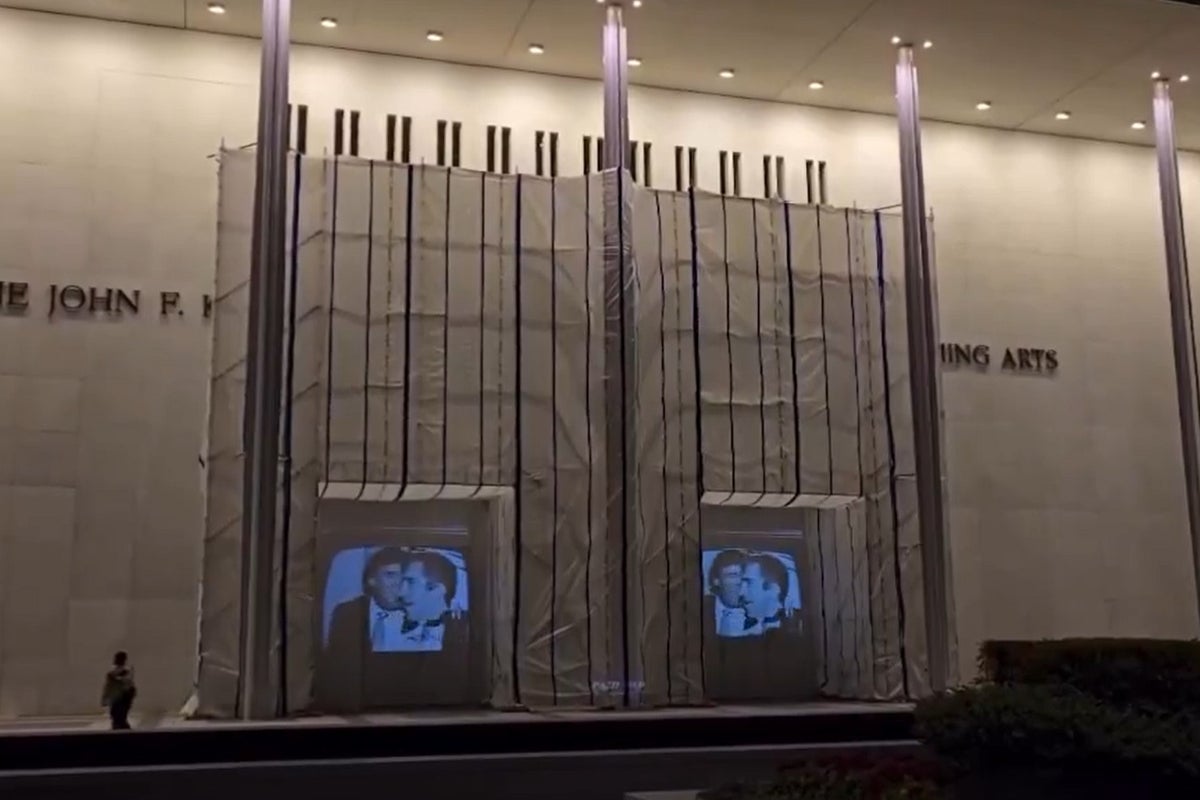
The generator hums a low, vibrating note that rattles the floorboards of a rented transit van parked just outside the perimeter of Washington’s official memory. It is three in the morning. The air carries that specific, heavy dampness peculiar to the Potomac in the colder months, a mist that clings to marble and turns streetlights into blurry halos. Inside the vehicle, fingers slick with nervous sweat tap against the housing of a high-lumens projector.
Then comes the flash.
A blinding beam of light cuts through the dark, striking the side of a massive stone facade. Instantly, the cold, institutional surface is overtaken by a massive, glowing caricature. Pete Hegseth stares out across the capital, reimagined as a weeping crocodile. Beside him, Stephen Miller’s features are warped into those of a predatory vampire, casting long, stylized shadows over the neoclassical architecture. Above them both, a stark digital stamp flashes over and over: 86 47.
This is the front line of a modern ideological conflict, fought not with legislative pens or cable news monologues, but with photons and stealth.
The Anatomy of a Midnight Raid
To understand why a group of anonymous creators would risk arrest to blast giant illustrations onto federal property, you have to look at the changing nature of public dissent. For decades, protest in the capital followed a predictable script. You applied for a permit. You marched down Pennsylvania Avenue. You held a cardboard sign that would eventually melt in the rain, and you went home hoping a camera crew caught your best angle.
That script is broken. In an era where digital noise drowns out traditional activism, these creators are choosing to bypass the system entirely.
Consider the logistics of a hit-and-run projection. It requires an intimate knowledge of lines of sight, electrical draw, and police patrol schedules. The artists operate in total anonymity, working under the cover of darkness to turn the city’s most sacred monuments into temporary billboards of resistance. The choice of imagery is calculated to sting. By portraying incoming administration officials not merely as political opponents but as grotesque archetypes—the insincere crocodile, the blood-drinking creature of the night—the installation attempts to strip away the polished veneer of executive authority.
The slogan 86 47 carries its own specific weight. Derived from old restaurant slang meaning to eject, discard, or refuse service to a customer, the phrase serves as a direct, numeric call to reject the incoming forty-seventh presidency before it even begins. It is short. It is punchy. It is easily memorized by passersby who snap photos before the authorities arrive to shut the operation down.
The Battle Over Collective Memory
Public spaces are never neutral. Every statue, every column, and every carved inscription in the District of Columbia is designed to project stability, permanence, and power. When guerrilla artists disrupt that permanence with temporary light, they create a jarring contrast between the timeless nature of the stone and the immediate, chaotic nature of current politics.
Imagine a commuter driving home after a grueling double shift. The city is quiet, almost dead. As they turn a corner near a well-known landmark, the familiar view is shattered by a multi-story display of political satire. For a brief moment, the illusion of total institutional control is broken. The viewer is forced to confront a counter-narrative, rendered in vivid, inescapable color.
This kind of activism relies entirely on the element of surprise. It treats the city itself as an interactive canvas, using the scale of the buildings to amplify a message that would otherwise be lost in the endless scroll of social media feeds. It is visual hijacking, forcing a captive audience to look at the faces of power through a deeply critical, satirical lens.
The Ephemeral Nature of Light
There is a profound vulnerability to this form of expression. Unlike a graffiti mural painted on a brick wall, light leaves no physical scar. When the plug is pulled, or when the security guards finally track down the source of the beam, the image vanishes instantly. The stone returns to its clean, white neutrality as if nothing ever happened.
But the image does not truly disappear.
In the modern ecosystem of protest, the physical projection is merely the catalyst. The real lifespan of the artwork exists in the digital photographs taken during those few minutes of exposure. Those images are uploaded, shared, and analyzed by millions of people who will never set foot in Washington. The physical wall is just a backdrop; the true gallery is the collective consciousness of the internet.
The authorities face a unique challenge in combating this tactic. You cannot easily arrest a beam of light. By the time a squad car pulls up to the curb, the transit van has already merged into the early morning traffic, its equipment cooling down in the back, leaving behind nothing but the cold, damp night air and a lingering sense of disruption.
The conflict over who controls the visual narrative of the nation's capital continues to evolve. As the political temperature rises, the tactics of dissent grow more inventive, more elusive, and significantly brighter. The walls of the city are no longer just monuments to the past. They have become the screen upon which the anxieties, fears, and furies of the present are projected for all the world to see.


