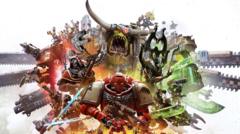
Hollywood has spent decades treating tabletop lore like a dry whiteboard, erasing the sharp edges to court a phantom mainstream audience. Then came the announcement that Mike Flanagan, the architect of modern melancholy television, was formally linking arms with Henry Cavill to steer Amazon's Warhammer 40,000 cinematic universe. It sounds like a match forged in high-tier fan fiction. It is actually a high-stakes collision between bleak auteurism and corporate risk management.
Amazon needs a massive, multi-platform anchor to justify the billions spent acquiring rights from Games Workshop, and Cavill needs a creative partner who can translate sprawling codex lore into prestige narrative without sanitizing the universe. Flanagan brings a reputation for treating genre fiction with literary dignity, transforming horror tropes into character studies about grief and obsession. Warhammer 40,000 is not merely a collection of space marines fighting aliens. It is a satirical, hyper-gothic tragedy where religious fanaticism is the only shield against literal daemons. Don't forget to check out our recent coverage on this related article.
For years, the adaptation graveyard has claimed properties that tried to flatten this universe into generic sci-fi action. The challenge facing Flanagan and Cavill goes far deeper than casting choices or visual effects budgets. They have to capture a tone that mainstream executives historically find terrifying: pitch-black irony wrapped in operatic despair. If they blink, the Imperium of Man turns into just another shiny space opera with bolters instead of blasters.
The Economics of Intellectual Property Stewardship
When Amazon signed a sprawling deal with Games Workshop to bring Warhammer 40,000 to the screen, studio accountants were betting on built-in built-up demand. They looked at the massive sales figures of miniature boxes, the sprawling digital ecosystem of video game adaptations, and the rabid devotion of a global community. Yet intellectual property of this scale comes with a distinct poison chalice. The audience does not just want entertainment. They want fidelity. If you want more about the history here, The Hollywood Reporter provides an informative breakdown.
The traditional Hollywood playbook demands broad accessibility. Execs want characters who can be easily summarized in a two-minute trailer, plots with clean moral arcs, and worlds that do not alienate casual viewers on a Tuesday night. Warhammer spits on all three requirements. The central faction, the Imperium, is a xenophobic, decaying fascist theocracy that tortures its own citizens to fuel interstellar travel. There are no heroes in the traditional sense. There are only monsters fighting worse monsters in a universe that grows darker by the millennium.
Flanagan specializes in claustrophobic character studies. His work on The Haunting of Hill House and Midnight Mass proved his ability to interrogate fanaticism, generational trauma, and institutional rot from the inside out. This background makes him uniquely qualified to handle the psychic weight of the Warhammer setting. He understands how to make viewers empathize with broken people trapped inside horrific systems.
Yet the friction point lies in Amazon's boardrooms. Can a multi-billion-dollar corporate enterprise sustain a television landscape where the protagonists are religious zealots committing atrocities in the name of a rotting corpse on a golden throne? Studio notes have a way of softening the edges until the unique flavor of the source material evaporates. Cavill, a notoriously outspoken custodian of lore who famously walked away from The Witcher over creative differences, acts as the primary firewall against this dilution. His presence is the only thing keeping the project anchored to the grim reality of the tabletop books.
Translating Miniature Lore to Prestige Television
The mechanics of tabletop world-building defy conventional screenwriting rules. A single footnote in a rulebook from 1998 can spawn entire digital subcultures, while official novels span dozens of overlapping conflicts, heresy timelines, and esoteric alien factions. Screenwriters usually respond to this density by either dumping exposition through clunky voiceovers or throwing the lore out the window to invent a brand-new story that merely borrows the aesthetic.
Neither approach works for Warhammer. The fans will spot a lore violation before the opening credits finish rolling, and casual audiences will tune out if the narrative drowns in impenetrable jargon about Warp-space, Primarchs, and Adeptus Astartes gene-seed. Flanagan faces the daunting task of structuring a serialized drama that functions on dual tracks.
Consider how Midnight Mass handled religious dogma. It did not require viewers to possess a theological degree to understand the suffocating grip of faith on a small community. Flanagan used human behavior, creeping dread, and interpersonal friction to ground the broader mythos. Applying this methodology to the Horus Heresy or an original story set in the grim darkness of the forty-first millennium means focusing on the small, miserable lives of baseline humans caught beneath the iron boot of interstellar empire.
Cavill brings the physical archetype of a Space Man, but the narrative engine must belong to the ordinary scribes, imperial guardsmen, and inquisitorial acolytes who witness the horror firsthand. If the camera remains fixed solely on towering super-soldiers, the human stakes vanish. The horror of Warhammer is found in the contrast between the vast, uncaring machinery of the state and the fragility of flesh.
The Creative Friction Between Auteur and Corporation
Hollywood history is littered with the corpses of ambitious genre crossovers where corporate mandates crushed creative vision. Streaming algorithms incentivize content designed to run as background noise while subscribers fold laundry. Flanagan creates work that demands absolute attention, forcing viewers to sit in uncomfortable emotional spaces.
Amazon's investment is immense, and corporate boards are notoriously risk-averse when hundreds of millions of dollars are on the line. When a project carries this much financial gravity, creative disagreements are inevitable. Cavill's public exit from Netflix's adaptation of The Witcher stands as a recent, high-profile warning sign. He cares deeply about the integrity of source material, often clashing with writers who prefer modernizing or subverting classic tropes for broad appeal.
Pairing Cavill with Flanagan suggests a deliberate strategy to lock down both the creative execution and the ideological defense of the IP. Flanagan writes dialogue that lingers and builds psychological tension. Cavill polishes the mechanical authenticity and ensures the armor looks functional rather than purely theatrical.
The Pitfalls of Modern Franchise Building
- Sanitization: Stripping away the dark satire to secure a broader family-friendly or general audience rating.
- Lore Bloat: Attempting to cram decades of complex canon into the first three episodes instead of establishing character foundations.
- Visual Homogenization: Relying on generic, gray-toned CGI environments instead of the baroque, gothic architectural horror defining the aesthetic.
Avoiding these traps requires ruthless discipline. Most franchises fail because they try to build an empire before earning the audience's trust with a single compelling room full of characters. Flanagan's television pedigree relies entirely on character interaction within confined spaces before expanding the scope to cosmic terror.
What Happens When the Imperium Hits the Screen
The real test of this partnership will be the premiere's reception among the hyper-critical core fanbase. Warhammer enthusiasts are famously protective of their hobby, having watched decades of video game adaptations swing wildly from brilliant tactical simulations to cash-grab disasters. They do not want a watered-down version of their universe. They want the terrifying, uncompromising, deeply satirical reality of a galaxy at war with itself.
If Flanagan and Cavill successfully navigate the minefield of corporate notes and fan expectations, they will establish a new benchmark for adapting tabletop properties. They will prove that complex, unrepentant grimdark storytelling can find a home on mainstream streaming services without losing its teeth.
Should they compromise, the project will quickly join the long shelf of expensive misfires that tried to please everyone and ended up satisfying no one. The blueprint is on the table, the talent is locked in, and the machinery of Amazon Studios is slowly turning toward the abyss.