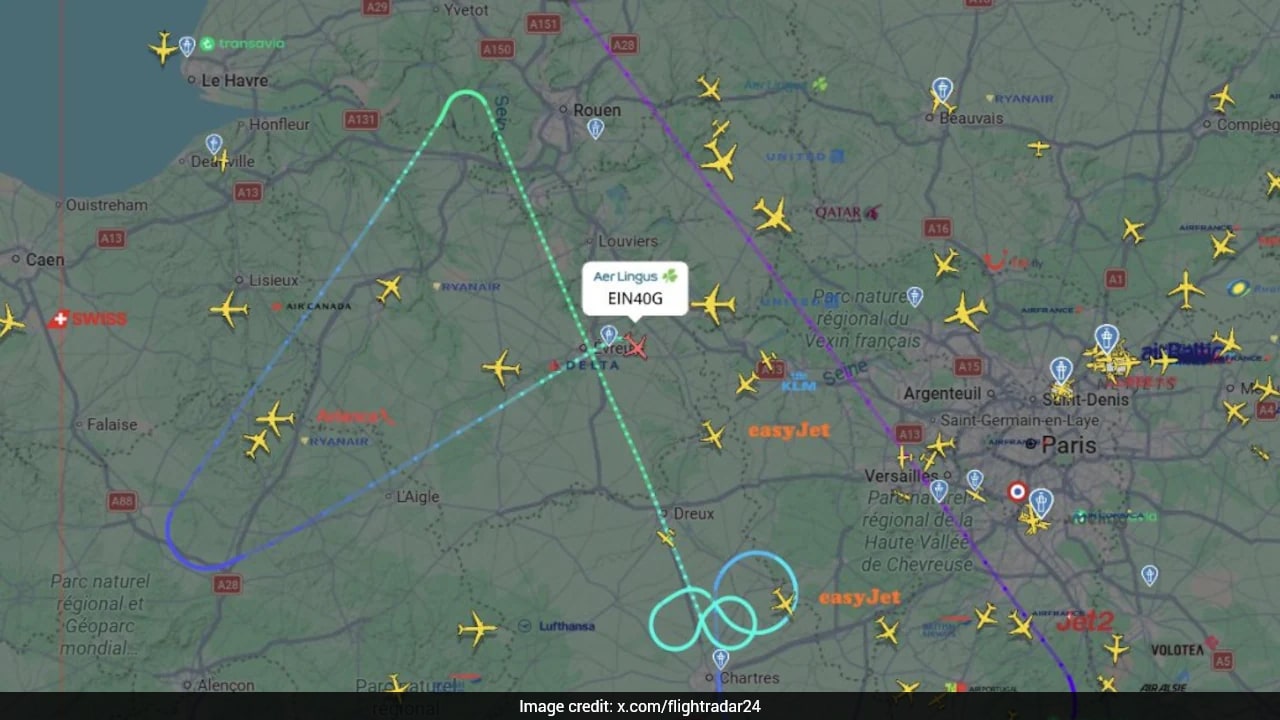
Mainstream aviation coverage treats a commercial airliner escorted by fighter jets to a French military base like a Hollywood thriller. It is not. It is a costly admission of total failure on the ground.
When a Dublin-to-Rome flight gets forced down onto a military tarmac over a bomb threat, the press immediately defaults to lazy cheerleading. They praise the rapid scrambling of Mirage or Rafale interceptors. They commend the calm cockpit crew. They celebrate the seamless execution of emergency protocols.
Stop applauding the fire department for showing up after the arsonist walked straight through the front door with a gas can.
Every single time a civilian passenger jet is diverted to a restricted military installation because of a mid-air bomb threat, it exposes a massive, systemic blind spot in pre-flight vetting and digital threat intelligence. The aviation industry has spent decades building an expensive, invasive physical security apparatus at the airport gate while leaving the front door wide open to anonymous digital disruption.
The Illusion of the Fighter Escort
Let us clear up a fundamental misconception about what a military interception actually accomplishes during a bomb threat.
When Air Traffic Control notifies defense command of a credible security threat aboard a commercial airliner, scrambled fighter jets do not possess magic sensors to scan the cargo hold for plastic explosives. They cannot defuse a device at thirty-five thousand feet. Their primary tactical function is visual inspection, radio relay if the cockpit goes dark, and—in the absolute worst-case scenario—acting as a kinetic last resort to prevent the aircraft from being used as a guided missile over a populated city.
Routing a commercial Boeing or Airbus to a military air base rather than a major civilian hub like Charles de Gaulle or Fiumicino is purely an exercise in blast-radius containment. Military bases sit away from dense urban centers. They feature reinforced blast walls, isolated taxiways, and on-site Explosive Ordnance Disposal (EOD) teams.
I have sat in post-incident operational reviews where airline executives patted themselves on the back for executing a clean military diversion. Meanwhile, the balance sheet bled out. A single wide-body or narrow-body diversion to a military base triggers a cascading logistical nightmare:
- Immediate Crew Timeout: Flight and cabin crews hit their legal duty limits on the tarmac, requiring a deadhead replacement crew to be flown in.
- Airspace and Gate Paralysis: Hundreds of connecting passengers miss onward flights, forcing the carrier to eat hotel vouchers, rebooking fees, and EU261 compensation claims.
- Military Recovery Fees: Governments do not scramble supersonic interceptors and shut down active military runways for free; the operational billing lands squarely on the carrier or gets absorbed by taxpayers.
Treating this as a triumph of preparedness ignores the central question: why was an unverified threat allowed to hijack the airspace of two sovereign nations?
Security Theater vs. Asymmetric Disruption
To understand how a Dublin-to-Rome flight ends up surrounded by armed soldiers on a French runway, you have to look at how modern aviation security allocates its resources.
For over twenty years, regulators like the European Union Aviation Safety Agency (EASA) and the International Civil Aviation Organization (ICAO) have doubled down on physical screening. We force grandparents to remove their shoes, confiscate 110-milliliter bottles of moisturizer, and subject millions of law-abiding travelers to millimeter-wave body scanners. We treat every passenger like a potential smuggler.
Yet, when an anonymous actor sends an encrypted email, makes a spoofed VoIP call, or leaves a scribbled note in a lavatory, the entire multi-billion-dollar apparatus grinds to a halt.
The industry operates under a rigid zero-tolerance doctrine. Because no airline executive or aviation minister wants to be the person who dismissed the one-in-a-million threat that turned out to be real, every single threat—no matter how absurd or poorly substantiated—triggers maximum tactical escalation.
Bad actors know this. You no longer need to smuggle a device past an X-ray machine to ground an airline. You only need a burner phone and a basic understanding of ATC emergency protocols. By weaponizing the aviation industry's own risk aversion, a single troll or low-level extortionist can inflict hundreds of thousands of dollars in damages and terrorize two hundred passengers without ever stepping foot inside an airport terminal.
Dismantling the Common Myths Around Mid-Air Bomb Threats
When these diversions hit the news cycle, the public immediately asks the wrong questions, fueled by decades of bad action movies and superficial reporting. Let us dismantle the most common assumptions head-on.
How do authorities know if a mid-air bomb threat is real?
They don't. That is the entire problem. Threat assessment teams at intelligence agencies and airline security operations centers run rapid triage—checking passenger manifests against watchlists, analyzing the linguistic patterns of the threat, and tracing communication origins. However, in the compressed timeframe of a two-to-three-hour European flight, definitive proof of a hoax is almost impossible to secure before the aircraft enters congested airspace. Under ICAO Annex 17 standards, ambiguity always defaults to worst-case action.
Why don't they just land at the nearest regular airport?
Major commercial airports are logistical choke points. Landing a suspected compromised aircraft at a civilian hub forces the shutdown of adjacent runways, halts terminal operations, and exposes thousands of bystanders to potential shrapnel or secondary attacks. Military airfields offer geographic isolation and immediate access to specialized military ordnance teams, isolating the contagion from the broader commercial network.
Does the airline actually pay for the fighter jets?
In most European jurisdictions, scrambling quick-reaction alert (QRA) interceptors is classified as sovereign airspace defense and absorbed by the national defense ministry. However, if a specific perpetrator is caught and prosecuted, courts routinely slap them with staggering restitution orders covering both military deployment costs and airline damages. When no culprit is found—which happens far more often than authorities admit—the airline eats the massive operational loss, and you pay for it through higher ticket prices.
The High Cost of Zero-Risk Dogma
There is a legitimate counterargument to my critique, and ignoring it would be intellectually dishonest.
Aviation safety was written in blood. The catastrophic failures of Air India Flight 182 and Pan Am Flight 103 proved beyond a shadow of a doubt what happens when warning signs are ignored or baggage reconciliation protocols fail. When you are responsible for two hundred lives at thirty-eight thousand feet, playing the statistical odds feels like criminal negligence. Nobody wants to be the bureaucrat who gambled with human lives to save a carrier some fuel burn and a bad PR cycle.
That reality is precisely why the current system is so broken. Regulators are trapped in an asymmetric warfare dynamic where the cost of defense is astronomical and the cost of attack is practically zero.
If you treat a credible intelligence tip from a foreign security service with the exact same tactical response as an anonymous, unverified email sent to a customer service inbox, you hand total operational control of European airspace to anyone with an internet connection.
Fixing the Vulnerability Without Compromising Safety
The solution is not to ignore threats. The solution is to shift the defensive perimeter away from the physical runway and into the digital and intelligence layers long before the boarding doors close.
First, airlines and national aviation authorities must stop treating digital threat attribution as an afterthought. When a threat comes in via email, social media, or telecommunications networks, security operations centers need real-time, automated telemetry integration with national cyber-command units. Waiting hours for traditional law enforcement subpoenas to trace an IP address or a VoIP provider guarantees that the plane will be sitting on a military tarmac before investigators even identify the server location.
Second, baggage and cargo reconciliation must evolve beyond basic barcode matching. Every single item loaded into the belly of an aircraft should be cross-referenced against dynamic behavioral risk scoring. If a passenger checks a bag, clears security, and the flight receives a threat, ground and air crews should already possess granular, real-time data on the exact physical profile and screening history of every anomalous item on board. Right now, pilots often fly blind, relying on vague relays from ground dispatchers who are scrambling to pull basic manifest data.
Third, international aviation law needs teeth that actually bite across borders. Spoofing a bomb threat against an international flight is an act of aviation terrorism, regardless of whether a physical device exists. Yet, extradition treaties and cross-border cybercrime prosecutions move at a glacial pace. Until perpetrators face swift, guaranteed, and devastating legal consequences across every jurisdiction—and until airlines aggressively pursue civil asset forfeiture against hoaxers—the incentive structure remains completely broken.
Stop Celebrating the Scramble
The next time you read a breathless headline about a commercial flight diverted to a military air base under fighter escort, look past the dramatic photos of sleek jets parked next to a passenger liner.
Do not confuse a loud, expensive emergency reaction with actual security. Real aviation security happens quietly, invisibly, and long before the wheels leave the tarmac. When fighter jets have to burn thousands of gallons of fuel to herd a civilian airliner onto a military runway over a phantom threat, the system did not succeed. It blinked.