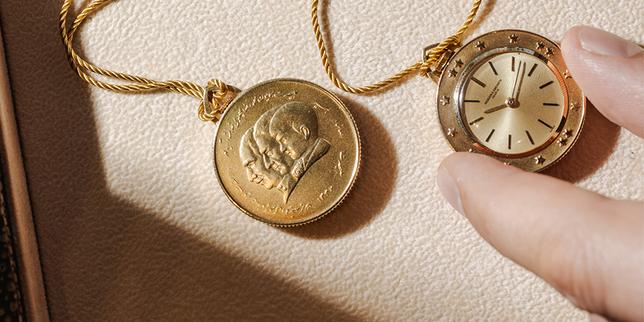
The international auction houses are running a brilliant, multi-million-dollar psychological operation, and the horological press is falling for it hook, line, and sinker. Every time a timepiece once owned by Mohammad Reza Pahlavi, the last Shah of Iran, hits the block, the headlines write themselves. They scream about "frenzied bidding," "historic provenance," and "unprecedented demand."
It is a beautiful narrative. It is also entirely wrong.
The lazy consensus in watch journalism treats these high-profile royal auctions as definitive proof of the soaring, ironclad value of historical provenance. Collectors are told that buying a piece of a deposed monarch’s asset portfolio is a bulletproof investment strategy. But if you look past the curated adrenaline of the auction room floor, the reality is far more clinical, far more volatile, and significantly less profitable than the press releases suggest.
I have spent two decades navigating the high-end secondary watch market. I have seen sophisticated buyers dump millions into pieces with "impeccable royal ties," only to realize they bought a liquid asset at an illiquid peak. The current fixation on the Shah’s collection is the ultimate case study in how emotional hype distorts market fundamentals.
The Myth of the Imperial Premium
The core argument driving the hype around the Shah’s watches is simple: royal provenance permanently elevates a watch above its standard reference value. When a Patek Philippe Perpetual Calendar or an ultra-rare Rolex Day-Date with an Iranian Imperial crest appears, the market assumes the provenance acts as a multiplier that will compound over time.
This assumption ignores how asset valuation actually works.
In standard horological valuation, a watch's worth relies on three primary pillars:
- Rarity: How many units of this specific reference exist?
- Condition: Is the dial original? Has the case been over-polished? Are the movement components intact?
- Historical Significance: Does the watch represent a technical or aesthetic milestone in filmmaking, exploration, or engineering?
When you buy a watch primarily for its connection to the last Shah of Iran, you are betting on a fourth, highly unstable variable: political and cultural nostalgia.
Unlike the provenance of an actor like Paul Newman or an explorer like Edmund Hillary—whose legacies are tied to specific, universally celebrated human achievements—political provenance is deeply polarizing and subject to generational decay. The premium paid today for a watch because it sat in a palace in Tehran during the 1970s is a sentimentality premium, not a horological one.
The Mechanics of the Artificial Auction Peak
To understand why these auctions are a trap for the uninitiated, you have to dissect the mechanics of how these record-breaking prices are manufactured.
Imagine a scenario where a rare reference Rolex Submariner with a verified imperial provenance comes to market. The standard market value for the reference without the history is $50,000. At auction, two ultra-high-net-worth individuals, driven by personal vanity, geopolitical nostalgia, or a desire for social signaling, enter a bidding war. The hammer falls at $450,000.
The press immediately reports that the market value for this provenance is a 9x premium.
What they fail to mention is that an auction price does not represent the baseline market value of an asset class. It represents the maximum price that exactly one person was willing to pay at a specific minute on a specific Tuesday. The moment that underbidder drops out, the market for that specific provenance at that price point evaporates.
If the winner tries to liquidate that same watch five years later in a private treaty sale or a less publicized auction, they quickly discover a brutal truth: the pool of buyers willing to pay a 900% premium for political history is exceptionally shallow. You aren't investing in a liquid market; you are speculating on a highly illiquid micro-niche.
When Provenance Cannibalizes Condition
The obsession with royal ownership frequently blinds buyers to severe flaws in the physical object itself. In the vintage watch world, condition is king. A single replaced hand, a polished bevel, or a water-damaged dial can erase 70% of a watch's value.
Yet, when a piece carries the weight of the Pahlavi name, buyers routinely violate the most basic rules of risk management.
The Case of the Over-Polished Royal Reference
I have personally examined historical pieces belonging to Middle Eastern dignitaries that fetched astronomical sums despite being in atrocious physical condition. Cases had been polished down to the point of losing their structural lines. Dial lume had degraded into a corrosive mess. Movements showed signs of historical servicing by local watchmakers who used non-matching parts.
In any other context, these watches would be deemed "project pieces" or degraded examples by serious collectors. But because they belonged to an emperor, the defects are repackaged as "character" or "patina."
This is a dangerous game. The premium on provenance fades as generations shift. The premium on an unpolished, flawless factory-original dial never does. Christie's, Sotheby's, and Phillips know how to use lighting and catalog copywriting to mask these deficiencies, turning a compromised watch into a historical relic. If you buy the relic, you are paying a premium for a story that you cannot sell back to a pure horological purist.
The Generation Shift That Will Value the Shah at Zero
The ultimate danger of investing heavily in the Shah's horological legacy is the inevitable march of time. Asset markets depend on future buyers. You must always ask yourself: Who am I selling this to in twenty years?
The current demographic driving the insane premiums for Pahlavi-era memorabilia consists largely of older, affluent individuals with a living, personal, or familial connection to pre-revolutionary Iran. To this specific demographic, these objects carry immense emotional weight. They represent a lost era, a symbol of modernization, and cultural pride.
But look at the incoming cohort of ultra-high-net-worth collectors—the millennials and Gen Z buyers currently entering the vintage watch market.
- They do not have an emotional connection to the geopolitics of the 1970s.
- They view historical figures through a clinical, historical lens rather than a nostalgic one.
- Their cultural touchstones are entirely different.
To a 35-year-old tech founder or hedge fund manager looking to deploy capital into alternative assets, a Patek Philippe reference 1518 is valuable because it is a mechanical masterpiece, not because it was worn by a monarch who abdicated nearly half a century ago. When the nostalgic generation exits the market, the artificial premium attached to that political provenance will contract violently. The watch will slide back down to its intrinsic horological value. If you paid a 500% premium for the history, you will be left holding a massive capital loss.
How to Actually Navigate High-Profile Asset Auctions
If you want to play in the deep end of the vintage watch market without becoming the liquidity for an auction house's marketing campaign, you must change your entire approach to bidding on historical pieces.
Stop asking: How famous was the original owner?
Start asking: Would I buy this watch at this price if it belonged to an anonymous dentist?
If the answer is no, you are not buying an asset. You are paying for entry into a high-society narrative.
If you are determined to acquire a piece from the Shah's era or any other royal collection, your bidding strategy must be cold and mechanical. You calculate the fair market value of the watch based strictly on its reference, rarity, and condition. You apply a maximum, conservative premium of 20% to 30% for the verified historical paperwork. If the bidding goes past that number, you close your paddle and let someone else fund the auction house's next quarterly profit report.
The smartest players in the room aren't the ones waving their paddles until the room applauds. The smartest players are the ones quietly buying the flawless, unpolished, unglamorous references from anonymous original owners while the crowd is busy overpaying for a ghost.