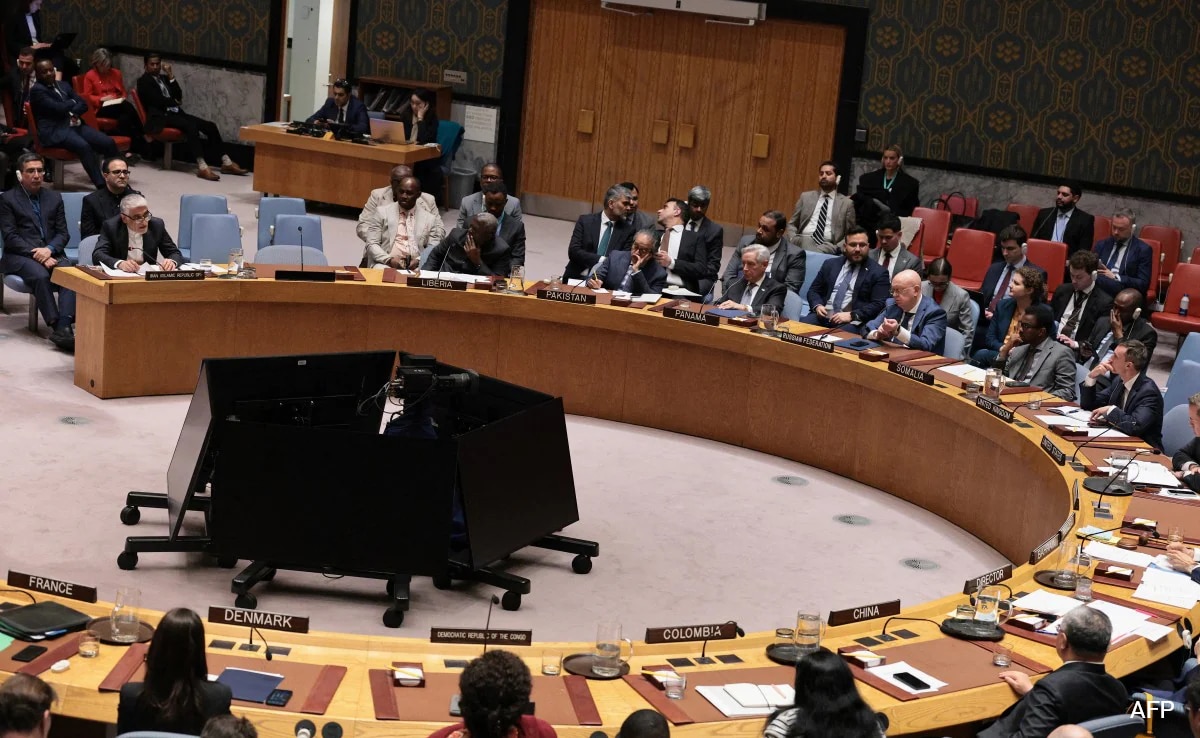
The global energy supply chain just hit a brick wall in New York. While the world watched for a diplomatic breakthrough that would clear the tankers sitting idle in the Gulf of Oman, Russia and China used their permanent seats on the UN Security Council to ensure the gates remain locked. By vetoing the resolution to reopen the Strait of Hormuz, these powers haven’t just blocked a waterway. They have signaled the start of a new, aggressive era where the flow of oil is a weapon used to dismantle Western economic dominance.
This isn't about local skirmishes or regional instability. It is a calculated squeeze.
The Strait of Hormuz is the world’s most important oil transit point. Roughly 21 million barrels of crude, condensate, and refined products pass through that narrow neck of water every single day. That is a fifth of global consumption. When that flow stops, the shockwaves don't just hit gas stations in London or New York; they paralyze industrial manufacturing in Germany and chemical production in Japan. By refusing to authorize an international maritime task force to secure the passage, Russia and China have effectively handed the keys of the global economy to the militant actors currently obstructing the route.
The Strategy of Managed Chaos
To understand why a shuttered strait serves the interests of Moscow and Beijing, you have to look past the official rhetoric about "sovereignty" and "interference."
Russia is an energy exporter currently under heavy Western sanctions. Every day the Strait of Hormuz remains closed, the price of Brent crude climbs. This isn't an accident. Higher oil prices provide the Kremlin with a fiscal cushion that blunts the impact of trade restrictions. For Moscow, a crisis in the Middle East is a direct subsidy for their own balance sheet. They don't need the water to be open; they need the tension to stay high enough to keep prices north of $90 a barrel.
China’s play is more complex and arguably more dangerous. On the surface, China is the world’s largest oil importer, making them seemingly vulnerable to a Hormuz shutdown. However, Beijing has spent the last decade building deep, "off-book" energy pipelines through Central Asia and securing long-term, discounted supply contracts with Iran and Russia. While the West pays the "Hormuz Premium" on the open market, China is insulating itself through a shadow energy grid.
Breaking the Western Security Umbrella
For seventy years, the security of the seas was a service provided by the United States Navy. If you were a merchant sailor, you relied on that presence to keep the peace.
By vetoing the reopening resolution, Russia and China are forcing a referendum on that reality. They are betting that the United States no longer has the political will or the naval capacity to act as the world’s lone policeman. If the UN cannot act, and the U.S. acts alone, Moscow and Beijing will frame it as illegal aggression. If the U.S. does nothing, the era of "Pax Americana" on the high seas is officially over.
This creates a vacuum. In that space, Beijing offers its own "Global Security Initiative"—a model where security is traded for political loyalty rather than adherence to international law.
The Logistics of a Global Grinding Halt
The math of a closed strait is brutal. There are very few ways to get oil out of the Persian Gulf without passing through Hormuz. Only Saudi Arabia and the United Arab Emirates have pipelines that can bypass the waterway, and their capacity is a fraction of what the market requires.
Even if every pipeline ran at 100% capacity, the world would still face a daily deficit of over 15 million barrels.
Insurance markets have already reacted. War-risk premiums for tankers in the region have spiked by 400% in the last week alone. Many shipowners are now refusing to send their vessels into the Gulf of Oman regardless of the price. This creates a physical shortage that cannot be solved by simply releasing strategic reserves. You can’t refine oil that you can’t move.
The Emerging Shadow Fleet
One of the most overlooked factors in this crisis is the rise of the "Shadow Fleet." These are aging, under-insured tankers that operate outside of Western oversight. While legitimate shipping companies are barred or scared off by the blockade and the subsequent UN failure, this ghost fleet continues to move.
Moscow and Tehran have perfected this system. They use ship-to-ship transfers in international waters to hide the origin of the crude. By keeping the Strait officially "closed" or "contested" via the UN veto, Russia and China ensure that only those willing to play in the gray market can move energy. It is a deliberate move to criminalize and complicate the legitimate energy trade while empowering a black-market economy that feeds their own coffers.
The Illusion of Diplomacy
The veto at the UN wasn't a failure of negotiation. It was a victory of intent.
Western diplomats spent weeks trying to water down the language of the resolution to appease the Russian delegation. They removed mentions of "proportional force" and focused instead on "humanitarian corridors." It didn't matter. The goal for the Moscow-Beijing axis isn't a better resolution; it is no resolution at all.
They want to demonstrate that the United Nations is a relic. By paralyzing the Security Council, they prove that the Western-led international order is unable to solve the most pressing crisis of the decade. This is theater meant to show the Global South that the old guards are powerless.
A Fragmented Market
What we are seeing is the birth of a two-tiered global economy.
- Tier One: Western nations and their allies, struggling with spiraling energy costs, rationing, and a desperate search for alternative fuels.
- Tier Two: A bloc led by China and Russia, trading in discounted, "sanction-busting" oil, protected by a refusal to cooperate with international maritime norms.
This fragmentation is permanent. Even if the Strait were to open tomorrow, the trust that underpinned the global shipping industry is gone. Companies are now forced to factor "geopolitical veto risk" into their long-term capital expenditures. This means higher prices for everything—from the plastic in your phone to the fertilizer used for your food—for the foreseeable future.
Beyond the Barrel
The implications of this veto extend far beyond the oil market. If the UN cannot guarantee the passage of ships through an international strait, then the entire framework of the Law of the Sea is under threat.
Think about the South China Sea. Think about the Arctic.
If the precedent is set that a regional power can close a waterway and be protected by a Security Council veto, then every maritime choke point in the world is now a potential target. This is the "Balkanization" of the oceans. We are moving toward a world where "freedom of navigation" is a privilege granted by your nearest superpower, not a right guaranteed by international law.
The veto in New York was a signal that the era of global cooperation is over. The lines are drawn. For the West, the challenge is no longer about diplomacy or finding common ground with rivals who don't want it. It is about building a new, resilient energy infrastructure that assumes the Strait of Hormuz is permanently compromised.
The tankers are not coming back to the docks anytime soon. The cost of living is about to become a cost of survival for the world's most vulnerable economies, and the architects of this gridlock are watching from the sidelines, waiting for the price to rise even further. If you are waiting for a "return to normal," you aren't paying attention to the map. The map has been redrawn, and the ink is already dry.
Move your assets. Secure your supply lines. The blockade is now legal.