Water has a memory. It remembers every path carved by ancient glaciers, every dry riverbed paved over by ambition, and every hillside stripped of its green armor to make room for concrete and glass.
In Santiago, Chile, that memory woke up angry.
To read the morning dispatch from the capital is to read a cold ledger of misery: heavy rain, swollen canals, flooded homes, cars tossed like plastic toys by muddy torrents rushing down from the Andean foothills. The numbers tick past in a blur of meteorological detachment. Millimeters of precipitation. Cubic meters of overflow. Evacuation tallies. But statistics are a poor shield against a wall of brown water moving at thirty miles an hour.
Consider Mateo. He is entirely hypothetical, a composite sketch of a thousand faces pressed against rain-streaked windows in the neighborhoods skirting the Mapocho River, yet he is as real as the asphalt beneath your feet. Mateo is thirty-four, an accountant who spends his weekdays wrestling with corporate spreadsheets in a glass-fronted tower in Providencia. On this particular morning, he is wrestling with something entirely different: the realization that the muddy brown tide lapping against his front door is about to swallow the sedan he spent four years paying off.
He hears it before he sees it. A low, subterranean growl, like an engine turning over deep inside the earth. It is the sound of tons of saturated soil, rock, and uprooted eucalyptus trees losing their grip on the Andean slopes and hurtling downward.
When the urban landscape expands, we draw maps of safety. We build asphalt veins, concrete storm drains, and brick walls, convincing ourselves that we have subdued nature. We talk of urban resilience as if it were a software update. But asphalt does not drink water. Concrete does not negotiate with gravity. Every square foot of valley floor paved over for parking lots and high-rises is a betrayal of the watershed. The rain has to go somewhere. And when it falls with the concentrated fury of a meteorological anomaly—dumping months of average rainfall in a matter of hours—it takes the path of least resistance.
That path leads straight through Mateo’s living room.
Rain is supposed to be a blessing in Santiago. For years, this sprawling metropolis nestled in a high desert basin has choked beneath a chronic, bone-dry mega-drought. The mountains, usually capped in blinding white crowns of snow that feed the reservoirs through the long, scorching austral summer, have stood naked and brown. People prayed for rain. They scanned the graying skies with desperate hope, whispering of parched aquifers and failing crops in the agricultural belts just beyond the city limits.
The sky finally answered. But it spoke in a roar.
There is a terrifying democracy to a flash flood. It does not check your credit score, nor does it care about your political affiliation. It moves through working-class colonias and affluent suburbs with the exact same indifferent violence. In neighborhoods like La Florida and Puente Alto, where rapid, often unregulated urban sprawl has pushed housing higher and higher up the alluvial fans of the cordillera, the danger is magnified a hundredfold. These are zones where the earth itself is unstable, built on ancient debris flows that nature reclaims whenever it loses patience.
Mateo runs outside, clutching his phone in a white-knuckled grip, though cell towers are already sputtering under the surge. The street is no longer a street. It is a churning, chocolate-colored rapid carrying garbage cans, patio furniture, and the hood of a red hatchback that vanished ten minutes ago.
Across the road, an elderly neighbor named Doña Rosa stands on her porch, clutching a transistor radio that crackles with static. She has lived in this same house for forty years. She remembers when the winter rains were gentle, soaking steadily into deep, loamy soil that smelled of damp eucalyptus and wet stone. She remembers when the mountain was green.
"The earth is tired," she says to no one in particular, her voice swallowed by the roar of the runoff.
That sentence lingers. The earth is tired.
We talk endlessly about climate change as a distant abstraction—degrees of warming, melting ice sheets in polar latitudes, geopolitical treaties signed in distant European capitals. We treat it like a weather forecast for the next century. But climate change has a local address. It lives right here, in the erratic, hyper-concentrated atmospheric rivers that slam into the western coast of South America, dropping torrential heat-fueled downpours on a landscape baked bone-dry by decades of atmospheric starvation.
When dry, compacted soil meets sudden, violent precipitation, it acts less like a sponge and more like concrete. The water cannot sink. It sheets across the surface, gathering momentum, picking up sediment, turning into a thick, destructive slurry that strips hillsides bare and turns urban thoroughfares into raging rapids.
Back in the street, Mateo watches his car groan, lift slightly on its suspension, and then pivot slowly before being swept downstream like a dead leaf. He feels a sharp, hollow punch in his chest—not just for the loss of the vehicle, but for the sudden, shattering realization of how fragile our daily routines truly are. We build our lives on the assumption of stability. We wake up, commute, work, return home, lock the door, and sleep. We assume the ground will stay where it is. We assume the river will stay in its channel.
We forget that civilization is just a thin, temporary varnish scratched onto the surface of a very restless planet.
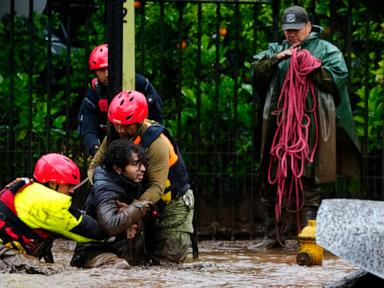
Emergency sirens begin to wail in the distance, cutting through the heavy, damp air. Flashing red and blue lights reflect off the swirling brown puddles, painting the walls of submerged storefronts in erratic strokes of urgency. Rescue workers in bright orange waterproof gear wade through waist-deep water, hauling ropes, guiding families toward higher ground.
These are the moments when the invisible machinery of society becomes visible. Not in the sleek corporate towers of Providencia, but here, in the muddy alleyways where strangers link arms to form human chains against the current. A teenager pulls a frightened dog from a rooftop. A shopkeeper throws open his half-flooded bodega, handing out dry blankets and bottled water to shivering neighbors.
The rain begins to ease, transitioning from a torrential roar to a steady, melancholic hiss. The gray clouds hang low over the Andean peaks, snagged on jagged ridges, pregnant with more water than the valley can ever hope to digest.
In the quiet aftermath, the true scale of the reckoning emerges. Cars are piled like discarded toys against bridge abutments. Homes are choked with a thick, foul-smelling silt that will take weeks to shovel out. The water recedes, but it leaves behind a signature stamp of clay across furniture, family photo albums, and foundational walls.
Mateo sits on his kitchen counter, his feet dangling just above the brown puddle covering his linoleum floor. The power is dead. His phone screen is dark, the battery flat. Outside, the city is beginning the agonizing, quiet work of waking up to a changed reality.
The storm will pass. The sun will eventually break through the Andean haze, baking the thick mud on the streets until it cracks like dry porcelain. Traffic will resume. The spreadsheets will wait. But the water has left its mark, carving a quiet, permanent line into the memory of the city—a reminder that we do not conquer the earth, we merely rent space on its surface, waiting for the day it decides to move again.