The Stage-Managed Illusion
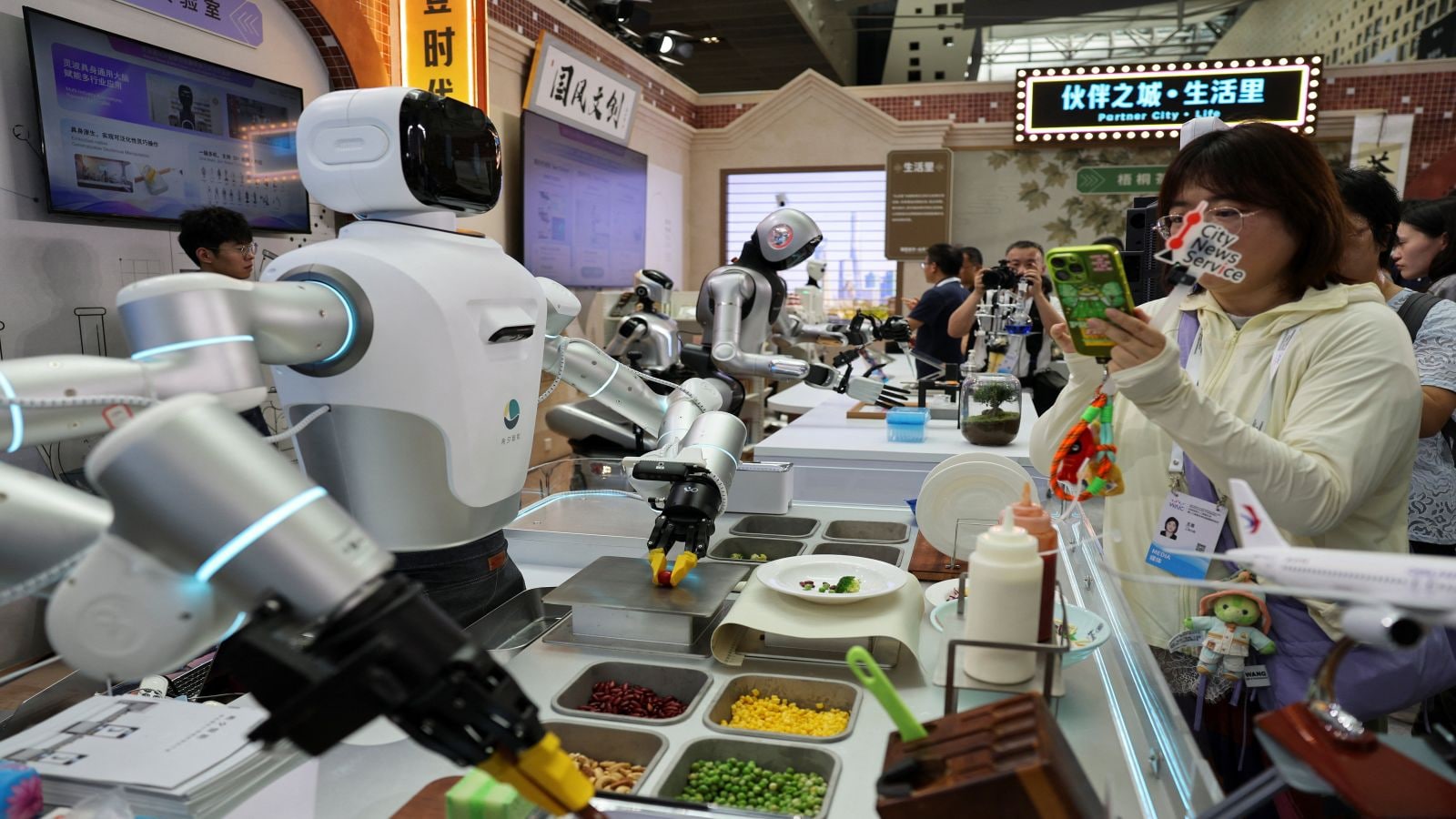
A sleek metal biped slowly reaches down, grips a t-shirt by the hem, and folds it in half. The crowd applauds. Tech journalists scramble to post 15-second clips on social media. Analysts predict that human workers will be obsolete before the decade closes.
It is a circus trick.
I have sat in closed-door lab reviews where engineering teams spent six weeks programming a $150,000 research platform to successfully butter a single piece of toast under strict, static conditions. Change the bread brand, move the butter three inches to the left, or adjust the room's ambient lighting, and the whole demo collapses into a catastrophic loop of missed grasps and failed subroutines.
Watching a humanoid robot fold a shirt at an expo does not mean we are on the verge of widespread mechanical domestic help. It means a team of brilliant software engineers spent three months overfitting a machine to execute one hyper-specific sequence in a controlled environment.
We are cheering for pre-rendered motion in a physical body, and we are calling it the future.
The Form Factor Fallacy
The general public has been sold on a simple, flawed narrative: because our world was built for humans, the ideal automated assistant must be human-shaped.
This assumption is expensive, inefficient, and fundamentally wrong.
Human biology is a compromise driven by evolutionary pressure, not optimal engineering. Bipedal movement is an ongoing effort to avoid falling over. Balancing a heavy upper torso on two narrow points of contact requires massive compute overhead, complex gyroscopic feedback loops, and high-torque motors that generate immense heat while consuming battery power at an unsustainable rate.
+---------------------+-------------------------------+-------------------------------+
| Feature             | Bipedal Humanoid Architecture | Purpose-Built Automation      |
+---------------------+-------------------------------+-------------------------------+
| Energy Efficiency   | Extremely Low                 | High                          |
| System Complexity   | Extreme (Cascade Failure Risk)| Low to Moderate               |
| Balance Overhead    | High Compute Requirement      | Zero (Stable Base)            |
| Deployment Cost     | Massive ($100k - $250k+)      | Moderate ($10k - $50k)        |
+---------------------+-------------------------------+-------------------------------+
When you build a machine to fold clothes, make sandwiches, or move boxes, choosing a bipedal form factor introduces hundreds of point-of-failure risks before the machine even attempts its primary function.
- Wheels beat legs. Unless your deployment area consists entirely of open mountain trails or broken stairs, a wheeled or tracked chassis offers superior stability, zero balance compute overhead, and triple the battery runtime.
- Specialized end-effectors beat five-fingered hands. Human hands are flexible because we lack built-in tools. A modular arm with interchangeable vacuum grippers, magnetic mounts, and micro-actuated clamps will out-perform an imitation human hand in speed, precision, and durability every single time.
- Fixed geometry beats dynamic posture. Stabilizing a torso while extending a two-meter arm creates dynamic weight distribution problems that require constant counter-balancing, draining power even while standing still.
If a factory or warehouse truly wants to automate, it does not buy a two-legged robot. It redesigns the floor plan and installs purpose-built arms on fixed tracks. The obsession with the human shape is driven by marketing departments, not operations teams.
Teleoperation: The Dirty Secret of Live Demos
When you watch a video of a robot performing a complex task like spreading jam on bread or executing a dance routine, ask one critical question: Where is the controller?
In the robotics sector, teleoperation is the silent elephant in the room. A significant portion of impressive, high-agility demos showcased at global expos are not running fully autonomous neural networks. They are being driven by a human operator sitting behind a curtain or across the room, wearing motion-capture gloves or manipulating an exoskeleton rig.
Even when the execution is autonomous, it is almost always powered by hard-coded trajectories rather than real-time spatial reasoning.
Hard-Coded Motion vs. Generalizable Spatial Intelligence
Consider the underlying math of spatial interaction. An autonomous system operating in an unstructured environment must continually solve for real-time kinematic control while integrating noisy sensory inputs:
$$x_{k+1} = f(x_k, u_k) + w_k$$
Where $x_k$ represents the state vector (position, orientation, velocity), $u_k$ is the control input, and $w_k$ represents environmental noise. In a real-world living room, $w_k$ is unpredictable. The shirt is wrinkled differently; the table surface reflects light unpredictably; a dog walks past the frame.
A hard-coded demo bypasses $w_k$ entirely by locking the environment into static coordinates:
- Position target object at exact coordinate $(X_1, Y_1, Z_1)$.
- Execute predefined motor joint trajectory $\theta(t)$.
- Terminate sequence.
If you shift the shirt two centimeters to the right, the gripper closes on empty air. This is not artificial intelligence; it is an animated statue.
The Real Bottleneck: Spatial Compute and Tactile Feedback
Why can an AI generate a complex painting in four seconds, yet struggle to pick up a slippery coffee mug without dropping or crushing it?
The answer lies in Moravec’s paradox: high-level reasoning requires very little computation, but low-level sensorimotor skills require enormous computational resources.
Human beings possess roughly 17,000 tactile mechanoreceptors in each hand. These sensors provide immediate feedback on pressure, shear force, temperature, and surface texture. When you pick up an egg, your brain adjusts gripping force instantaneously based on micro-slips that you do not even consciously process.
[ Object Contact ] ---> [ Micro-Slip Detection ] ---> [ Instant Torque Adjustment ]
                             |
                             v
               (Without tactile feedback)
                             |
         +-------------------+-------------------+
         |                                       |
         v                                       v
[ Too Much Force: Crush ]               [ Too Little Force: Drop ]
Current robotic end-effectors are fundamentally blind in comparison. Most rely almost entirely on computer vision.
Using vision as your primary feedback loop for tactile manipulation creates severe latency issues:
- Optical frames must be captured, processed, and analyzed.
- Depth maps must be calculated.
- Control adjustments must be sent down the wire to high-torque servo motors.
By the time the vision model registers that the sandwich is slipping out of the fingers, the sandwich is already on the floor. Until soft-actuator tactile sensing technology becomes scalable, cheap, and durable, humanoids will remain clumsy, slow, and prone to breaking whatever they touch.
Stop Waiting for an Autonomous Butler
The hype cycles promise that within three to five years, consumer-grade humanoid helpers will be running our households. This timeline is pure fiction designed to capture venture capital valuations.
If you are an investor, executive, or technology strategist evaluating this space, stop falling for polished video presentations. Look past the high-energy background music and demand real-world metrics.
- Demand to see the failure rate under altered ambient conditions.
- Demand to know the ratio of teleoperated training hours to autonomous deployment hours.
- Demand to see the mean time between hardware failures (MTBF) under continuous load.
The path to practical automation will not be televised in a viral clip of a shiny metal frame executing a programmed jig on an expo floor. It will happen quietly, in structured environments, using non-humanoid form factors optimized for physics rather than vanity.
The next time a company unveils a bipedal robot folding laundry, do not buy the stock. Ask why they spent millions building a fragile, inefficient stand-in for a $200 washing machine agitator.