The Mechanics of Posthumous Place Branding
Cities rarely honor cultural figures out of pure sentiment. When municipal leadership establishes recurring civic observances—such as Birmingham's inauguration of "Ozzy Day" on July 22, 2026—the initiative operates as a structured apparatus for regional economic activation, cultural export, and heritage management. The strategic value of converting a deceased cultural icon into permanent municipal infrastructure lies at the intersection of three specific vectors: commercial footprint generation, public-private partnership integration, and intellectual property (IP) extension.
The inaugural event, coming exactly one year after John Michael "Ozzy" Osbourne's death on July 22, 2025, serves as a case study in how post-industrial urban centers extract long-term economic utility from working-class cultural exports.
The Strategic Architecture of Civic Commemoration
Vague municipal messaging framing civic memorials as simple community gatherings ignores the underlying operational strategy. The execution of a city-wide cultural initiative relies on a distinct three-tier framework.
       [ MUNICIPAL CULTURAL ARCHITECTURE ]
                        │
      ┌─────────────────┼─────────────────┐
      ▼                 ▼                 ▼
 ┌──────────┐     ┌───────────┐     ┌──────────┐
 │ PHYSICAL │     │ INSTITUT. │     │  COMM.   │
 │ ANCHORS  │     │ VALIDATION│     │ ENGINES  │
 └────┬─────┘     └─────┬─────┘     └────┬─────┘
      │                 │                │
 ┌────┴─────┐     ┌─────┴─────┐     ┌────┴─────┐
 │  Public  │     │ Museum    │     │ Central  │
 │  Assets  │     │ Curations │     │ BID & OPUS│
 └──────────┘     └───────────┘     └──────────┘
1. Physical Assets as Anchor Nodes
A municipal identity strategy requires tangible, localized destinations to concentrate visitor density. In Birmingham, the geographical deployment of assets utilizes specific infrastructure:
- The Black Sabbath Bench on Broad Street serves as the primary static memorial hub, driving steady foot traffic into the city's main entertainment corridor.
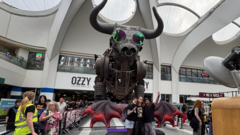
- The "Ozzy" Mechanical Bull at New Street Station acts as high-volume Transit Oriented Infrastructure, intercepting commuter and traveler traffic at the city's primary transit node.
- Pop-up performance routes—such as those by the Bostin' Brass Band—create dynamic pedestrian flows connecting distinct retail districts rather than isolating activity to a single venue.
2. Institutional Validation Mechanics
Raw subculture cannot directly drive broad public tourism without institutional translation. The Birmingham Museum & Art Gallery’s "Working Class Hero" exhibit normalizes counter-cultural heavy metal into codified civic history. By converting heavy metal's mid-20th-century origins into structured academic narrative, the museum provides a formal framework that attracts heritage tourists who would otherwise bypass traditional music venues.
3. Public-Private Execution Coalitions
Civic interventions fail when driven solely by municipal councils. The operational execution of Ozzy Day relies on Central Business Improvement Districts (Central BID) and creative agencies like OPUS. Business Improvement Districts operate on self-assessed commercial levies; their direct co-sponsorship confirms that the economic return—calculated via retail sales, hospitality revenue, and foot-traffic metrics—justifies the operational cost of managing city-wide public programming.
The Industrial Origin Friction: Deconstructing the "Working-Class Hero" Narrative
The primary logical flaw in standard regional reporting is the failure to identify why specific subcultures originate in specific geographic nodes. Heavy metal did not emerge in Birmingham by random chance; it was a structural output of the city's post-WWII heavy industrial ecosystem.
The Sound-to-Industry Feedback Loop
[Industrial Infrastructure] ──> [Worker Dislocation/Disability] ──> [Acoustic Adaptations] ──> [Genre Genesis]
The causal link between mid-century industrial manufacturing and the sonic output of Black Sabbath follows a direct chain of physical cause and effect:
- Industrial Acoustic Environment: Aston’s heavy manufacturing facilities subjected workers to continuous, high-decibel, low-frequency acoustic vibrations from heavy machinery.
- Physical Trauma and Technical Limitation: Guitarist Tony Iommi’s famous factory accident—resulting in the loss of the tips of his middle and ring fingers—forced a mechanical shift in guitar playing. To lessen string tension and physical pain, Iommi slackened his guitar strings and tuned down his instrument.
- Acoustic & Harmonic Transformation: Down-tuning, combined with Geezer Butler’s matching bass lines and Osbourne’s vocal delivery designed to pierce dense sonic fields, established the heavy, minor-key harmonic structures that defined the genre.
Civic celebrations like Ozzy Day frequently romanticize "working-class origins" while stripping away the stark economic reality: the origin of heavy metal was a direct response to physical labor conditions, systemic urban decay, and limited socio-economic mobility in late-1960s England.
The Economics of Legacy Monetization and Estate Management
Posthumous cultural management presents a high-risk balancing act between brand preservation and capital extraction. When an iconic figure passes, the right-holders must shift from managing a live performer to managing an enduring IP asset portfolio.
                  ┌─────────────────────────────┐
                  │ POSTHUMOUS ESTATE MANAGEMENT │
                  └──────────────┬──────────────┘
                                 │
         ┌───────────────────────┴───────────────────────┐
         ▼                                               ▼
┌─────────────────────────┐             ┌─────────────────────────┐
│ REAL-WORLD LEGACY ASSETS│             │   DIGITAL IP EXTENSION  │
├─────────────────────────┤             ├─────────────────────────┤
│ • Annual Civic Events   │             │ • Licensed AI Avatars   │
│ • Live Charity Concerts │             │ • Posthumous Memoirs    │
│ • Physical Museum Sets  │             │ • Documentary Biopics   │
└─────────────────────────┘             └─────────────────────────┘
The management of Osbourne's posthumous brand reveals two conflicting strategic pathways currently operating in parallel:
Low-Friction Authentic Integration
The execution of the "Back to the Beginning" final show at Villa Park—occurring just 17 days prior to Osbourne's death—and the subsequent redirection of event yields toward Parkinson's research and local children's hospitals establishes a high-trust, low-cynicism foundation. Authentic regional alignment protects the long-term value of the underlying brand by grounding it in physical community impact.
High-Friction Digital Monetization
Simultaneously, initiatives such as the proposed AI conversational avatar—announced by Jack and Sharon Osbourne—represent high-yield, high-friction digital extraction. While interactive AI models unlock infinite scalability without physical constraints, they introduce significant reputational friction. Fans and critics often reject generative avatars as opportunistic capital extraction that risks devaluing the core asset: authentic human expression.
Strategic Imperatives for Municipal Cultural Operations
For urban planners, economic development boards, and estate directors seeking to convert localized cultural history into sustainable municipal assets, three operational directives must be executed:
- Build Infrastructure Over Ephemera: One-day street celebrations generate temporary spikes in foot traffic, but permanent physical touchpoints (such as dedicated museum exhibits, public infrastructure installations, and named transit assets) ensure year-round baseline tourism revenue.
- Align Estate Capital with Municipal Incentives: Private estates must partner directly with local Improvement Districts to ensure municipal security, licensing, and transit support are underwritten by commercial stakeholders who benefit from increased visitor density.
- Enforce Authenticity Thresholds in Digital Scaling: Estate managers must limit generative and digital IP deployments to verified, archive-backed experiences. Over-saturating the market with synthetic media risks alienating core consumer demographics and eroding the primary value of the physical estate.