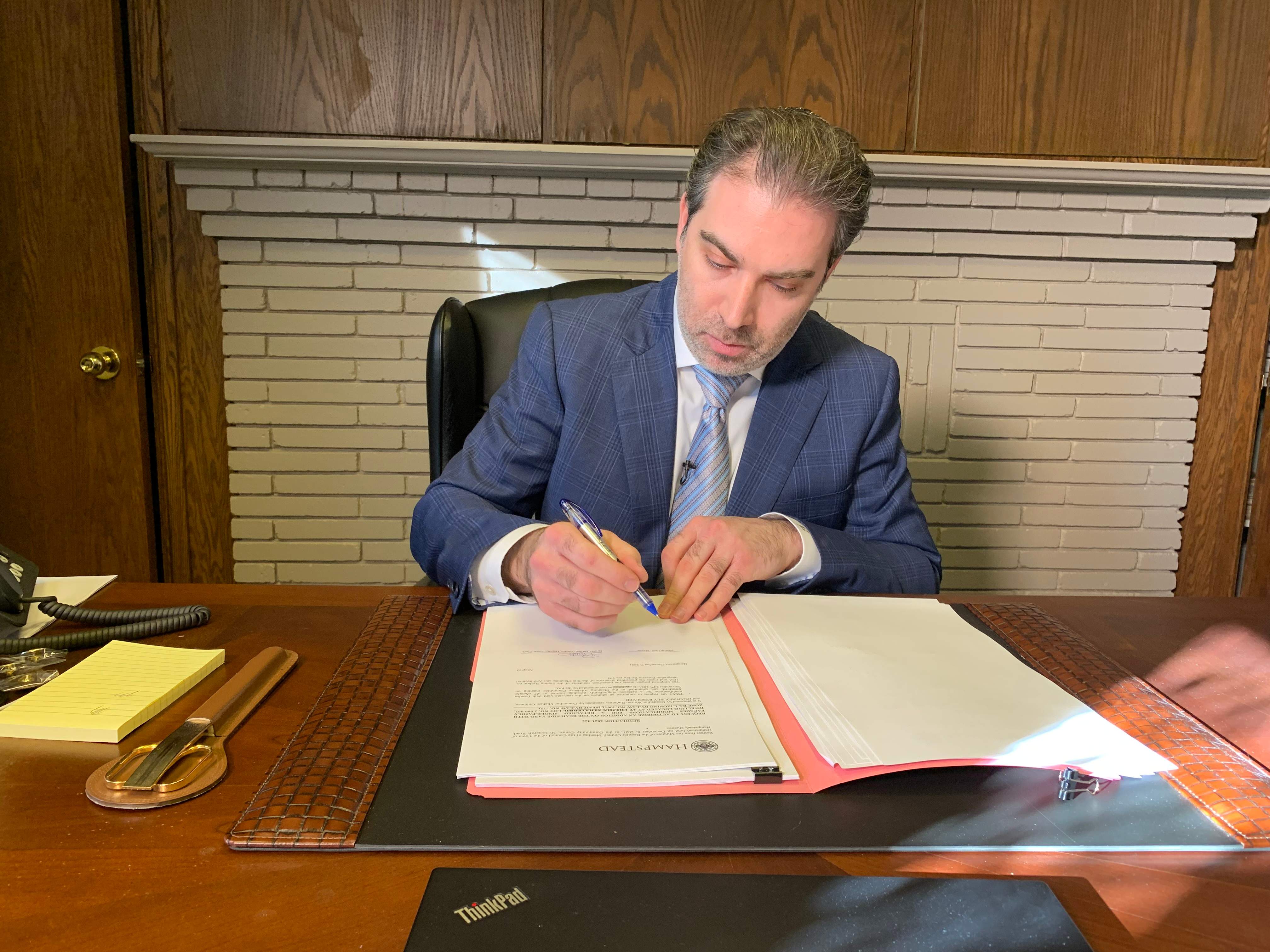
Jeremy Levi, the mayor of Hampstead, pleaded guilty to multiple ethics breaches stemming from inflammatory social media posts targeting Palestinians and their supporters, a resolution that exposes him to up to $30,000 in fines. The decision before the Commission municipale du Québec (CMQ) settles a protracted disciplinary battle over how far a local elected official can go when posting personal political commentary online.
The ruling hits a nerve far beyond the affluent enclave on the Island of Montreal. For years, municipal politicians across North America have treated personal social media accounts as digital soapboxes, firing off hot takes on international conflicts while assuming their day jobs—paving roads, collecting garbage, managing zoning—insulate them from regulatory blowback. Levi’s guilty plea shatters that illusion. It establishes a stark precedent in Quebec municipal law regarding the duty of reserve, civility, and the blurred boundary between a private citizen’s free expression and a mayor’s statutory obligations.
The Anatomy of a Municipal Ethics Breach
To understand how a suburban mayor ended up facing tens of thousands of dollars in penalties over tweets, you have to look at the mechanics of Quebec’s Municipal Ethics and Good Conduct Act. Enacted to curb corruption and restore public trust after the Charbonneau Commission, the law requires every municipality in the province to adopt a binding code of ethics.
Most residents think these codes only govern financial kickbacks, rigged contracts, or nepotism. They don't. Modern municipal codes in Quebec explicitly mandate that elected officials treat the public and fellow councilors with respect and civility, both inside council chambers and in the broader public square. When Levi took to X (formerly Twitter) to publish a series of aggressive, polarizing statements—including posts calling for the destruction of Gaza and mocking pro-Palestinian demonstrators—complaints flooded the CMQ.
The Commission operates as an independent administrative tribunal. Unlike a criminal court, where prosecutors must prove intent to incite hatred beyond a reasonable doubt under the Criminal Code, the CMQ evaluates whether an official’s conduct undermines the dignity of their office or erodes public confidence in municipal institutions.
That distinction is critical. Levi was not convicted of a hate crime. He admitted to violating the ethical standards expected of a sitting mayor. By entering a guilty plea on multiple counts, he bypassed a full evidentiary hearing—a strategic legal maneuver that avoids weeks of damaging public testimony while leaving the tribunal to determine the exact financial penalty, which carries a statutory ceiling of $5,000 per infraction.
The Legal Fiction of the Personal Account
Every politician caught in a social media firestorm reaches for the exact same defense. They claim the account is personal. They point to a bio that says "views are my own." They argue that stripping away their right to speak bluntly on international affairs turns mayors into neutered bureaucrats.
Courts and administrative tribunals across Canada have systematically dismantled this argument over the last decade.
When you hold executive office, the badge never fully comes off. A mayor is the chief magistrate and primary ambassador of a municipality twenty-four hours a day. If Jeremy Levi posts an incendiary comment about Middle Eastern geopolitics at 11:00 PM from his living room couch, the public does not read it as the musing of a private Montreal resident. They read it as the official posture of the Mayor of Hampstead.
Furthermore, the Code of Ethics and Good Conduct makes no distinction between speech delivered at a podium during a council meeting and speech broadcast from a smartphone. The medium changes; the fiduciary duty to maintain public trust does not. When an official uses language that dehumanizes a group of people or appears to cheer on mass civilian suffering, residents who belong to that demographic—or simply oppose those views—have legitimate grounds to wonder whether they will receive fair, impartial treatment from town hall.
Hampstead and the Politics of Hyper-Local Representation
Ignoring the specific demographics and political culture of Hampstead misses half the story. Hampstead is not a sprawling, anonymous metropolis. It is a tightly knit, predominantly Jewish suburb of roughly 7,000 residents tucked into the center of Montreal. Following the October 7 Hamas attacks on Israel and the subsequent war in Gaza, anxiety, grief, and anger within the community reached a boiling point.
Levi positioned himself not merely as a municipal administrator, but as a vocal, unapologetic defender of Israel and his constituents' anxieties. To his supporters in Hampstead, his blunt rhetoric was seen as moral clarity in a moment of crisis—a refusal to bow to diplomatic niceties while antisemitism surged across Canadian cities. In a town where local elections turn on razor-thin margins and deep personal networks, taking a hardline stance played well to a specific domestic audience.
This is the fundamental trap of modern local politics. Incentives are completely misaligned with statutory rules.
- Political incentives reward outrage, tribal loyalty, and viral combativeness. A mayor who posts measured, bureaucratic statements gets ignored; a mayor who wades into culture wars gets national media coverage and fierce loyalty from their base.
- Legal obligations demand restraint, neutrality, and institutional decorum. Ethics commissioners care nothing for viral engagement or partisan applause.
Levi leaned entirely into the political incentive structure, treating his X feed like a wartime bulletin board. When he posted remarks suggesting that Gaza should be wiped out or engaged in vitriolic exchanges with critics, he satisfied an immediate political impulse while handing his opponents a slam-dunk ethics complaint.
Free Speech vs Statutory Restraint
The fallout from Levi’s guilty plea inevitably triggers a fierce debate over freedom of expression under the Canadian Charter of Rights and Freedoms. Civil libertarians and conservative commentators frequently argue that administrative tribunals like the CMQ are morphing into speech police, punishing elected officials for holding unpopular or offensive opinions rather than actual corruption.
There is a legitimate tension here that shouldn't be brushed aside. Democracy relies on vigorous, sometimes ugly debate. If ethics codes are weaponized by political rivals to silence mayors over controversial policy stances, local democracy suffers. Voters, not unelected tribunal judges, are supposed to be the ultimate arbiters of a politician’s character at the ballot box.
However, Canadian administrative law has long held that Charter rights are not absolute, particularly when balanced against the statutory duties of public officeholders. Taking an oath of office involves voluntarily accepting constraints that do not apply to ordinary citizens. A private citizen can stand on a street corner and scream obscenities at passersby without losing their livelihood. A sitting mayor cannot.
The CMQ’s jurisdiction does not strip Levi of his right to hold political opinions or support Israel. It penalizes the manner in which he expressed those views—specifically, crossing the line from political advocacy into degrading, uncivil rhetoric that brings the office of mayor into disrepute. Even when factoring in Charter protections, administrative tribunals consistently rule that preserving the integrity and impartiality of municipal government justifies placing guardrails on how mayors conduct themselves in public.
The Financial Reality of Ethics Penalties
The headline figure of $30,000 sounds devastating, yet the mechanics of municipal fines in Quebec reveal a more complicated picture. Under the Municipal Ethics and Good Conduct Act, a tribunal can impose a fine of up to $5,000 per violation, payable by the elected official personally. Unlike legal defense fees—which municipalities are often forced to cover under provincial law unless a court finds gross misconduct—the fine itself cannot be expensed to taxpayers.
For a suburban mayor, a $30,000 personal hit is substantial. In small municipalities like Hampstead, mayoral salaries are a fraction of what big-city executives earn in Montreal or Toronto, often hovering well below a full-time corporate wage. A maximum penalty would effectively wipe out a massive chunk of an annual municipal stipend.
Yet the true cost isn't the check written to the Receiver General. The real damage is the permanent stain on the official record and the precedent it sets for every other councilor in the province. A guilty plea creates an indisputable paper trail of ethical misconduct. If Levi runs for re-election, opponents won't have to argue that his tweets were offensive; they can point to an official admission of guilt before a provincial tribunal.
Why Municipal Councils Keep Falling Into This Trap
Levi is hardly the first Quebec mayor to run afoul of the CMQ over social media behavior, and he won't be the last. Across the province, from small rural towns to major Montreal boroughs, ethics dockets are increasingly clogged with disputes over Facebook comments, leaked text messages, and X tirades.
The root cause is structural. Municipal governance is the closest tier of government to the people, yet it suffers from the least institutional buffering.
Federal cabinet ministers and provincial premiers operate behind thick walls of communications directors, legal counsel, and press secretaries. A federal minister rarely hits "send" on a controversial post without three staffers vetting the phrasing for legal and political blowback. Suburban mayors have none of that infrastructure. They hold the login credentials to their own accounts. They type out responses late at night without an editor, a lawyer, or a chief of staff telling them to put the phone down.
At the same time, global crises increasingly bleed into local jurisdictions. City councils across North America have spent the last two years bogged down in fierce debates over ceasefire resolutions, flag raisings, and international boycotts—issues over which a municipal government has zero actual authority. Mayors are pressured by activist groups and constituents to take sides on foreign wars, dragging local officials into minefields they are entirely unequipped to navigate.
The Chilling Effect on Local Governance
As the CMQ finalizes the sanctions against Levi, municipal lawyers across Quebec are quietly updating their training manuals for newly elected councilors. The message going out to town halls is unambiguous: treat every digital utterance as an official proclamation from the council floor.
This stricter enforcement carries an unavoidable side effect. Expect a noticeable chilling effect on how local politicians communicate. The safest path for any mayor looking to avoid a five-figure fine is to retreat into sterile, pre-approved platitudes about snow removal, pothole repairs, and community barbecues. Authenticity—already a rare commodity in politics—becomes a massive financial liability.
Some voters will welcome the return of boring, disciplined local administrators who stick to municipal business and keep their geopolitical takes to themselves. Others will argue that sanitizing political speech creates a dishonest distance between leaders and the communities they represent, forcing genuine convictions underground while rewarding bland careerists.
Jeremy Levi chose confrontation over caution, betting that fierce advocacy for his worldview outweighed the constraints of his office. The Commission municipale du Québec's docket now holds the receipt for that gamble, leaving every other mayor in the province to calculate the exact price of hitting send.