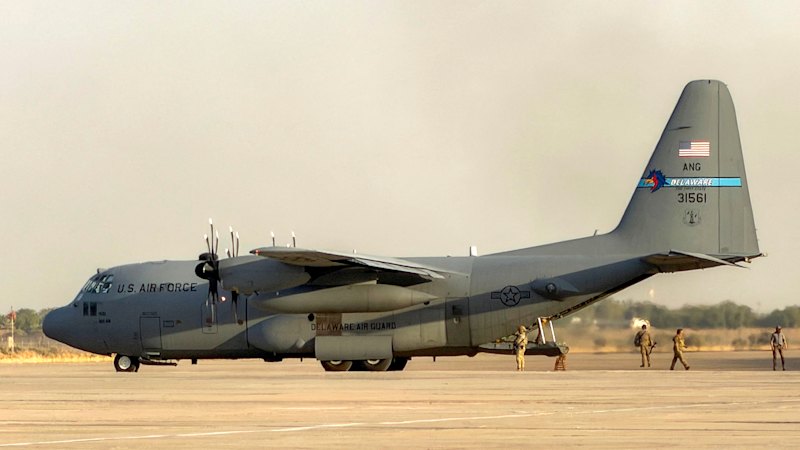
For two decades, the narrative of American involvement in Iraq has been written in concrete, blast walls, and logistics manifests. When military planners announce a drawdown or a transition of personnel from facilities like Ain al-Asad or Erbil, diplomatic cables in Washington frame the shift as a responsible recalibration of security assistance. Local populations hear withdrawal. Analysts hear redeployment. But on the ground across Mesopotamia, the departure of foreign boots changes almost nothing about the structural reality governing the country.
The Popular Mobilization Forces, known widely as the PMF or Hashd al-Shaabi, do not need American troops to remain inside Iraqi borders to justify their existence. Their mandate was never merely defensive resistance against a foreign occupier; it was the systematic acquisition of domestic sovereignty. When Western reporters and policy briefs fixate on the timetable of departing coalition forces, they misread the fundamental vector of power in post-2003 Iraq. Power is no longer contested in the streets through open insurrection. It has been codified into law, funded by the state treasury, and embedded within every ministry from telecommunications to construction. Read more on a related subject: this related article.
The Architecture of the Shadow State
To understand why the future of Iran-backed militias remains impervious to Western troop movements, one must trace the evolution of the PMF from an emergency volunteer mobilization in 2014 into a statutory government entity. When Grand Ayatollah Ali al-Sistani issued his religious edict calling for able-bodied men to defend the country against the Islamic State, the resulting brigades were hastily organized. Yet, within a remarkably short span, political leaders aligned with neighboring Tehran recognized a historic opportunity.
They did not overthrow the Iraqi state. They absorbed it. Additional journalism by NPR explores comparable perspectives on the subject.
Legislative milestones, most notably the PMF Law passed by the Iraqi parliament, granted these militias official status under the Prime Minister's office. This legal sleight of hand achieved what decades of clandestine operations could not: total fiscal and institutional legitimacy. Thousands of fighters draw regular government salaries, carry official state identification cards, and answer to commanders whose political wings hold decisive sway over legislative voting blocs. This fiscal integration creates an ironclad protection shield. Any attempt by an Iraqi prime minister to disarm or dismantle these factions triggers an immediate political crisis, a legislative blockade, or targeted coercion that paralyze state institutions before a single shot is fired.
The Anatomy of Legislative Capture
The infiltration of the Iraqi state extends far beyond security portfolios. Parliamentary committees governing finance, security, and infrastructure are heavily influenced by deputies tied directly to armed factions. This means that the very organizations operating outside state control are simultaneously drafting the laws that fund them.
Consider the annual national budget battles in Baghdad. Year after year, allocations for the PMF have expanded, rivaling or exceeding the budgets allocated to conventional military branches. This money does not vanish into black holes; it is deployed to build social welfare networks, schools, hospitals, and media conglomerates. By positioning themselves as both the protectors of the faith and the providers of municipal services, these groups have constructed a constituency that views the state not as a neutral arbiter, but as an instrument of militia patronage.
When international financial institutions or Western embassies raise concerns about fiscal transparency, they encounter a brick wall of bureaucratic inertia. The financial architecture of Iraq has been effectively captured by networks that weaponize administrative complexity to shield their assets from external oversight.
Institutionalizing the Militia Economy
Beyond the state budget, these networks command sprawling economic empires. Smuggling routes along the Syrian and Iranian borders generate vast revenues through customs evasion, fuel trafficking, and narcotics distribution. Front companies secure lucrative public works contracts, ensuring that every kilometer of highway paved or every school built funnels capital back into the coffers of militia leadership.
Major border crossings, such as Al-Qaim and Mandali, operate with varying degrees of autonomy from central customs authority. Goods entering the country under commercial manifests bypass standard inspection
Why Leaving Iraq Changes Nothing for Iran-Backed Militias
news
The departure of American military personnel from Iraqi soil provides a convenient diplomatic talking point in Washington and Baghdad alike, yet it fundamentally misreads the architecture of power in Mesopotamia. Washington frames every drawdown as a strategic evolution, a transition from direct combat support to bilateral security cooperation. Baghdad presents it as a hard-won assertion of national sovereignty. Both narratives ignore the core truth on the ground. U.S. troops are packing up, but the Iran-backed armed groups known collectively as the Popular Mobilization Forces or their political fronts are not going anywhere. They are already the state.
To understand why an American military exit alters almost nothing regarding militia supremacy, one must abandon the outdated mental model of an insurgency operating from the shadows. These factions stopped hiding behind improvised explosive devices a decade ago. They integrated into the official bureaucracy, secured billions of dollars in state funding through legislative acts, and built an economic empire spanning construction, border customs, real estate, and banking. When foreign advisors clear out their quarters at Ain al-Asad or Erbil, they leave behind a political environment where Tehran's primary proxies hold veto power over governance, judicial appointments, and security policy.
The Illusion of Disengagement
Military footprints matter, but they are secondary to political and institutional gravity. For two decades, American strategy in Iraq operated on a linear assumption. Apply military pressure, train local security forces, build professional institutions, and the state will naturally repel malign external influences. That theory collapsed under the weight of its own abstractions.
When the Islamic State swept across a third of Iraq in 2014, the traditional military apparatus crumbled. Into that vacuum stepped religious edicts and organized armed factions backed directly by the Islamic Revolutionary Guard Corps. Those groups did not merely fight an existential war; they wrote themselves into the resurrection of the Iraqi state. By the time the territorial caliphate was dismantled, these factions had codified their existence via parliamentary legislation, transforming emergency militias into a permanent auxiliary security force funded by the Iraqi treasury.
Consider how state financing works in practice. Tens of thousands of militia fighters receive official government salaries, retirement packages, and medical benefits directly from Baghdad's budget. This means Iraqi taxpayers—and by extension, the broader international financial system that props up Iraq's oil-revenue-dependent economy—help subsidize the very organizations targeting American logistics convoys and regional diplomatic missions. When Western policymakers talk about withdrawing troops, they are discussing a few thousand uniformed personnel. They are not addressing the state-sanctioned payroll feeding an entrenched paramilitary apparatus.
Institutional Capture from Within
Power flows through ministries, provincial councils, and legislative committees. Over the past several years, political wings of Iran-aligned factions have mastered the art of democratic capture. They do not need to overthrow the government because they won elections, formed coalitions, and stacked administrative offices with loyalists.
Every ministry dealing with infrastructure, transport, and border control features directors who answer ultimately to militia commanders rather than the prime minister. This dual-key system creates paralysis for any Iraqi leader attempting to exercise genuine independence. If a premier tries to dismantle illicit checkpoints, crack down on unauthorized border crossings, or curb rocket fire directed at regional neighbors, they face immediate political collapse. Parliament blocks the legislation, the judiciary stalls enforcement, and streets erupt with well-organized protests or kinetic intimidation.
This structural reality renders foreign military presence largely symbolic. A few hundred soldiers stationed at a joint operating base cannot reverse institutional capture that took over a decade to construct. In fact, the presence of foreign troops often serves a domestic political utility for these militias. It provides an enduring justification for their continued existence. As long as a foreign power maintains a base on Iraqi territory, the militia can cast itself as the vanguard of national resistance, masking its domestic extortion and political dominance behind anti-imperialist rhetoric.
The Economic Empire of the Shadow State
Military power requires financial sustenance, and the factions backed by Tehran have long since diversified beyond state salaries and foreign cash transfers. They operate a sprawling corporate network that mirrors other state-embedded military economies across the Middle East.
Border crossings between Iraq and neighboring countries function as private revenue generators. Goods entering through ports in the south or land terminals in the east are subject to parallel taxation systems managed by militia-affiliated networks. Businesses that refuse to pay protection fees find their licenses revoked, their shipments delayed indefinitely, or their facilities targeted by mysterious security incidents. Real estate acquisitions in prime Baghdad neighborhoods and holy cities like Karbala and Najaf have concentrated vast wealth in hands loyal to external actors.
This economic self-sufficiency means that external sanctions or diplomatic pressure from Western capitals bounce off these networks with minimal damage. They have built alternative financial channels, utilizing front companies, regional currency exchanges, and cooperative local banks to insulate themselves from international banking restrictions. When an American administration imposes targeted penalties on a specific militia commander, the financial impact is negligible. The economic machinery hums along unaffected, fueled by domestic commerce and illicit trade.
Baghdad Caught Between Two Capitals
Every successive Iraqi prime minister inherits an impossible geopolitical math problem. Baghdad must maintain a functional security and economic relationship with Washington, which holds the keys to Iraq's oil revenues sitting in Federal Reserve accounts, while managing an aggressive, deeply entrenched eastern neighbor that views Iraq as strategic depth.
This balancing act produces a theater of perpetual compromise. A prime minister issues a strongly worded condemnation after a drone strike hits a logistics base. They announce an investigation into unauthorized armed groups. Days pass, the investigation yields no arrests, and the cycle resets. The state apparatus is simply too weak and too deeply penetrated to impose a monopoly on the legitimate use of force.
When American forces execute a phased withdrawal, they hand over remaining installations to Iraqi security forces. But Iraqi security forces are not a monolithic entity. They are an amalgamation of conventional units trained by Western militaries, counter-terrorism services with high professionalism, and heavily compromised divisions where loyalties are sharply divided. Within the very forces receiving abandoned bases, officers hold allegiance to the high command of the paramilitary apparatus. The handover does not transfer control to a sovereign, neutral state; it redistributes physical assets directly into a sphere of influence managed from Tehran.
The Structural Reality of Regional Power
Observers often search for a single tipping point, a dramatic showdown where the state reasserts its authority or where foreign intervention decisively shifts the balance. History suggests a more grinding, permanent reality.
Militias do not vanish because a timeline is signed or a treaty is updated. They evolve, adapt, and calcify. They become too big to confront and too integrated to excise without risking total state fracture. The debate over foreign troop levels in Iraq addresses the symptom while ignoring the disease.
The future of these armed factions is already written into the budget allocations of the state, the organizational charts of the ministries, and the commercial ledgers of the black market. As the last transport planes lift off from coalition runways, the shadow state remains firmly in place, waiting out the world on its own turf.