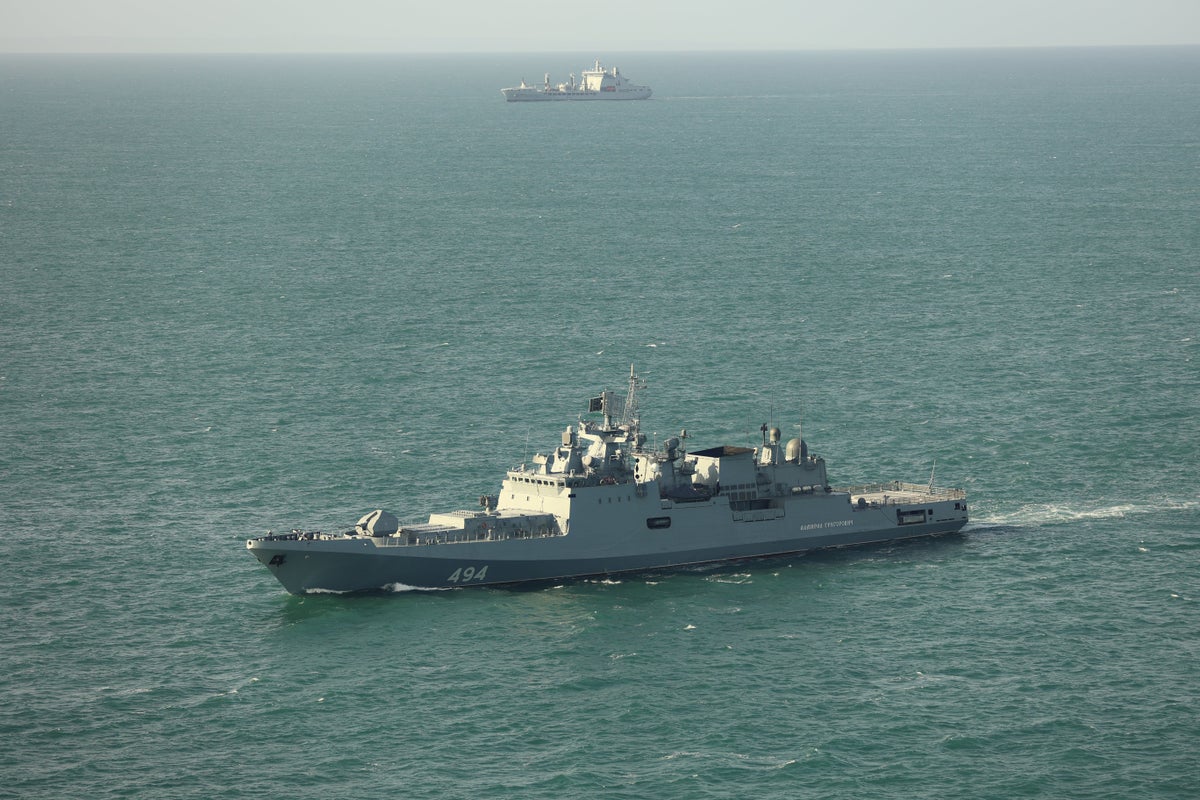
The mainstream defense press loves a predictable drumbeat. For nearly four years, every time a Russian spy ship triggers a routine tracking response off the coast of Scotland, or a refueling tanker passes through the English Channel, the headlines scream of an escalating, unprecedented naval cold war. The lazy consensus among Western defense analysts is simple: Russia is aggressively testing the UK’s maritime perimeter, preparing to slice underseas cables, and dominating the strategic choke points through sheer, menacing presence.
It is a neat, terrifying narrative. It is also entirely wrong.
If you look at the raw data of UK-Russia maritime encounters since the escalation of the Ukraine war, you are not looking at a rising superpower flexing its muscles. You are looking at a desperate, structurally flawed navy executing predictable, defensive transit patterns because it literally has nowhere else to go. The Royal Navy isn't deterring a brilliant aggressor; it is managing a maritime traffic jam caused by geography and failing hardware.
The media treats these incidents like a chess match. In reality, it’s bumper cars.
The Geography Delusion: Russia's Lack of Options is Not "Aggression"
Every public timeline of maritime incidents highlights the same handful of events: Russian frigates tracked in the North Sea, submarines monitored in the GIUK (Greenland-Iceland-UK) gap, and intelligence vessels lingering near wind farms. The immediate assumption is offensive intent.
To understand why this premise is flawed, you need to understand basic hydrography and international law, specifically the 1936 Montreux Convention.
When the war in Ukraine intensified, Turkey triggered Article 19 of the Montreux Convention, effectively shutting the Bosphorus and Dardanelles Straits to all military vessels from belligerent nations. This single legal move fundamentally broke the Russian Navy. The Russian Black Sea Fleet became a closed ecosystem, unable to reinforce its losses from the outside. Conversely, any Russian vessels built in northern shipyards or stationed with the Northern or Baltic fleets that intended to project power in the Mediterranean or support operations in Syria were suddenly forced into a massive, multi-thousand-mile detour around Western Europe.
[Baltic / Northern Fleets] ──> [North Sea / English Channel] ──> [Gibraltar] ──> [Mediterranean / Syria]
                                      │
                         (The UK "Incident" Zone)
When a Russian Surface Action Group moves past the UK, they aren't hunting. They are commuting.
They are using international shipping lanes because geography dictates they must. The English Channel is one of the busiest shipping lanes in the world. Writing a breathless timeline entry every time a Russian ship uses a legal transit corridor is the equivalent of a traffic reporter claiming a commuter is invading the highway.
The Subsurface Panic: The Real State of Russian Infrastructure
"But what about the undersea cables?" asks every frantic panel of defense experts. The fear that Russia will deploy deep-sea submersibles to sever the fiber-optic lines connecting North America and Europe is a staple of maritime anxiety.
Let's look at the actual mechanics of underwater sabotage. Severing a cable in the deep ocean requires highly specialized assets, specifically the vessels operated by GUGI (the Main Directorate of Deep-Sea Research). These are not standard attack submarines. They are unique oceanographic research ships like the Yantar or specialized nuclear power stations acting as mother ships for mini-subs.
Yes, these ships are tracked off the Irish and British coasts. But treating their presence as an imminent act of war misses the structural reality of how Russia maintains these platforms. I have watched defense budgets and maintenance schedules for years, and the reality is bleak: the Russian defense industrial base is cannibalizing itself to feed the land war in Ukraine.
Deep-sea maritime operations require immense capital, specialized foreign parts, and flawless drydock availability. Russia's primary northern drydock, the PD-50, sank years ago. Their sole aircraft carrier is a floating fire hazard. The vessels capable of actual cable warfare are aging, plagued by maintenance backlogs, and running on dwindling reserves of Western-manufactured marine electronics that are increasingly difficult to acquire through third-party smuggling routes.
If Russia severs a major transatlantic cable, they don't just blind the West; they trigger an immediate, potentially kinetic escalation with NATO that they are systematically unequipped to handle while losing thousands of troops a week in Donbas. The tracking of these vessels isn't a prelude to a blackout; it is a game of signaling. Russia wants the UK to spend millions of pounds scrambling Type 23 frigates and P-8A Poseidon maritime patrol aircraft to monitor a ship that is often simply testing its sonar arrays or conducting basic hydrological mapping. They are burning Western operational readiness on cheap theater.
Dismantling the "People Also Ask" Assumptions
The public discourse around this topic is driven by fundamentally flawed questions. Let’s dismantle the most common ones with brutal reality.
Does Russia possess the capability to cut off UK trade by blockading maritime routes?
Absolutely not. To execute a naval blockade against an island nation backed by the world's most powerful military alliance, you need absolute sea control or at least local sea denial. Russia cannot even achieve sea control in the Black Sea against a nation with no functional navy. Ukraine used a combination of uncrewed surface vessels (USVs) and anti-ship missiles to force the Russian Black Sea Fleet to retreat from Sevastopol to Novorossiysk. If Russia cannot protect its capital ships from home-built exploding jet-skis in its own backyard, the idea that it can project a sustained blockade in the North Atlantic against NATO's combined anti-submarine network is a cinematic fantasy.
Why does the Royal Navy scramble ships for every Russian transit?
Because of political necessity, not immediate tactical threat. The Ministry of Defence (MoD) needs to justify its existence and its budget to a skeptical public and a cash-strapped Treasury. Deploying a multi-billion-pound warship to escort a rusting Russian tanker through the Dover Strait makes for great public relations photos. It demonstrates vigilance. What the press releases don't tell you is that these escorts deplete the hull life of an already overworked, under-maintained British fleet. Every day a Type 23 frigate spends babysitting a Russian tugboat is a day it isn't undergoing deep maintenance or training for high-end, actual warfare.
Are Russian submarines getting quieter and harder to detect around the UK?
This is the one area where the threat is real, but the context is botched. The newer Yasen-M class nuclear attack submarines and the upgraded Kilo-class diesel-electric boats are remarkably quiet. They pose a legitimate challenge to hydrophone arrays. However, a submarine's effectiveness is entirely dependent on its deployment cycle. Russia can build two or three exceptionally quiet hulls, but if those hulls spend ten months out of the year tied to a pier in Severomorsk because of a shortage of qualified nuclear technicians or specialized valves, the systemic threat is contained. A weapon system that cannot deploy reliably is just an expensive piece of pier-side art.
The Actionable Pivot: What the UK Should Do Instead
Stop playing the escort game.
The current policy of matching every Russian hull with a British hull is an unsustainable strategy of asymmetric attrition. Russia is using cheap, long-endurance hulls—often civilian-flagged research vessels or auxiliary tugs—to draw out high-value, low-endurance Western military assets. The Royal Navy is wearing out its teeth chewing on rubber.
[Russian Strategy]                        [UK Reaction]
Cheap civilian/auxiliary hulls  ───>  Deploys high-value Type 23/45 frigates
Low operational cost                  High operational cost & hull wear
Result: Asymmetric attrition of Western naval readiness
Instead of sending an expensive frigate to shadow a Russian vessel through the Channel, the UK should leverage its structural advantages:
- Commercialize the Shadowing: Deploy automated, low-cost uncrewed surface vessels (USVs) and long-endurance aerial drones to maintain persistent visual contact with Russian transits. Save the manned frigates for complex acoustic tracking in the deep Atlantic.
- Weaponize International Law: Enforce strict environmental and safety inspections on the Russian "shadow fleet" of aging oil tankers passing through the English Channel. Many of these vessels lack proper sovereign insurance and violate standard maritime safety codes. Detain them under international maritime law for safety violations rather than escorting them like visiting dignitaries.
- Invest heavily in passive seafloor infrastructure: Instead of trying to catch a submarine after it leaves port, build out the next generation of fixed undersea sensor webs across the GIUK gap. Acoustic arrays don't get tired, they don't require shore leave, and they don't cost millions of pounds a week to steam through a storm.
The UK-Russia maritime standoff is not a series of isolated, aggressive provocations. It is a structural byproduct of a broken land war forcing a constrained navy into predictable lanes. Stop treating every routine transit like the hunt for Red October. The real danger isn't that the Russian Navy is too strong; it's that the West is wasting its resources pretending a desperate detour is a brilliant offensive strategy.