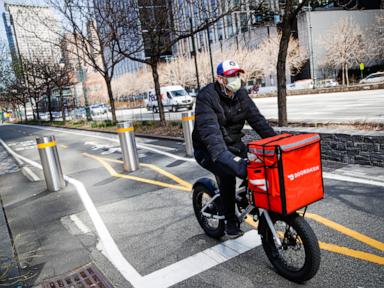
The headlines are writing themselves. DoorDash just agreed to cough up one hundred thirty-one million dollars to settle a massive wage dispute with New York City over underpaid delivery workers. Activists are popping cheap champagne. Local politicians are taking victory laps on Twitter, framing the payout as a glorious triumph for the exploited working class over the cold, unfeeling algorithmic monolith of Silicon Valley.
Everyone loves a good David versus Goliath story. Everyone wants to believe that justice was served, that the system works, and that a hefty corporate fine will somehow restore economic harmony to the streets of Manhattan.
It is a comforting delusion. It is also completely wrong.
I have spent years watching urban labor markets distort under the heavy thumb of well-meaning municipal mandates, and I can tell you with absolute certainty that this settlement is not a win for workers. It is a slow-motion eviction notice for the very people it pretends to protect.
When you peel back the emotional theater of corporate settlements and examine the raw plumbing of the gig economy, a starkly different reality emerges. The one hundred thirty-one million dollar payout is not proof that the system is fixing itself. It is proof that regulators are successfully forcing a dynamic, liquid marketplace back into a rigid, twentieth-century industrial box that does not fit.
The Fallacy of Guaranteed Hourly Mandates
To understand why this settlement and the underlying New York City minimum pay rules are economic poison, you have to look past the sticker price of the check. The whole narrative rests on a fundamental misunderstanding of what app-based delivery actually is.
Regulators look at a courier zipping through traffic on an e-bike and see an employee working a shift. They see hours logged, miles covered, and pizzas delivered, and they apply the mental framework of a traditional factory floor or a retail counter. They demand an hourly wage floor because hourly wages are what they know.
App-based work is not employment. It is an option.
When you convert an optional, high-liquidity marketplace into a fixed-wage labor market, you break the math that makes the marketplace function. In a traditional labor market, an employer guarantees an hourly rate because they control your time. They tell you when to arrive, how to stand, what to wear, and whether you are allowed to check your phone. If you are sitting around doing nothing during a slow Tuesday afternoon lull, the employer absorbs that cost because they own your availability.
DoorDash never owned anyone's availability. That was the entire point.
A courier in Brooklyn could log on for twenty minutes while waiting for a load of laundry to dry, pick up two high-tipping orders blocks away, pocket thirty bucks, and log off. Another courier could work ten hours straight across three different apps during a torrential downpour, capitalizing on surge pricing to maximize revenue.
When New York City forced platforms into a mandatory minimum hourly pay rate—and when DoorDash pays out back-pay settlements to calibrate to those shifting standards—the platforms cannot afford to let random people log on whenever they feel like it. The economics of paying a guaranteed minimum wage to an infinite pool of floating contractors simply does not pencil out.
How Platforms React When Regulators Break the Math
When the state mandates an artificial cost floor, companies do not absorb the hit out of the goodness of their corporate hearts. They adapt. And their adaptation always hurts the marginal worker.
First, access gets restricted. You no longer see an open platform where anyone with a smartphone and a bicycle can instantly start earning. Instead, you see shift-scheduling systems, tier ratings, acceptance rate filters, and lockouts. The casual worker—the student trying to squeeze in cash between classes, the parent working odd hours around childcare—gets pushed out entirely. They are replaced by professional fleet operators who treat app delivery like a full-time job, precisely because the app companies are forced to treat them like traditional shift workers to manage their labor overhead.
Second, consumer prices spike. When delivery fees and service charges climb to cover mandated labor floors, order volume drops. People stop ordering three-dollar coffees or single lunches because the delivery markup doubles the price of the item.
Fewer orders mean fewer total hours available on the platform. When total volume contracts, the absolute amount of work shrinks. Regulators can mandate a high hourly rate on paper, but if there are zero active orders because consumers have rebelled against exorbitant fees, that hourly rate becomes zero dollars multiplied by zero hours.
The Regulatory Cartel Disguised as Compassion
Look closely at who actually lobbied for these regulations in the first place. It is rarely the casual part-time courier who loves the flexibility of hopping online between shifts at a restaurant. It is legacy labor organizers, traditional taxi lobbies, and well-funded worker advocacy groups who view decentralized freelance work as an existential threat to traditional union organizing models.
Union organizers hate the gig economy because they cannot easily unionize millions of independent micro-entrepreneurs who value individual autonomy over collective bargaining. By forcing gig companies into employment-like models through litigation and legislation, these groups create high compliance barriers that favor massive, institutionalized labor structures.
This is the ultimate irony of the one hundred thirty-one million dollar settlement. It punishes DoorDash for operating a marketplace the way it was designed to be operated, forcing them to build a walled garden of locked-out accounts and managed shifts. The established players absorb the legal hit as a cost of doing business, lock down their local market share against smaller emerging competitors, and pull up the ladder behind them.
The individual worker who just wanted the freedom to work when they wanted, where they wanted, gets left holding the bag.
Dismantling the People Also Ask Delusions
If you search for information regarding gig worker settlements and minimum pay rules, you inevitably run into a predictable set of anxieties and questions from the public. Let us dismantle them directly.
Are delivery workers actually employees or independent contractors?
Legally, they have been classified as independent contractors because they retain control over their schedules, tools, and routes. But public discourse is obsessed with blurring this line because society has become addicted to binary categorizations. Either you are a exploited corporate slave sitting in a cubicle, or you are a free-spirited entrepreneur running a lemonade stand.
The reality of the twenty-first-century digital economy is entirely hybrid. It is task-based micro-entrepreneurship. Trying to shoehorn a decentralized task-routing algorithm into a New Deal-era labor framework is like trying to force a floppy disk into a USB-C port. It destroys the hardware in the process.
Does raising minimum pay for gig workers help them earn more?
For the tiny fraction of workers who manage to game the new scheduling systems and secure steady shifts, yes, short-term earnings might tick up. But for the aggregate pool of labor, total earnings drop because total hours and total order volumes plummet.
Economics does not suspend its laws just because a city council passes an ordinance with good intentions. When you artificially inflate the price of a service, demand contracts. When demand contracts, employment opportunities evaporate for the most vulnerable participants.
Why do gig companies settle instead of fighting in court?
People often assume that a massive multi-million dollar settlement is an admission of moral guilt. It is not. It is a risk-adjusted financial calculation.
Litigating against a municipal government with endless taxpayer-funded legal resources while facing hostile local public relations is a losing battle for a tech platform, regardless of the merits of the case. Settling for one hundred thirty-one million dollars is cheaper than enduring years of injunctions, brand damage, and regulatory harassment in the nation's largest consumer market. It is corporate triage, not a moral confession.
The Uncomfortable Truth About Platform Flexibility
I have no romantic attachment to Silicon Valley executives or venture-backed logistics apps. They are profit-seeking entities optimizing for shareholder value. But demonizing them for building a platform that millions of people willingly chose to use because it offered unmatched schedule flexibility is intellectually dishonest.
The uncomfortable truth that neither the activists nor the tech executives want to admit is that gig work solved a specific economic problem: it absorbed millions of underemployed people during times of economic transition, offering friction-free earnings without the friction of interviews, resumes, or fixed schedules.
When you regulate that friction away, you do not create utopia. You recreate the exact rigid, bureaucratic, gatekept labor market that people turned to gig apps to escape in the first place.
The Cost of Regulatory Hubris
Every time a city council decides it can outsmart supply and demand curves with a stroke of a pen, the market punches back. New York City couriers might be seeing payouts from a one-hundred-thirty-one-million-dollar war chest today, but tomorrow they will face a desert of locked-out accounts, throttled flexibility, and vanishing orders.
The gig economy was never broken because it lacked hourly minimums. It was radical because it discarded them entirely. By forcing old-world rules onto a new-world model, regulators haven't rescued the worker. They have just locked them back in a cage and called it liberation.